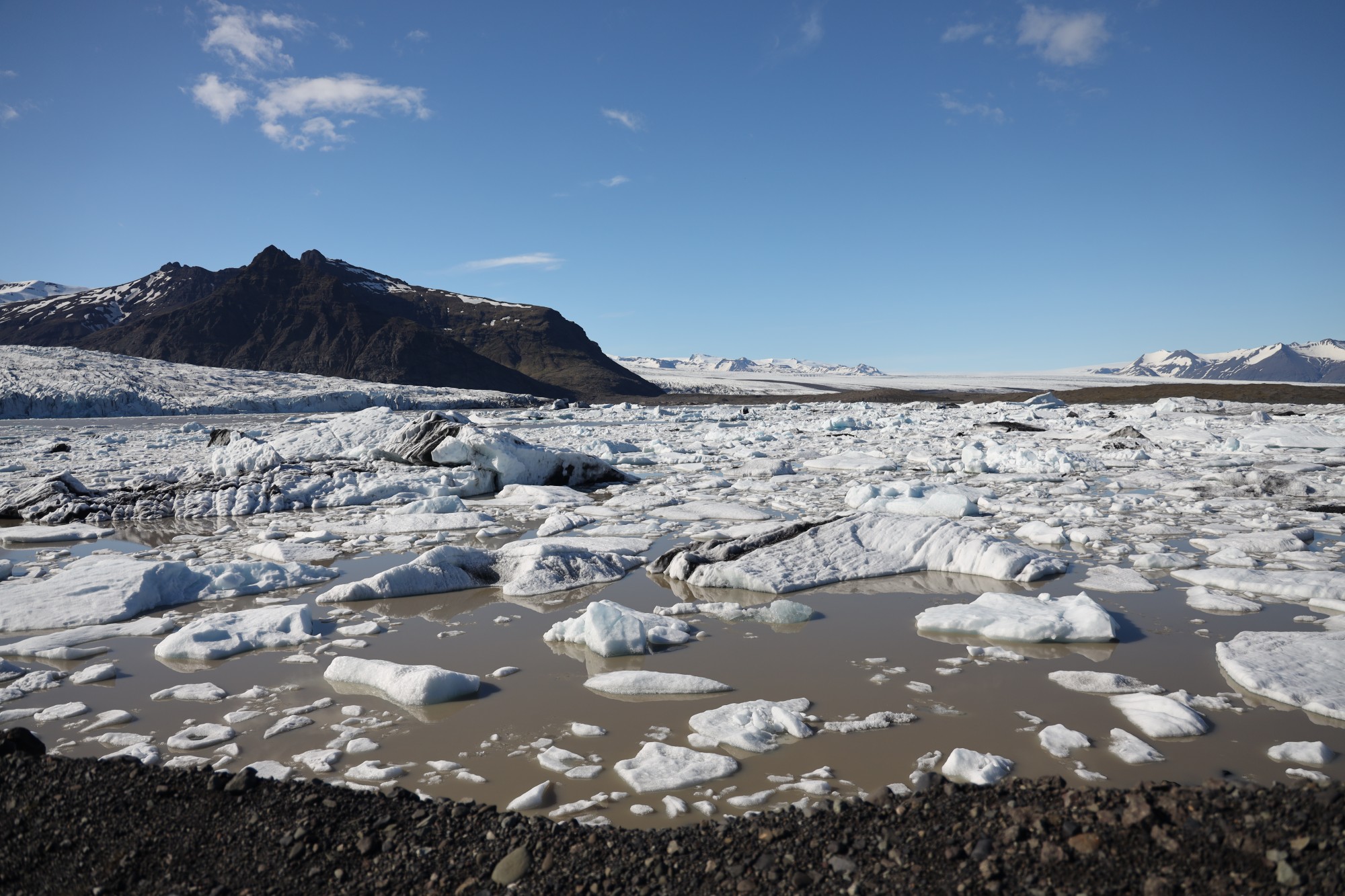
It was at the beginning of January that I needed to find recordings related to glaciers for Kristjan Maack’s photography exhibition at the Reykjavík Museum of Photography that I had to run a few selected recordings through a spectrogram. Including this recording that I recorded at Fjallsárlón in the wonderful COVID year of 2020 when the number of tourists decreased so sharply that it was possible to record at this place as well as at various other places without much interference from tourists and car traffic.
I myself find it strange that I had not run this recording through a spectrogram earlier because I remember well that I had slept all night in a Bivi bag, not far from the recording location. So I had no idea what I had recorded that night.
This recording has several interesting soundscapes during these 30 minutes while it runs. In fact, it is very interesting to listen to it all, i.e. for 14 hours.
It is recorded on 4 channels. Two microphones were on the shore of the lagoon and two hydrophones were in the lagoon. What you hear is therefore the entire soundscape that can be found in this place at a time when there is calm and quiet, before it starts to get more windy and rough. The background noise is entirely from the surface. In this calm wather, the surf is heard out on the Atlantic coast (and some traffic too) in the right channel, the echo of the surf from the mountains is in the left channel. When it starts to get rough, you can hear ripples on the surface of the lagoon.
The more I listen to this recording, the more interesting I find the background noise. How it changes slowly while birdlife and other things in the environment go about their business. Somehow this background noise is reminiscent of what is heard underwater at sea when recording from a boat drifting with currents and winds.
There is not much sound below the surface of the lagoon, although there was a lot of ice on the lagoon. This reflects a slow melting, as the temperature of the lagoon is only about one degree and the lagoon is salt-free, unlike Jökulsárlón. However, you can hear air bubbles bursting from the icebergs like a faint bird’s chirp. Occasional clicks and pops as the ice splits, crumbles and turns. . You can also hear yaks touching and scraping the bottom of the lagoon.
This part of the whole recording was made at sunrise early in the morning and the sun was starting to warm the environment. You can hear it clearly in the Rode NT1 microphone when the metal housing clicks due to temperature changes.
I let these clicks be because many people have asked me about this microphone for outdoor recordings. But these clicks are mostly heard during sudden temperature changes.
This recording is rather low-key, but has endlessly something interesting to offer, Sometimes it is something related to the ice in the lagoon, sometimes it is the glacier and sometimes it is the animal and bird life that is a pleasant surprise. At the same time, the background noise is in constant motion.
I think it is likely that I will put more of this recording on the website later
(mp3 256kbps / 56,5Mb)
Recorder: Sound devices MixPre6
Mics: Rode NT1 (90°30cm NOS) & Benthowave BII-7121 (AB 2m)
Pix: Canon EOS-R
Weather: Calm, 2-14°C, clear sky.
Location: 64.012605, -16.388963


 HLJÓÐMYND - SOUNDIMAGE