Feeds:
Færslur
Athugasemdir

Posts Tagged ‘AB45 recording’

IMG_2200

Earthquakes and volcanic eruptions seem to be becoming a daily occurrence for Icelanders. It is best to notice them when such events start to bother you personally. In July I was traveling, including in Fjörður area in North Iceland. On the night of July 15, 2025, I woke up around 5am in a tent to a creaking sound outside my tent. At first I thought a silent electric car was creeping along the gravel road right behind me, but soon fell back to sleep again. The next day I heard that there had been several earthquakes in the area during the time I was there. The strongest one was close to midnight measuring 3.9 and several aftershocks up to 2.0 during the night to the morning
I myself somehow did not notice the 3,9 earthquake. Probably because there was wind and considerable noise from the beach and the large rivers in the surrounding mountains.
But later in the night, It gets calm and foggy and the ambient noise diminished during the aftershocks.
The recording proves what woke me up this night was a landslide in the mountains.
Up on the mountainside above me was a microphone set that managed to record both the rockslide and the gravel slide, but at a considerable distance.
Because of the natural noise in the background in this soundscape the recording itself is rather boring, e.g. stream-rivers in the valley at left side, and waves from the shore at the right side.
But this unpretentious soundscape is very typical in valleys that extend into the sea all around the country. So it can’t be avoided to put something like this on this blog. Under all normal circumstances, such a recording would simply go into storage with all the other 90% of similar recordings.
One thing that can be noticed in this recording is that just before the aftershock and the rockfall this morning, the birds seem to react in some way. After this first earthquake, for about 20 minutes, you can regularly hear rocks falling and gravel sliding.
Quality open headphones are recommended while listening at low to mid volume.
If the media player doesn’t start to play, please reload this individual blog in a new tab or frame.

  (mp3 265kbps / 55,3Mb)

Recorder: Tascam FR-AV2
Mics: Sennheiser MKH20 (AB45)
Pix: Samsung S22

Weather: Partly cloudy, 1-2 m/sec, 15°C
Location: 66.136151, -18.068340
Skjálftalísa Verðurstofunnar
Read Full Post »

IMG_2200

Here is a difficult and poor recording that probably should not have taken place on this blog site, except because this is a recording of „HUM“.
This is the second Hum recording I have managed to record. In the first one, the origin of the sound was obvious, but in this recording the rumble, or drone sound, is slightly incomprehensible.
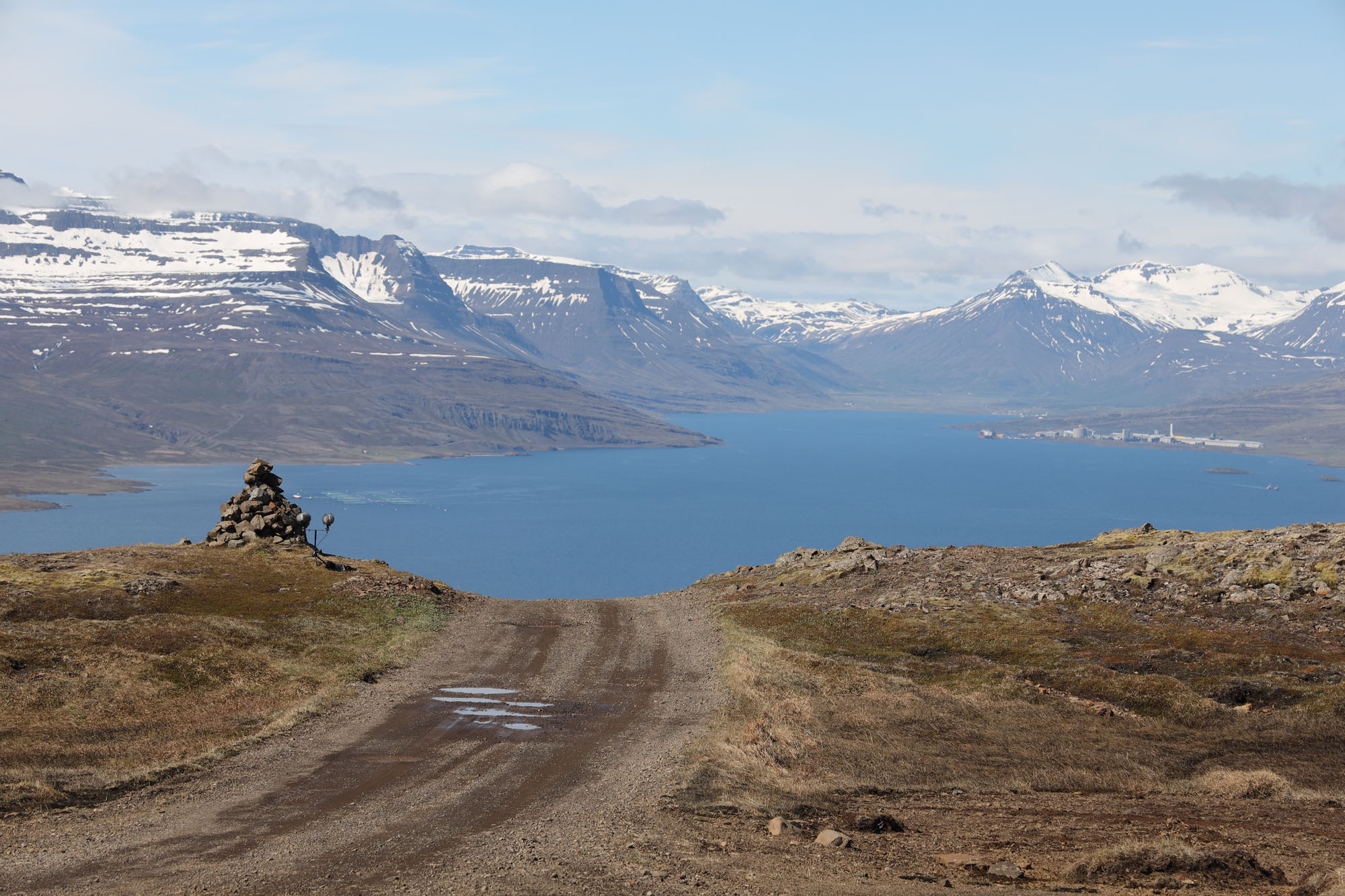
This recording was recorded in quite a bit of wind. I therefore had to hide the microphones behind a small stone cairn which in a way affects the recording and is heard differently in different headphones. It was a total coincidence that I heard this HUM because I was not walking or riding a bicycle, but in a car, which usually takes away all natural experience.
There at the top of the Vikurheiði heath I decided to stop and brew myself a coffee. That’s how I became aware of the HUM that filled the air around me. I somehow couldn’t figure out where the sound was coming from. It was coming from literally all directions, but somehow I convinced myself it probably originated from the mountaintops beyond the fjord. I tried to listen for engine noise through this rumble noise, but it wasn’t exactly clear, except twice. 
The remarkable thing about this noise was that, considering the wind and turbulence in the air, the sound was surprisingly loud. Not least if the sound originated from the aluminum plant in Reyðarfjörður, which was 17km away (in a straight line). Later that day it was confirmed that this noise was not heard from the aluminum plant.
Out in the fjord were two feeding or service boats around aquaculture. But they weren’t moving so the sounds were hardly coming from there.
At the pier by the aluminum plant there was a large bulk ship that turned its exhaust pipe towards me. But it was motionless the entire 3 hours I was up on the heath, so the sounds definitely didn’t come from the ship’s main engines.
The only explanation I have for the origin of these sounds is probably this:
The mountain slopes in Reyðarfjörður are many shaped like parabolas. They can therefore amplify sounds in certain places and directions. I therefore assume that the sounds came from the bulk ship’s generators, mixed with traffic noise in the fjord, as well as noise from the aluminum plant.
It can be assumed that this HUM will be heard differently in different headphones or speakers. Therefore, it should not be surprising if some listeners are disappointed.
Quality open headphones are recommended while listening at low to mid volume.
If the media player doesn’t start to play, please reload this individual blog in a new tab or frame.
More about this phenomenon „Global HUM
My erlier „Hum“ recording „Waste of power

(mp3 265kbps / 55Mb)

Recorder: Sound devices MixPre6
Mics: Sennheiser MKH20 (AB45)
Pix: Canon EOS-R

Location: 65.023528, -13.758306
Date: 20th of June 2024
Weather: Partly cloudy, 8°C, 1-5 m/sec

Read Full Post »

IMG_2200

It’s time for me to put a recording from my new Zoom F3 on the web.
The recording is from Stafholtstungar in Borgarfjörður, western Iceland, 4th of June 2022.
This is a 30 minutes part of another 35 hour long recording at circa 5AM. All these 35 hours I used only three 10Ah / 5V Li-Ion batteries. So each battery, which is smaller than the recorder, lasts for 12 hours.
It is different from around the mid eighties when I tried to record a natural sound on a Sony TC-D5M cassette recorder with a 4Ah acid battery that lasted for about 3 hours, or for 30 minutes with internal batteries.
The microphones in this recording were Rode NT1  in AB45 setup, dressed in Rycote WS2 windshields, about 20cm from the ground. It was recorded at 32bit / 48khz, with a recording gain at „32“ which I could believe was comparable to a 45dB gain at Sound Devices. In post-production, the recording was normalized by + 22dB up to -6dB and then converted to mp3 256kbps.
Various bird species are in the recording, such as Redwing, common snipe, common redpoll, whooper swan, raven, rock ptarmigan and definitely other birds too.
The name „Lambaklettur“ (Lamb rock) is a rocky hill above the recording site.
Quality open headphones are recommended while listening at medium or low volume
If the media player doesn’t start to play, please reload this individual blog in a new tab or frame.

  (mp3 256kbps / 56Mb)

Recorder: Zoom F3
Mics: Rode NT1. AB45 setup
Pix: Canon Eos R

Location: 64.675900, -21.623373
Weather: Dry, calm, clear sky, 5°C

Read Full Post »