
For about 10 years I have been using a nice „stereo“ ELF/VLF receiver built by Stephen P McGreevy. It is designed for two loop antennas.
These loop antennas have always been a lot of trouble to install. In addition, I have never known whether I was installing the antennas in a good place with regard to low or non 50Hz EMF pollution or to space weather conditions.
I have only known it afterwards and have often been disappointed.
I have therefore long dreamed of building my own receiver that would be as easy to turn on a pocket radio. So I started gathering materials this winter to build a new receiver, which actually turned out to be twins, or a pair.
This receiver has a High-ohm input and therefore is not designed for low-ohm loop antennas. However, it is using a 75cm whip antenna that can be connected to the receiver in an instant via BNC connector. Connect to headphones via mini jack, turn on and listen in very good quality. I can therefore instantly find out that the location I am in is free of 50Hz EMF pollution and check the status of the space weather.
As mentioned earlier, I had thought of using this receiver just to check whether it would be worth installing the loop antennas. But I have found that this new receiver is excellent in many ways. It reaches lower frequencies or below 10Hz and seems to reach much higher frequencies than 24Khz. The fact that the receiver should reach frequencies above 18Khz does not serve me at all regarding solar storms, except to check transmitter signals that are mainly intended for submarines for military purposes.
Solar storms are usually below the 18Khz frequency range, down to just a few Hz.
The transmitted signals above 18Khz are actually so strong that I clearly have to build a filter on the headphone output to avoid hearing damage. Old blokes like me can’t hear these high frequencies, but the strength is such that it causes a feeling of discomfort when listening and gives me tinnitus for a few days.
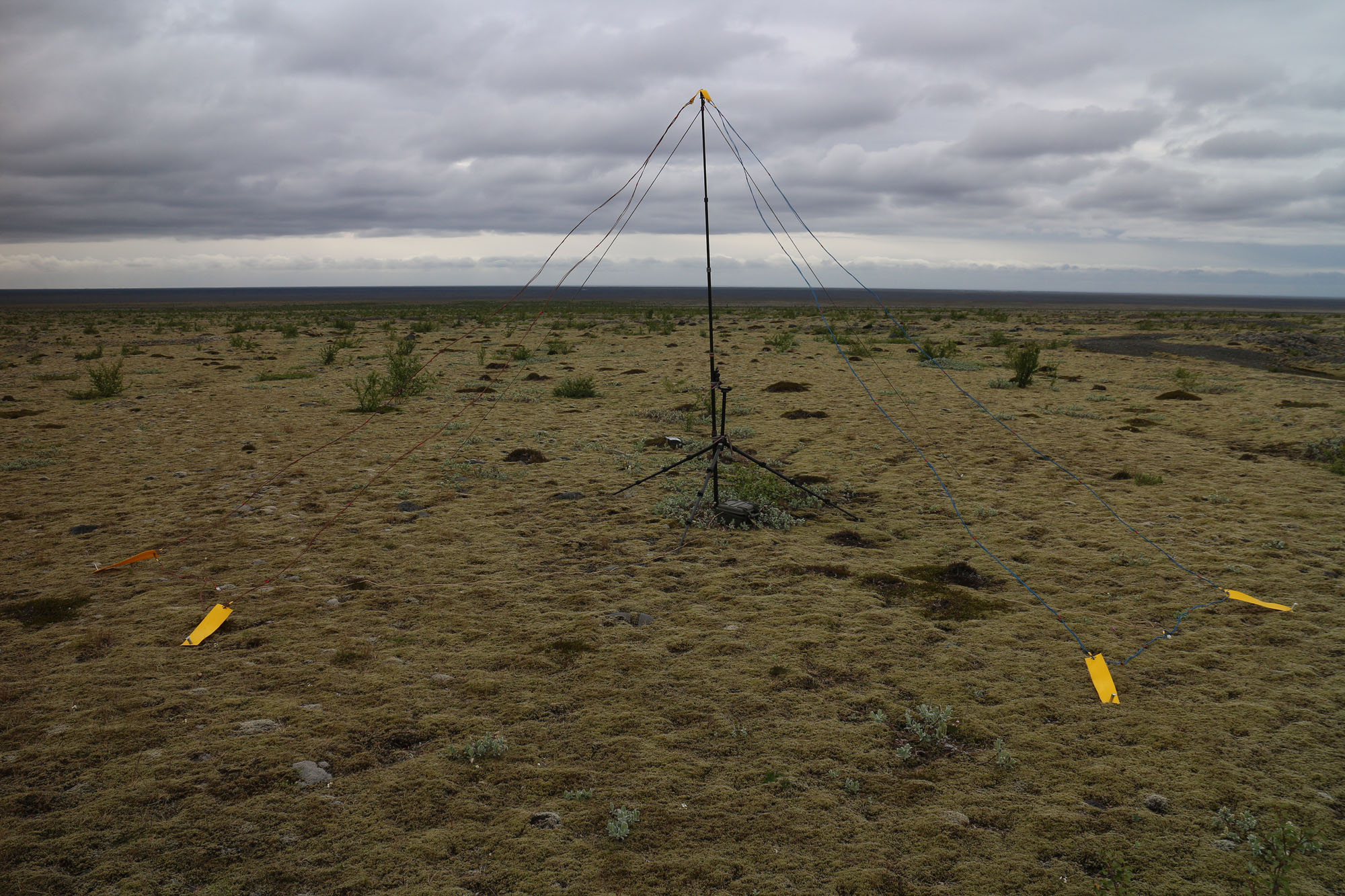
I drove out of the city in mid-March 2025 to a place that is relatively free of EMF pollution. There had been quite strong storms from the sun days before, so it was worth testing the new receiver. It was partly cloudy so that sometimes it was possible to see very power- and colorful Auroras in 3 to 4 colors. In between there was wind and hail which clearly also affected the reception conditions.
I made various attempts to record from the new receivers, which was difficult. The handheld devices that I used to use with the loop antenna receiver seemed to just send interference into the receiver. I tried ground isolation transformers, but that didn’t work. It wasn’t until I recorded with a MixPre6 and had the device far from the receivers that I was able to record solar storms without interference from the recording devices.
I am not satisfied with this recording. I am well aware that I am dependent on various details such as connection to the ground, size and type of antenna, height from the ground, location of the receiver and antenna as well as environmental and weather conditions and other things.
This recording only took into account that I did not hear interference from the recording device or other human objects during the recording. The receiver was not lying on the ground, but was on the top of a fence post.
I would like to mention that I have erased all transmitter signals above 18 Khz in this recording, so it should not bother anyone.
I could continue talking about the content of this recording, but I will stop here. You will definitely hear new recordings of solar storms on this blog in the coming months because it is not necessarily most interesting to record in late evening when Aurora is most active. It is very often just before dawn and the small details behind the clearly audible sparks, which is most interesting to listen to.
Here you can hear an older recording. Recorded from a Stephen P McGreevy receiver with a loop antenna.
(mp3 265mbps / 62Mb)
Recorder: MixPre6
Receiver: Explorer E202 ver. 1,4 with 75cm whip antenna
Pix: Canon E0S R
Location: 63.867430, -22.062817
Weather: Partly cloudy, hail, wind 2-4m/s, around -6°C


 HLJÓÐMYND - SOUNDIMAGE