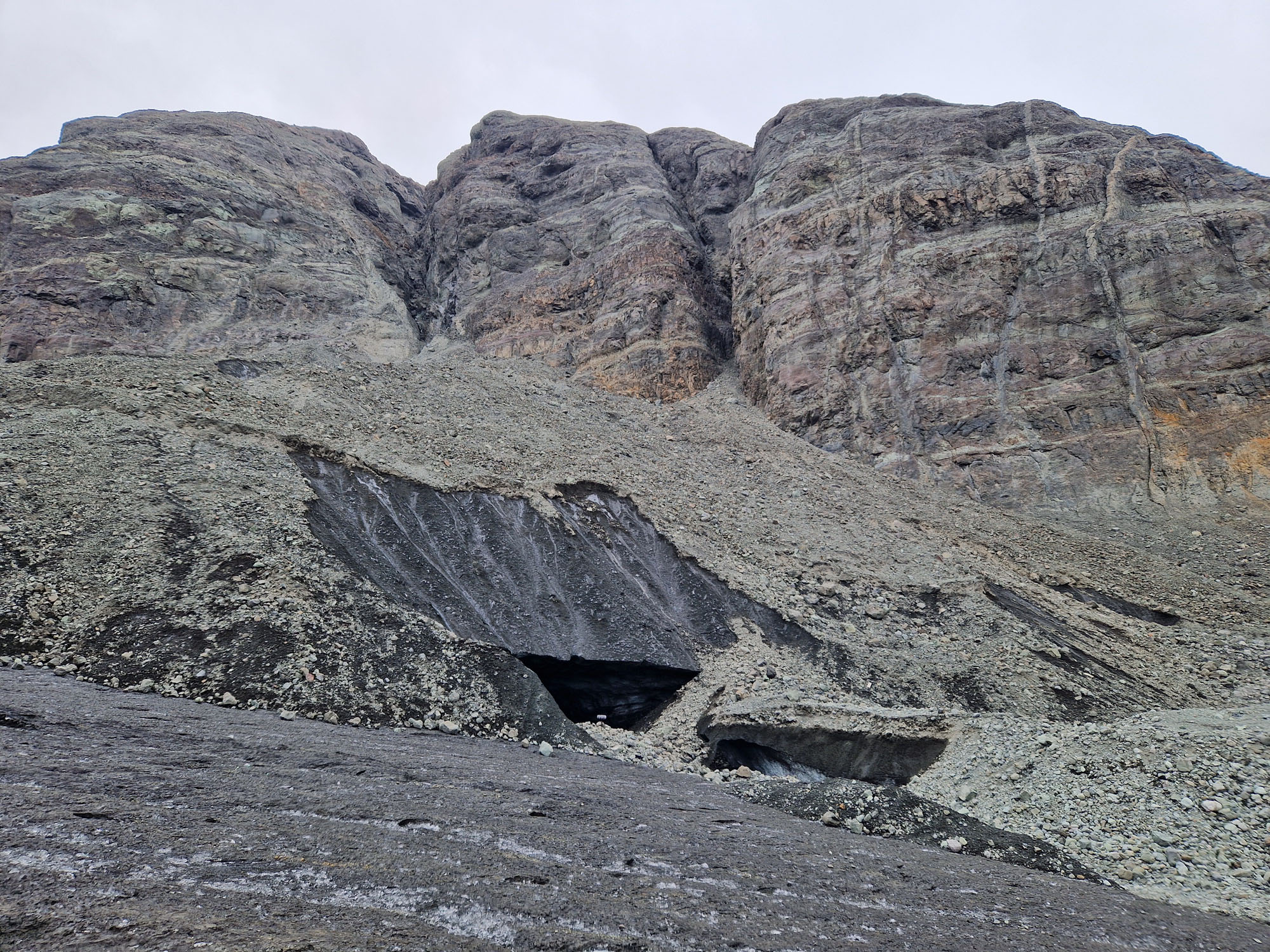
Here is one of those recordings that I record without being directly aware of what will come out of it. Equipment is placed in a suitable location where the wind was minimal and left there for 30-40 minutes while taking a walk. So I really don’t know what is being recorded until much later when you have time to listen and process the recording.
In fact, I knew of a rockfall at this location and was rather afraid about leaving the equipment behind, because the ice cave that the recording equipment was in might as well collapse. Then there would be a mud and rock slide from the mountain slope that would submerge everything.
This ice cave was at the end of Breiðamerkurjökull icefall, in a place where the glacier was probably 300 meters thicker only 40 years ago when I first came to this part of Iceland. Now the glacier is not more than dirty, „dead“ ice. A lot of it is buried under sand and rocks.
For centuries, the glacier has scraped the slopes of the mountains in Suðursveit. When the glacier retreated, gravel and rocks fell from the mountain slopes on the glacier below, which then formed a thick insulating layer over the ice closest to the mountain slopes. Under normal circumstances for centuries, the advance of the glacier would have carried this gravel down to the glacier toe. But the glacier has for two decades stopped advancing in this place. The glacier has lost all its mass so it will not crawl anymore in this place. The glacier lies flat and dirty towards the sun in the south, thin and melts rapidly. However, the ice that is covered with gravel and rocks melts much more slowly. Therefore, e.g. still possible to see ice high up on the mountain slope of Vestur Miðfell, although it is probably 30-40 years since the glacier was there and reach so high in the mountain slope
The pleasant surprise of this recording was that the wind did not interfere with the recording. You can hear mudslides sliding down the ice-covered mountain slope with all kinds of sounds that sometimes remind of car traffic. Sharp clicks in the rock as it bounces all around the mic and in good headphones you can hear the rock bouncing over the mic.
You will hear people speaking in the distance, which was several hikers coming from the glacier.
You might hear a lot of „white noise“ in this recording but it is mainly coming from nearby rivers, the wind and rapidly melting glaciers which are usually astonishingly noisy when they melt fast .
Quality open headphones are recommended while listening at medium to high volume.
But be careful. This recording has a high dynamic range and can damage both speakers and your hearing if it is played too high.
(mp3 256kbps /62Mb)
Recorder: Sound devices MixPre6
Mics: Sennheiser MKH8020/8040. (2x2ch Baffled AB35)
Pic. Samsung S22
Location: 64.134056, -16.226150
Weather: cloudy, dry, up to 8 m/sec, 7°C,


 HLJÓÐMYND - SOUNDIMAGE
Wow, incredible recording! You really must fear that the whole mountain buries you when listening.
Did you ever consider using your Nevaton MC59s in this setup instead of the Sennheisers? I am currently struggling to decide between those two…
Thanks for your comment.
My short answer is something like this: I wouldn’t mind using the MC59 much more than I do. At the moment I only use the MC59 to record classical music. This is because the MC59 sounds exceptionally beautiful for all acoustic music. In my opinion, much better than Sennheiser. However, this only applies to the MC59C which has a very natural, soft, airy sound.
This difference is not so decisive out in nature and in itself the MKH40 sounds very similar to the MC59C in outdoor recordings
There is another thing that may have been a problem with old MC59s in the past like mine, as I understand that they had a tendency to fail in humid air. I have never encountered this, but I know that the MKH80xx tolerate humidity very well. …and the old MKH20 and 40 much better.
I don’t want to lose the MC59 in some outdoor recording mess.
So I prefer to use Sennheiser for outdoor recordings.
It’s also the case that I can get a new Sennheiser microphone within a week. But it could take many weeks if not months to get a Nevaton.
At least that’s how it was when I got mine back in the day
Thank you for the insight.
I thought something like that and that is the reason I go back and forth. Unfortunate, as the Nevatons sound so incredible, also on nature recordings. I found someone recording the wind in a wintery pine forest with the MC59O. (https://www.youtube.com/watch?v=XBbol1S6JGY) I had never heard it as realistic as that. The soft noise from a pine might be one of my favorite sounds, and it is very hard to record with most microphones. Well, there is always something!
Anyways, I want to thank you for this blog. You are a great resource for me and your recordings are on another level.
I would love to hear a CD or some album or so, is there anything like that? 🙂