Feeds:
Færslur
Athugasemdir

Posts Tagged ‘Ís’

IMG_2200

In recent years, I feel that Iceland has cooled down and the summers have also been colder and more rainy. This should not be surprising because the meteorologists who have predicted the consequences of „global warming“ have predicted this weather pattern due to changes in the Gulf Stream. Added to this are natural fluctuations that could explain why it has been colder the last two years than the years before. This is all an emotional assessment so it is best not to say anything further about this. But this cold weather has offered the possibility of recording under frozen lakes near the capital. Something that I have not been able to do since I acquired hydrophones, except by difficult trips to remote places up in the highlands. The only thing I have to strive for is to get suitable recording weather on the weekend so that I am less busy at work. The possibilities for getting good recordings therefore have a few hours a year.
The little experience I have with these recordings has told me that it is not enough to find icy water, drill a hole and record. I can get very different recordings by finding the right hydrophone location, such as depth and the gap between two hydrophones. Then the frost must be below -5°C and the frosty days must have lasted for more than 5 days. Whether there is a thick layer of snow on the surface or naked ice, windy or calm weather. Size and depth of the lake and the thickness of the ice.
For me, this is always a bit of an issue. I have always traveled alone and been very careful when traveling and avoided all risks. Traveling on ice of varying thickness where no one sees or knows about me is therefore unexciting.
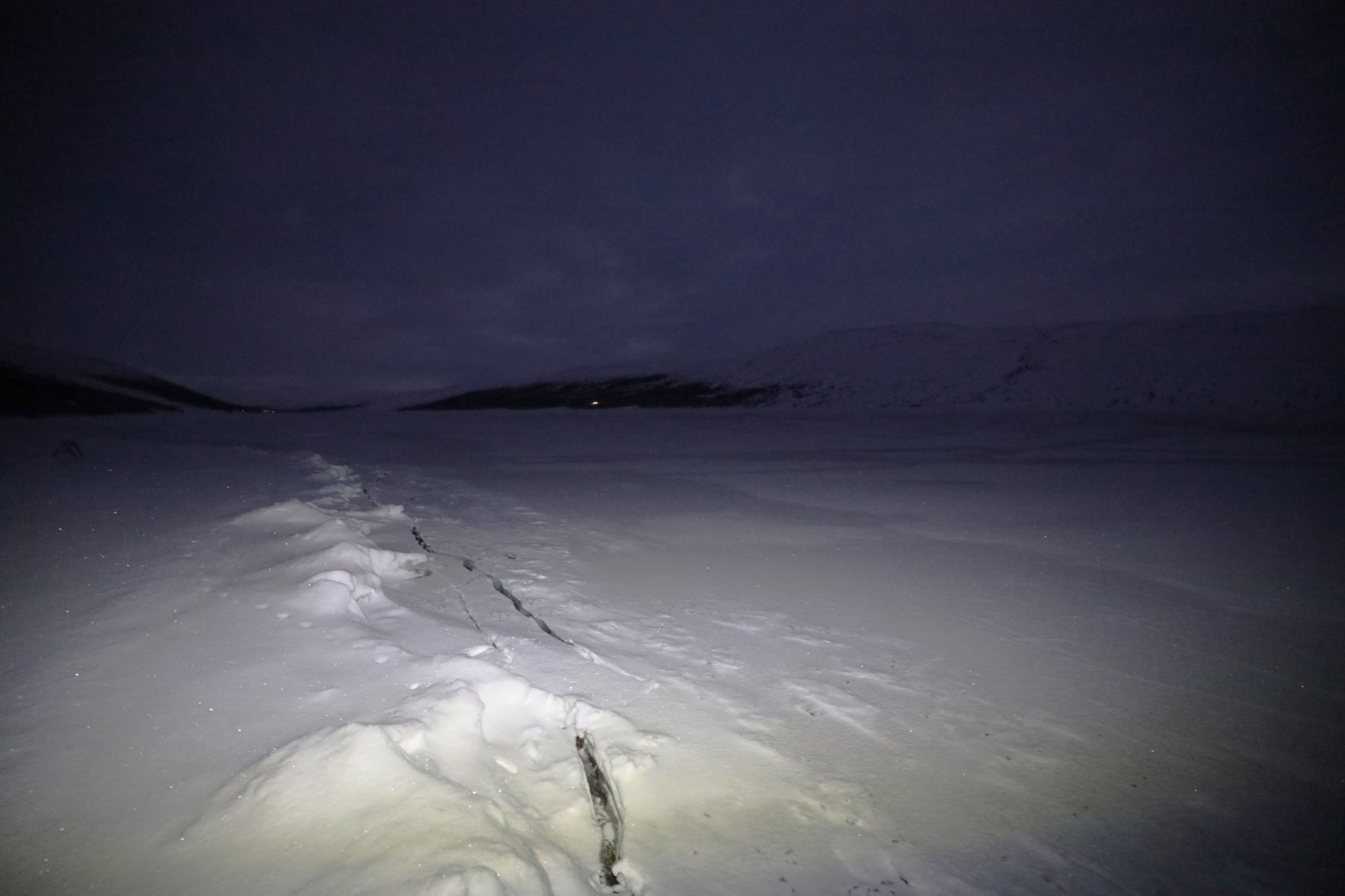
It was like that when I arrived at Skorradalsvatn (lake) in the dark and -8°C frost on January 5, 2025. I just went a few meters out onto the ice and drilled two holes there. The ice turned out to be about 25cm thick and the depth under it was almost a metre. Even though it was calm, sounds from the ice could still be heard on the surface. Sounds that would have been much clearer in the wind earlier that day.
I had to start recording immediately if I was going to be able to record these sounds under the ice. If it gets calm for a few more hours the lake will get very quiet.
The sounds heard in the recording are heard just as well on the surface, except that they are heard much louder under the ice, plus all kinds of smaller details.
Since I was not far from land, the rumble of a car driving along a road about 100 metres away is also heard through the ground. Then you can hear the rumble of air traffic very well, which is probably because the ice on the lake acts like a membrane on a microphone. At the same time, I climbed out onto the ice to take pictures so that my footsteps could be clearly heard.
Quality open headphones are recommended while listening at low to mid volume. There are a lot of very powerful sounds in this recording that can easily damage your hearing and speakers. I therefore do not recommend high volume
If the media player doesn’t start to play, please reload this individual blog in a new tab or frame.
Some of the loudest pitch there seems to be have some distortion. I didn’t notice this until the recording was transfered to mp3. But this is not a problem on the original recording WAV 24bit/48Khz. Let’s just leave it like this

(256Kbps / 60Mb)

Recorder: Sound Devices MixPre6
Mics: Benthowave BII-7121
Pix: Canon EOS-R

Weather: Cludy, Calm, about -8°C
Location: 64.5137303,-21.4130149

Read Full Post »

IMG_2200

Skorradalsvatn lake is located in the western part of Iceland, about an hour’s drive from Reykjavík. In the winter of 2023, I had the opportunity to record under the ice under ideal weather conditions. That was in good wind and good frost after 2-3 weeks of frost.
The winter of 2023 to 2024 was similar in many ways when looking at temperature numbers, but I only managed to record under the ice once.  It was calm weather and the ice therefore did not make any sounds.
But then just a few days before the spring arrived there was one windy weekend so I made a trip to the lake even though I knew the frost had only lasted more than a week.
When the lake was reached, the ice was solid, but quiet in all this the wind, which indicated that it could be soft and not human-proof. Among the banks were many polynyas with broken ice.  This broken ice was turbulent due to currents and under waves from the ice-covered water.
It was therefore stupit to try to get out on the lake, even though the ice seemed thicker there. I was also traveling alone, so no risks were taken this year.
This turbulent dancing ice in the polynyas makes pleasant natural music. So I had not come to the place to do nothing. There was considerable wind or about 12-20 m/sec. But what saved me was a wooded mountainside behind me so the wind was not constant, but occasionally came in with strong gusts.
The wind made a lot of pink noise in the forest. Quiet microphone was therefore not important. Two cardioids would have been the best choice for this project, but I did not have them in a good windshield.  I simply chose the one that suited the weather best. It was my home-made Primo EM172 Binaural/baffled stereo microphone which I put on ice close to the one polynya.
When I got home, things got worse. The gusts had been so strong that even my best set of mics for these conditions failed.
I don’t have Advanced Izotope RX, so I don’t have the De Wind plugin, which is sorely missing from the RX Standard version. So I got my soulmate in sound, Buzby Birchall to run the recording through his RX De Wind software. The result was interesting and made me feel like I didn’t really need to own or use the RX De Wind. After I had set the HPF on the original recording to 111Hz / 1.7oct, the recording was „no worse“ than the one that had received the RX De Wind treatment. However, you could clearly hear that the HPF recording had a bit more wind noise below 200Hz, but on the other hand, other details sounded somehow better and tighter than on the De Wind recording. When inspecting the Spectrogram, it was clear from the De wind recording that frequencies below 100Hz had somewhat deteriorated, also slightly below 1.2Khz. This visible attenuation was not audible in all headphones, but was audible in the HD650 headphones at 24bit/48Khz.
Below are both the HPF version and the DeWind version.
Feel free to judge the difference and comment below.
Quality open headphones are recommended while listening at low to mid volume.
If the media player doesn’t start to play, please reload this individual blog in a new tab or frame.

HPF file (mp3 256kbps / 33.3Mb

DeWind file (mp3 256kbps / 33,3Mb)

Recorder: Zoom F3
Mics: DIY Stereo mic. Double Primo EM172 capsules in AB baffled/binaural setup
Pix: Samsung G22

Weather: Cloudy, wind between 12-20 m/s, about -5°C
Location: 64.513802, -21.410157

Read Full Post »