This incoherent and rather strange headline was the result of my last sound recording under the ice on Skorradalsvatn in western Iceland on 14th of March 2026.
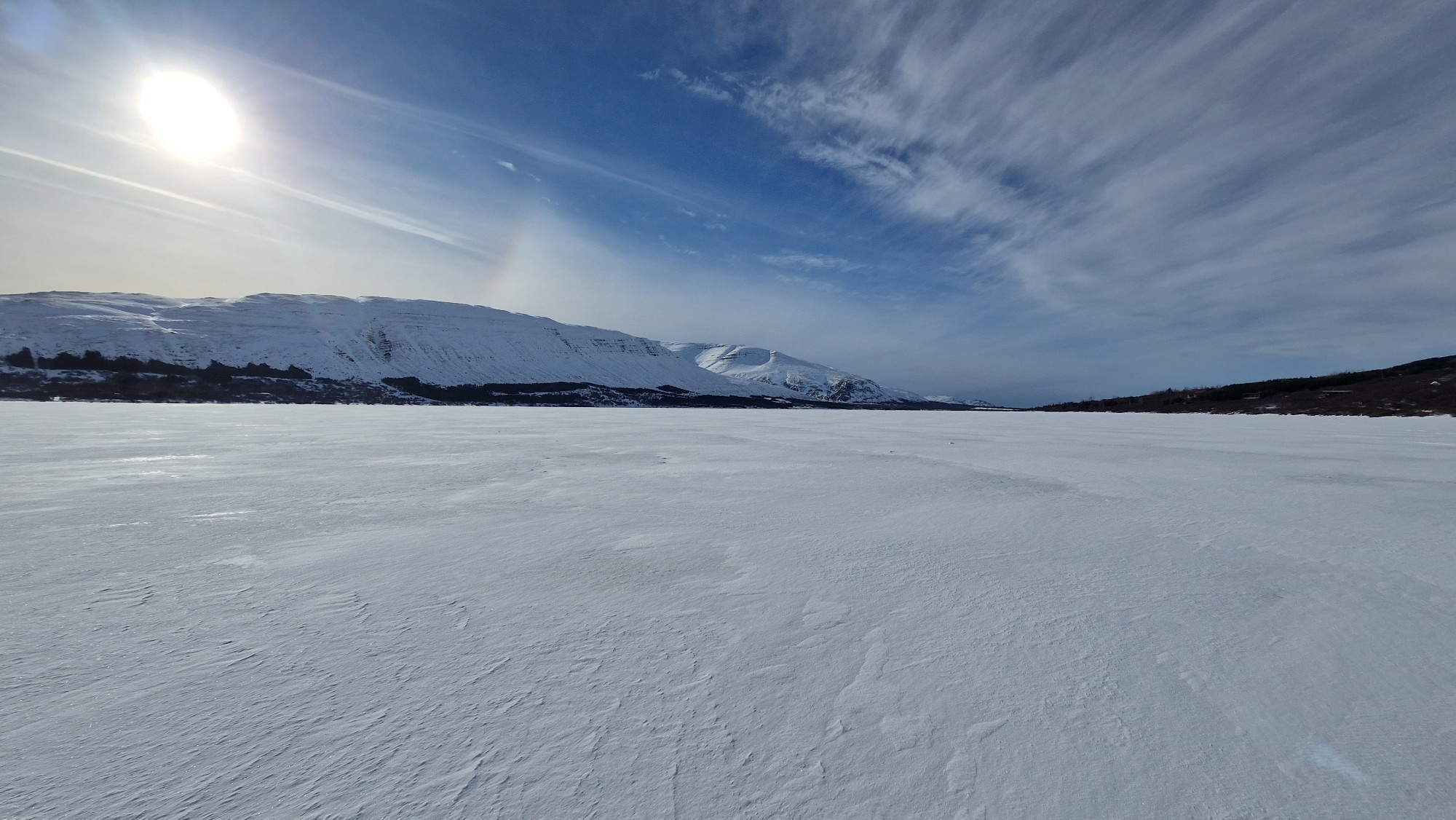
I had found a new place by the lake where I had good access by car and equipment and was close to the deepest point of the lake which is 46 meters deep. I considered it unnecessary to go where the depth was the greatest on the ice but the hydrophones went down about 9 meters without touching the bottom. I had 8 meters between the microphones and arranged them so that I would get a good stereo image from the deepest part of the lake. The ice on the lake had been the same all this winter. It was 40 cm thick formed from slush and therefore opaque. On top of it was snow of varying thickness and in many places the bare ice could be seen.
When I first arrived it was sunny and frosty, about -4C°. However, it was noticeable that in direct sunlight it was quite hot, probably +5c°
Shortly after the recording started, high-altitude clouds appeared, which meant that within 40 minutes it was completely cloudy and sunless.
The weather forecast had promised me considerable wind in the afternoon. After four hours of waiting by the lake, a wind began to move, which I thought would be a good sign. However, I could not hear anything in the ice on the surface, which I thought could be because the snow on the ice dampened all surface sounds. When darkness fell, I decided to stop the recording.
At first I was alarmed because I could not see the equipment and snow now covered the path out onto the ice where the equipment was located.
When we got there, all the equipment was covered in snow.
It was quite a disappointment when I reviewed the recording at home. Mostly complete silence after the sun disappeared behind the clouds and then I heard a huge white noise that I thought at first was a malfunction in the equipment.
By zooming into the spectrogram of almost 5 hours of recording, several things became visible, some of which called for research work. The result is this:
Wind creates waves on icy water. Although no movement is visible, the waves create an enormous amount of noise under the ice, which can often also be heard at a limited intensity on the surface.
When direct sunlight shines on icy water, the temperature difference in the ice creates tension and fractures that can be clearly heard under the ice. This decreases in proportion to increased cloud cover. The ice and the water become completely silent when it is calm and it is completely cloudy. The same applies to snow lying on the ice. The more snow that covers the ice, the quieter it will be under the ice, whether the sun is shining or the wind is blowing.
In the recording below, you can hear a very powerful „explosion“ or „thunder“ that has no obvious explanation. There were no strong earthquakes in the area at this time. The closest one was under Langjökull glacier, which was measured 50 km away on the magnitude 2, which cannot explain this loud noise. After a short conversation with geologist Páll Einarsson, he thought it could be a ground freeze, but in my opinion the frost was not strong enough that day, or the days before, for that to be a likely explanation.
The only explanation I can give is that it was a meteorite that entered the atmosphere. The ice on the lake has received the impact of the wave like a microphone and echoed under the ice. Although such shock waves from meteorites are usually closer to an explosion, it is the size and length of the water that makes this explosion echo for 25 seconds. With software I see that two shock waves create these rumbles. First one is clearly visible as a one wave in 8-10 millisecond and the second one, slightly weaker, lasts as 10 Hz in one second, which then flows out as echoes under the ice. This low frequency is lower than the human ear can detect, so it is no wonder why I never hear anything that day, or some „explosion“ which is not unusual in the human world.
It should be noted that I had heard news of meteorites all over the world on social media around mid-March, so a meteorite was the most likely explanation.
Another interesting thing was that I didn’t quite understand and it lasted for 8 minutes. It was a regular „burping sound“ that made me think at first that it was some fish because it sounds like a regular „breath“. But the most likely explanation is that it was a release of methane gas from the bottom. What argues against it is that it is not clearly audible when the bubbles float to the surface. However, it could explain that these bubbles came up very close to land.
Then there is the question of why bubbles rose from the bottom, both there and clearly deeper into the lake. Then we came back to the earthquake under Langjökull Glacier which was at a very similar time when the methane gas released from the bottom of the lake
In the end was another thing that really surprised me. When it started to get windy, which was actually a 4-5m/sec gust, it did not create „waves“ with cracking sounds in the ice. But instead it was strong enough to create a „blizzard“ on the surface of the ice, which sounded like a fairly loud white noise below the ice surface.
The audio below is a composite of this 5-hour recording. You can hear the ice cracking when the sun shines on it and how the sound diminishes as the cloud cover increases. Then you can hear me walking to the recording location and breaking the ice in the holes where the hydrophones were. After that comes the expotion sound from the Meteor at 16:30
Then you can hear methane gas escaping from the bottom of the lake and at the end there is a blizzard that sounds like a „white noise“ under the ice.
Because of the low key sections of this recording, I felt I needed to use noise reduction in the quietest part of the recording. Not much more than that, but you will still hear some noise.
Keep in mind that there are also some very loud moments in this recording. Especially when I am breaking ice in the holes for the microphones.
The shockwave from the meteor is also loud. I do not recommend playing it loud.
Keep in mind, however, that the drones from the meteorite sound very bad and poorly here in mp3 format compared to the full recording quality 24bit/48Khz WAV.
This is one of those recordings where I was thinking of using a compressor to reduce the extremes between the highest and lowest volume levels. But since these hydrophones have both a wide frequency range and a wide dynamic range that sound amazing in good headphones, I decided to do as little post-processing as possible.
Quality open headphones are recommended while listening at any comfortable level, but be carefull, there are high dynamic moments.
If the media player doesn’t start to play, please reload this individual blog in a new tab or frame.
(mp3 256kbps /56,3Mb)
Recoder: Sound Devices MixPre6
Mics/Hydrophones: Benthowave BII-7121
Pix: Samsung S22
Weather. Sunny to coudy, – 5°C, calm to 3 m/s
Location: 64.518492, -21.463615