Feeds:
Færslur
Athugasemdir

Archive for the ‘Náttúra’ Category

IMG_2200

Here is a recording that came as a surprise after I put it in Spectrogram, because I was sure that I had not recorded anything special.
Earlier the evening before the recording started, a lot of wind had been forecast for later that night. So I was not spreading recording equipment around me as I would have liked in this wonderful and secret place in the highlands.
However, I decided to use Lewitt LCT540s in an IRT cross in a sheltered place from the coming storm. Two of the four microphones were pointed as much as possible into the ground, while the other two were allowed to point out into an open area. The recording seemed to only sound interesting in the wind that was present when I started the recording. The entire time I had been at this place in the highlands, I had not heard birds or any other life. Only in the wind and the flow of water in the nearby water sources.
But later that night while I was sleeping, a completely calm weather came that seemed to awaken a lot of birdlife. Birds that I had neither seen nor heard earlier the days before.
However, I never noticed this peaceful weather that night or this bird song. I just went to sleep in the breeze and woke up in a storm. It was therefore quite amusing to discover that I had managed to record the birdsong even though the microphones were placed in the wrong place for such a thing. It was first and foremost the microphones facing the ground that captured the most bird song. Those facing out into the open mainly recorded the behavior of Red necked phalarope which were at a considerable distance and goose in far distance.
To be honest, considering the placement of the microphones, this is a surprisingly good recording. This can probably be attributed to these excellent Lewitt microphones, also because they were not very visible to the birds that are best heard because they do not emit warning sounds. But if I had worn the microphones in something other than fur and been positioned closer to where the birds were, I would have achieved incredibly clear recordings in the most subtle way. In addition, very distant sounds would have become more clear and focused. But it is always difficult to be prepared for such weather conditions that it is possible to be without fur in Iceland when such times are perhaps 6-12 hours a month.
You can hear in the entire recording running water, also a kind of rumbling from running water that I assume could be a stream of spring water below the ground. But in this area there are huge water sources that could probably serve a city of millions with fresh water. The sound was recorded at +50dB gain and increased by +20dB in post up to -10dB. No RX noise reduction, mainly because I have never been satisfied with the result when I have used the LCT540. But EQ was used. Sharply pulled down below 50hz and above 10Khz, mainly to bring down unnecessary rumble and white noise from the equipment.
Quality open headphones are recommended while listening at low to mid volume.
If the media player doesn’t start to play, please reload this individual blog in a new tab or frame.

(mp3 265kbps / 66Mb)

Recorder: Sound Devices MixPre6
Mics: Lewitt LCT540s (IRT cross setup)
Pix: Samsung S22

Weather: Calm cloudy, about 7°C
Location. Secret place on the Icelandic highland

Read Full Post »

IMG_2200

The „recording summer 2025“ started rather poorly. Cold, rainy, always strong winds and the birdlife was rather quiet. However, it does happen regularly during the nighttime the weather gets calm for about 1-4 hours. There was therefore no need to panic because the equipment was allowed to work almost every night. However, it seemed to be a small gain considering the cost, time and effort.  I only could hear birds when I wandered close to their nests or youngs
The most important thing was to follow the weather forecast, search maps and try to find new recording locations as well as get to know the local conditions. If the weather was going to be completely impossible for a microphone, it was almost always possible to set up an antenna and record the space weather.
But then it suddenly happened at the beginning of July that summer arrived with warmth and less wind. Birds also started to sing without me as a human being triggering a warning sound all over the fields.
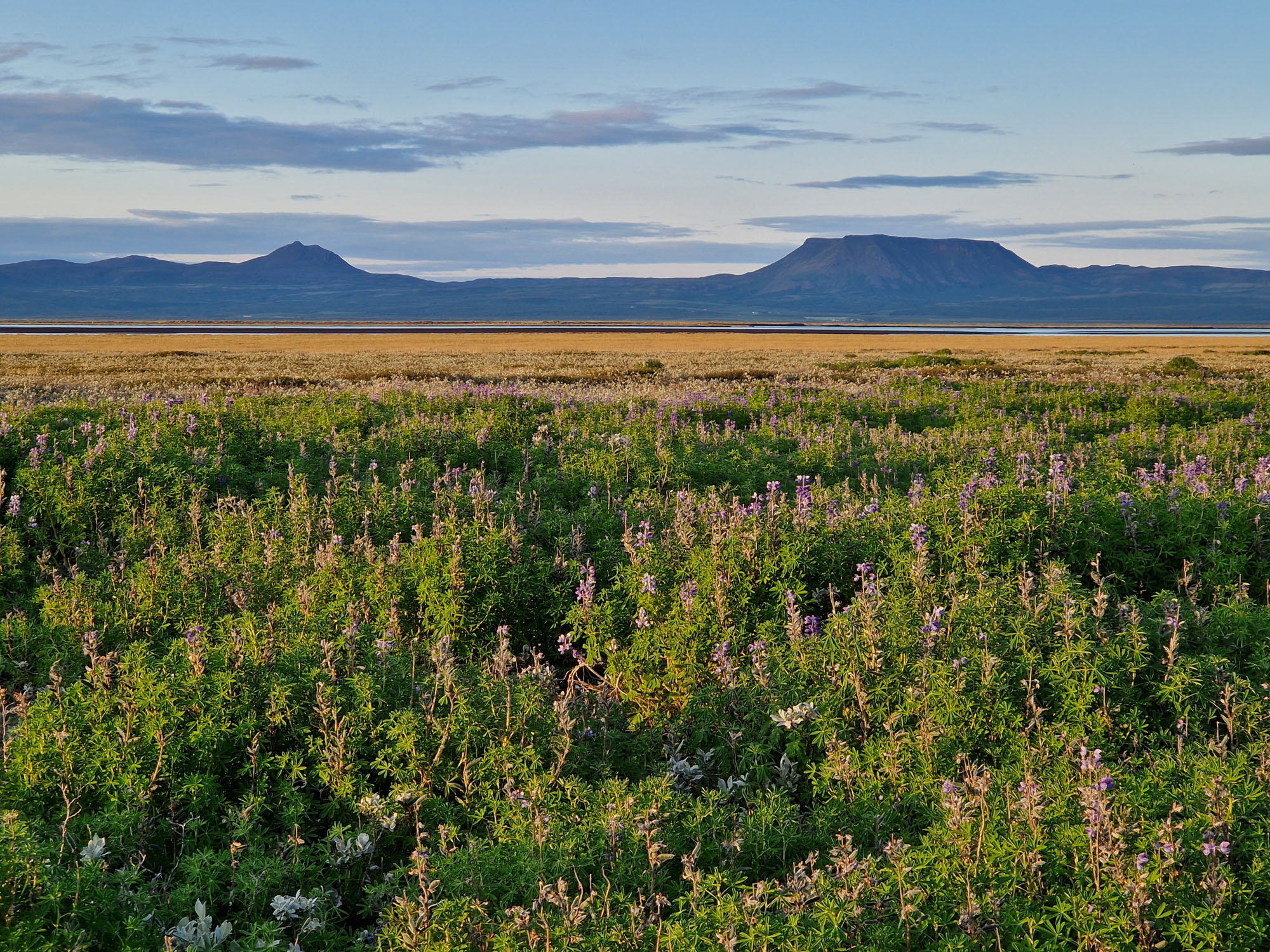
I was then at Öxarfjordur and had thought about going to an old recording site on Vestursandur. Then I saw a gate open on a trail that has always been closed when I have been there. So I drove along the trail and suddenly I was in a green oasis that contained a lot of bird life that I did not know about.
So I found a place where it was easy to find as many recording sites as possible within walking distance.
In the end, 4 recording devices were running that night. The drawback was that in the countryside you could hear most of the night that the farmers were working all night long until early morning. But after a jet flew over, the farmers quit their work and a relaxing summer silence took over.
There is still something in this recording that gives off a vibrating background, noise or hum. Which I suspect could be the surf from the beach not far away and sometimes the occasional car traveling through the county.
Quality open headphones are recommended while listening at low to mid volume.
If the media player doesn’t start to play, please reload this individual blog in a new tab or frame.

(256kbps / 66Mb)

Recorder: Sound devices MixPre
Mics: Lewitt LCT540s (IRT Quad / 4x NOS)
Pix: Samsung S22

Weather: Clear sky. Calm to 4 m/sec. 12°C
Location: 66.093326, -16.645256

Read Full Post »

IMG_2200

Earthquakes and volcanic eruptions seem to be becoming a daily occurrence for Icelanders. It is best to notice them when such events start to bother you personally. In July I was traveling, including in Fjörður area in North Iceland. On the night of July 15, 2025, I woke up around 5am in a tent to a creaking sound outside my tent. At first I thought a silent electric car was creeping along the gravel road right behind me, but soon fell back to sleep again. The next day I heard that there had been several earthquakes in the area during the time I was there. The strongest one was close to midnight measuring 3.9 and several aftershocks up to 2.0 during the night to the morning
I myself somehow did not notice the 3,9 earthquake. Probably because there was wind and considerable noise from the beach and the large rivers in the surrounding mountains.
But later in the night, It gets calm and foggy and the ambient noise diminished during the aftershocks.
The recording proves what woke me up this night was a landslide in the mountains.
Up on the mountainside above me was a microphone set that managed to record both the rockslide and the gravel slide, but at a considerable distance.
Because of the natural noise in the background in this soundscape the recording itself is rather boring, e.g. stream-rivers in the valley at left side, and waves from the shore at the right side.
But this unpretentious soundscape is very typical in valleys that extend into the sea all around the country. So it can’t be avoided to put something like this on this blog. Under all normal circumstances, such a recording would simply go into storage with all the other 90% of similar recordings.
One thing that can be noticed in this recording is that just before the aftershock and the rockfall this morning, the birds seem to react in some way. After this first earthquake, for about 20 minutes, you can regularly hear rocks falling and gravel sliding.
Quality open headphones are recommended while listening at low to mid volume.
If the media player doesn’t start to play, please reload this individual blog in a new tab or frame.

  (mp3 265kbps / 55,3Mb)

Recorder: Tascam FR-AV2
Mics: Sennheiser MKH20 (AB45)
Pix: Samsung S22

Weather: Partly cloudy, 1-2 m/sec, 15°C
Location: 66.136151, -18.068340
Skjálftalísa Verðurstofunnar

Read Full Post »

IMG_2200

I have been quite busy recording this summer. Not least the space weather, i.e. solar storms, because in the coming years solar activity will increase, which could well be my last chance to record something like this.
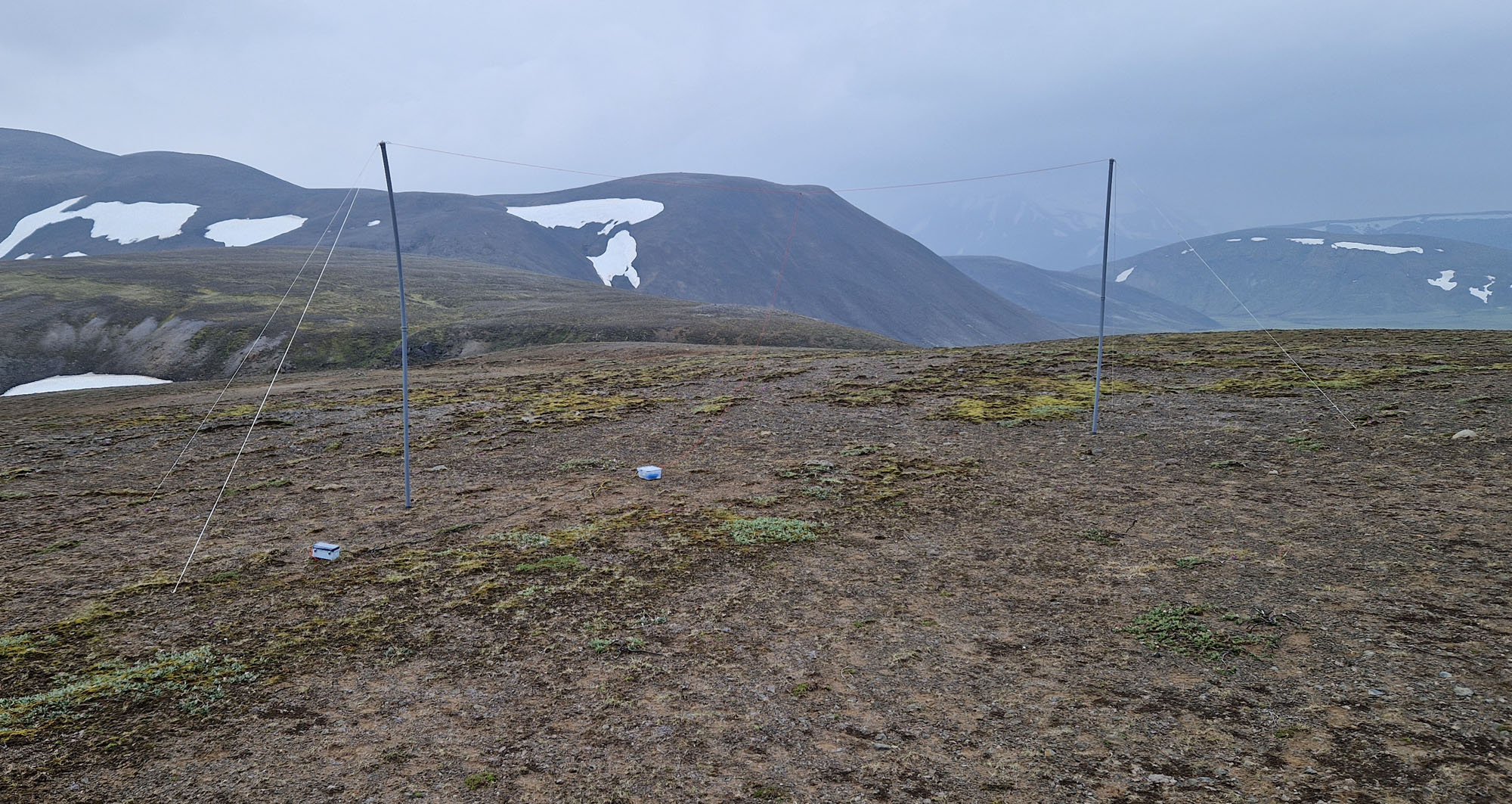
Last winter I built both a VLF receiver and a good antenna that was and is easy for me to set up alone in almost any weather.
At first glance, the summer recordings seem to have been quite successful. However, there are various „technical“ issues that need to be fixed so that the recordings will be better. but that will hopefully happen in the fall.
I always tried to record for as long as possible to collect as much information as possible. I try to avoid being close to high mountains or buildings that block the view into space, or cause electrical pollution. The same goes for high-voltage lines and electric fences that create electrical pollution. All of this has to be behind mountains, or at least 20 km away. Unfortunately, these places are hard to find in Iceland. I didn’t record as much material as I was interested in, but I have found some pretty good places here and there all over the country.
Although I am recording the same thing as the northern lights, it has been shown that the most interesting sounds are heard in the mornings from about 06am to 11am. Almost without exception, you can expect to hear „Dawn chorus“ and „Whistlers“. in all sorts of varying pitches. No recording therefore sounds the same, although „Tweeks“ can be heard pretty much all day long, but with varying intensity.
What interests me most is what happens in the frequency range of 1Khz to 5Khz, as well as what happens at low frequencies, below 40Hz. Then there are silences in certain frequency ranges on a kind of background noise that seems to come from outer space, which I previously thought was due to poor equipment. Much of this material requires special analysis in spectrograms and time spent listening that awaits a better time.
Mainly due to lack of time, I must admit that I am not yet good at this subject. But I can thank Stephen P McGreevy for inspiring me for over a decade.
Here is a recording chosen at random from the summer’s recordings. It does not necessarily have to be the best, but there is a typical „Dawn chorus and Whistler“ that calls for good listening and attention.
Quality open headphones are recommended while listening at low to mid level, or in speakers at medium level.
Be careful, if too loud, it can damage both your speaker and your hearing.

(mp3 256kbps / 65,6Mb)

Recorder: Zoom F3 & Exporer E202 Receiver
Receiver: Explorer E202 V1,4
Pic: Samsung S22

Weather: Clam, dry, misty (misty because of the eruptin at Reykjanes
Location: 64.820680, -19.693353

Read Full Post »

IMG_2200

I must admit that I have posted a recording with this particular mouse before, but it does not play a major role in this recording.
It is the silence, the „calm“ weather and light gusts that can be heard in the recording that I have now been waiting for for almost two weeks, i.e. the end of May – June.
The summer is not going to start well for sound recordings. Winds are well over 4 m/sec and very cold, sometimes up to -3 °C. Normal wind has been all over the country around 4-9 m/sec up to 20-32 m/sec in some places and days.
The situation has therefore been easily called a traditional „winter storm“, then and when snowfall is added.
In such weather, bird song falls silent and young birds die in nests, although some birds are breeding again.
This weather has also meant that it is not possible to install VLF antennas. But major solar storms have raged in the solar system in recent months. But VLF recordings need same weather situation as microphone recordings. Wind should preferably not exceed 2-3 m/sec if anything is to be interesting in the content of the recordings.
But then we turn to the accompanying recording, it was recorded early in the morning on November 26, 2023 under a full moon in Stafholtstungur at -1°C and 2-3m/sec which rustles gentle straw and leaves.
Because of an earlier experience. This time I thought that I had given the mouse a butter cake, that I spread around the microphones.. It is therefore quite remarkable that the mouse tried to chew on the cables that night. It starts chewing on the microphone cables with great noise (around 20 minutes). Almost throughout the recording, various sounds can be heard that can probably be traced to the mouse, especially in the last three minutes.
As it was getting close to 6am, you could hear some traffic in the distance
The SD788 was recorded with a gain of +48dB with no LPF, which was probably not wise. But if you can get away with it during recording, it’s often more fun to manipulate it afterwards. It was cut below 50Hz and above 10Khz
The gain was increased by another +14 dB to normalize to peak level in post-processing.
Quality open headphones are recommended while listening at low to mid level, or in speakers at medium level.

(mp3 256kbps / 62Mb)

If the media player doesn’t start to play, please reload this individual blog in new tab or frame

Recorder: Sound devices 788
Mics: Lewitt LCT540s ( IRT cross 90°/30cm)
Pix: Canon Eos R

Wether: Calm up to 2 m/sec, partly cloudy.
Location: 64.673381, -21.628700

Read Full Post »

IMG_2200

Here is an audio recording from a secret spot in the central highlands of Iceland that I have previously shared sounds from. But I will not say where that place is.
By pure coincidence, I was on the outskirts of the central highlands on June 29, 2024 when I heard that a road into the highlands that had been closed all winter had been opened. So I was among the first to enter the highlands and this secret spot this summer.
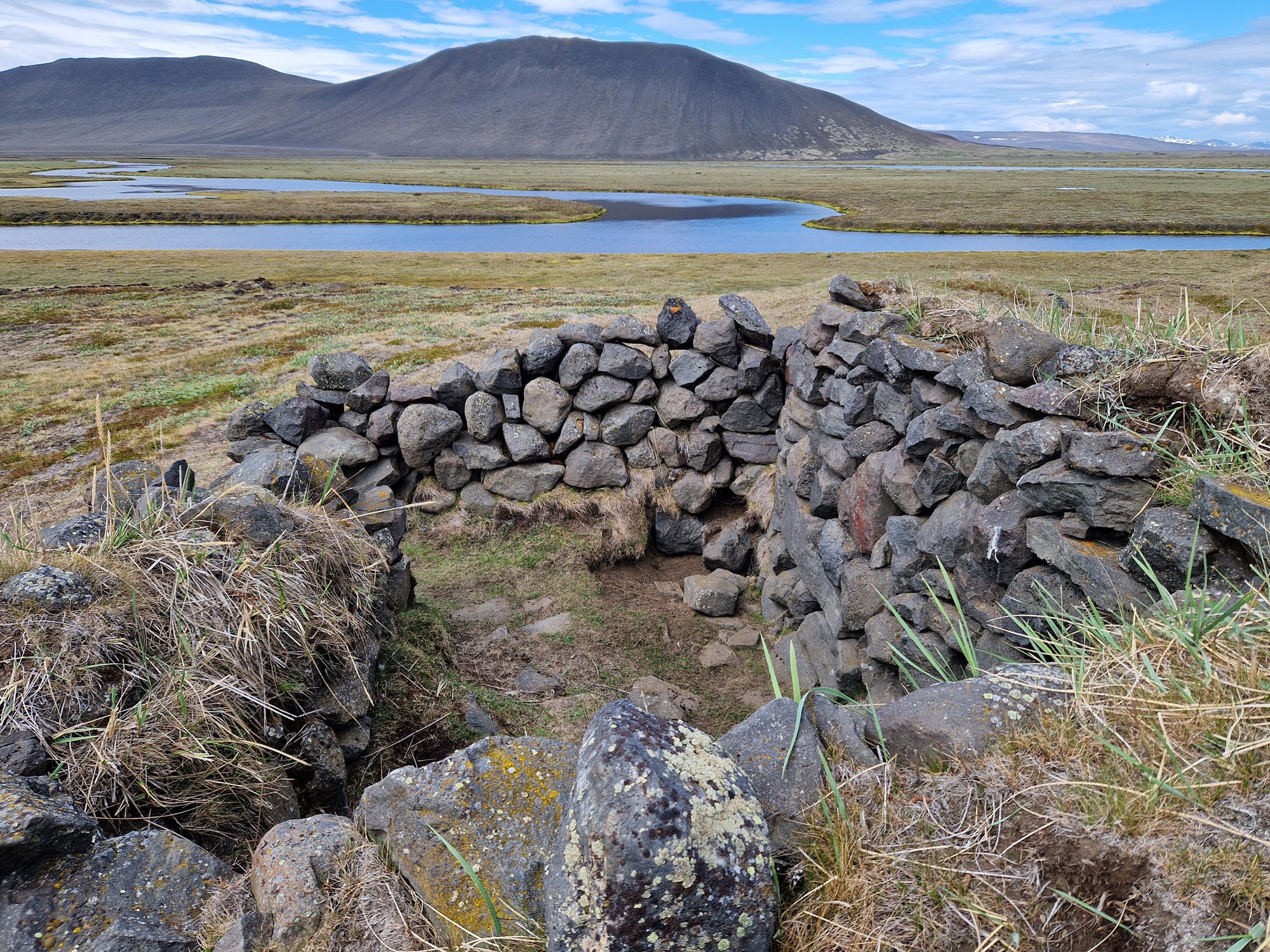
There are old stone/turf ruins at the site where I noticed a White Wagtail had made a nest inside the wall. It was quite windy so it was the perfect opportunity to record what was happening inside the ruins.
For the first few hours, I did not notice much birdlife at the ruins, until very early in the morning. The recording began soon after I noticed the birds had arrived in the area. It was clear that the birds were not happy with these gray furry neighbors so close to their nesting site. One of the birds tried to scare the microphones away with wingbeats and warning sounds. But the microphones stood firm and did not move, so later that night the birds took the microphones in peace.
Later in the morning it was heard that the White Wagtail can make various sounds, probably for communication, but that will be the subject of another post.
This area has incredibly abundant freshwater springs, so it’s a real surprise every time I visit the area. The sound of the water from these springs can be heard in the background of the recording, as well as other birdlife that is always found in such water and vegetation oases in the Icelandic highlands, which are otherwise just a black desert.
The recording was made with a Rode NT1a inside the walls of the ruins. The sound, or stereo image, is therefore a bit strange, but you get used to it.
Recorder was Zoom F3. Digital gain at 256 and HPF 40hz.
In post, add +13dB to normalize, fade in & out, and then downgraded to mp3

(mp3 256mbps / 60Mb)

Recorder: Zoom F3
Mics: Rode NT1a (NOS 90°-30cm)
Pix: Samsung S22

Weather: Calm up to 8m/s, partly cloudy.
Location: Secret place

Read Full Post »

IMG_2200

For about 10 years I have been using a nice „stereo“ ELF/VLF receiver built by Stephen P McGreevy. It is designed for two loop antennas.
These loop antennas have always been a lot of trouble to install. In addition, I have never known whether I was installing the antennas in a good place with regard to low or non 50Hz EMF pollution or to space weather conditions.
I have only known it afterwards and have often been disappointed.
I have therefore long dreamed of building my own receiver that would be as easy to turn on a pocket radio. So I started gathering materials this winter to build a new receiver, which actually turned out to be twins, or a pair.
This receiver has a High-ohm input and therefore is not designed for low-ohm loop antennas. However, it is using a 75cm whip antenna that can be connected to the receiver in an instant via BNC connector. Connect to headphones via mini jack, turn on and listen in very good quality. I can therefore instantly find out that the location I am in is free of 50Hz EMF pollution and check the status of the space weather.
As mentioned earlier, I had thought of using this receiver just to check whether it would be worth installing the loop antennas. But I have found that this new receiver is excellent in many ways. It reaches lower frequencies or below 10Hz and seems to reach much higher frequencies than 24Khz. The fact that the receiver should reach frequencies above 18Khz does not serve me at all regarding solar storms, except to check transmitter signals that are mainly intended for submarines for military purposes.
Solar storms are usually below the 18Khz frequency range, down to just a few Hz.
The transmitted signals above 18Khz are actually so strong that I clearly have to build a filter on the headphone output to avoid hearing damage. Old blokes like me can’t hear these high frequencies, but the strength is such that it causes a feeling of discomfort when listening and gives me tinnitus for a few days.
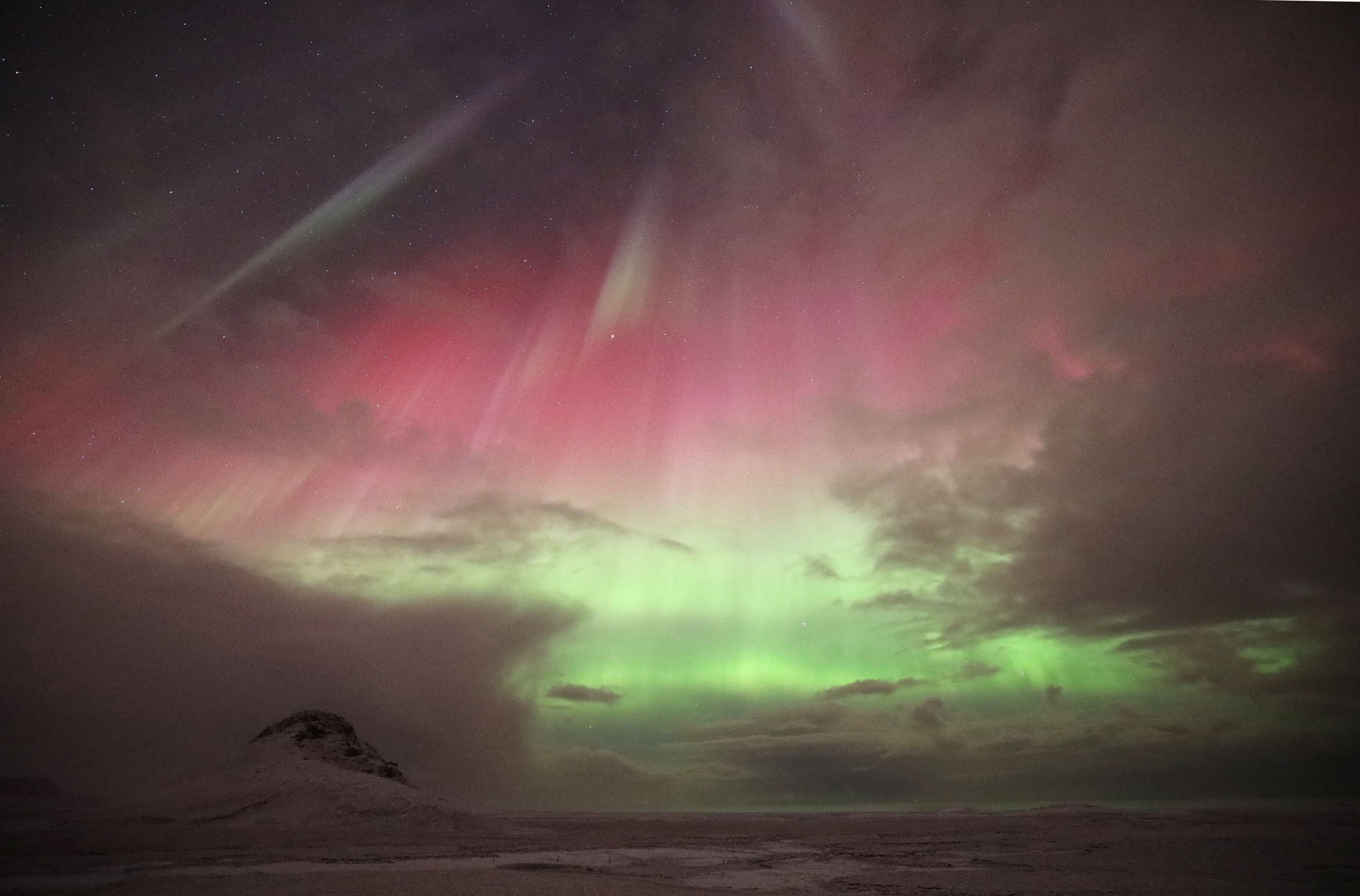
I drove out of the city in mid-March 2025 to a place that is relatively free of EMF pollution. There had been quite strong storms from the sun days before, so it was worth testing the new receiver. It was partly cloudy so that sometimes it was possible to see very power- and colorful Auroras in 3 to 4 colors. In between there was wind and hail which clearly also affected the reception conditions.
I made various attempts to record from the new receivers, which was difficult. The handheld devices that I used to use with the loop antenna receiver seemed to just send interference into the receiver. I tried ground isolation transformers, but that didn’t work. It wasn’t until I recorded with a MixPre6 and had the device far from the receivers that I was able to record solar storms without interference from the recording devices.
I am not satisfied with this recording. I am well aware that I am dependent on various details such as connection to the ground, size and type of antenna, height from the ground, location of the receiver and antenna as well as environmental and weather conditions and other things.
This recording only took into account that I did not hear interference from the recording device or other human objects during the recording. The receiver was not lying on the ground, but was on the top of a fence post.
I would like to mention that I have erased all transmitter signals above 18 Khz in this recording, so it should not bother anyone.
I could continue talking about the content of this recording, but I will stop here. You will definitely hear new recordings of solar storms on this blog in the coming months because it is not necessarily most interesting to record in late evening when Aurora is most active. It is very often just before dawn and the small details behind the clearly audible sparks, which is most interesting to listen to.
Here you can hear an older recording. Recorded from a Stephen P McGreevy receiver with a loop antenna.

(mp3 265mbps / 62Mb)

Recorder: MixPre6
Receiver: Explorer E202 ver. 1,4  with 75cm whip antenna
Pix: Canon E0S R

Location: 63.867430, -22.062817
Weather: Partly cloudy, hail, wind 2-4m/s, around -6°C

Read Full Post »

IMG_2200

Here is a recording that was left to run for a whole summer night, 29th of June, 2023.
The summer vacation was coming to an end, I had been suffering from a kind of flu for a month. I had no energy for long, difficult journeys, or lying outside in any weather to record and bird life that had been extremely silent all spring due to the cold and wet.
Field recording is by no means an easy and blissful job.
Although it is often possible to be filled with hopelessness and feel as if nothing has been recorded, it always becomes clear on closer listening that interesting material is often hidden somewhere in long recordings.
Here is one recording that I recorded at a farm that I have access to.
This night I decided to use the NT1 beneath a house wall to have a shalter against the wind. The choice of NT1 was made because if I had used an omni microphone there would have been an annoying reflection or echo from the house wall.
It is dawn and you should hear a lot of birdsong. But the wind drowns out all the birdsong.
But then the wind starts to calm down and you can hear more birdsong and bird actictivity, both near and far.
This recording is a bit of a mystery. It is therefore likely that I will later put another part of it on the web.
Quality open headphones are recommended while listening at low to mid volume.
If the media player doesn’t start to play, please reload this individual blog in a new tab or frame.

  (mp3 256kbps / 64Mb)

Recorder: Sound Devices MixPre6
Mics: Rode NT1 (NOS 30cm/90°)
Pix: Samsung S22

Weather: Windy up to 15m/sec, coudy, about 4°C
Location: 64.673300, -21.629835

Read Full Post »

IMG_2200

I made the big mistake of formatting an HD disk with photos I took throughout 2023 and into the winter of 2024, but in my absolute stupidity I didn’t have a backup. So I always run into problems if I’m going to post audio from this time period here on this blog.
But I also take photos on my SLR camera which has a fairly large card so I have consciously allowed photos to be on the card precisely to save such accidents and losing photos.
I don’t actually have a lot of good audio recordings from this summer. Both because the weather was boring most of the summer and I had the flu most of the summer vacation.
But there are a few recordings that I think are interesting from this summer. Especially the ones I took in Steingrímsfjörður and around Drangsnes in western Iceland.
I had a few pictures on my SLR SD card that saved me from being able to put these recordings on the web.
This is part 2. But part 1 was recorded at midnight, before the sunlight hit the recording location. Here in part 2 the sun has risen. Just a minute before the recording started I had to move the microphones to a slightly more sheltered spot, because over the night the wind started to increase which unfortunately can still be heard in the recording.
The recording is „unprocessed“. Recorded at +50dB gain, normalized up to -7dB by adding +20dB in post, fade in and out and then converted to mp3.
The recording starts exactly at 4:00 in the morning on June 22, 2023 and ends just over half an hour later. After a high tide earlier in the night, the tide was already starting to recede. The seaweed on the shore was still wet, which makes a soft clicking and dripping sound, which can be heard differently well with different headphones. The birds are slightly quieter than earlier this night, but the soundscape is still magnificent.
There was several gull species, at last great black backed gull. arctic tern, common eider, whimbrel, European golden plover, red throated loon, common loon, arctic puffin and eurasian oystercatcher.
There you can hear me getting in and out of the car to take pictures. Including the accompanying picture. At least one truck can be heard from across the fjord. It can also be heard in small fishing boats at the beginning and end of the recording.
It is clearly a new day rising.
Quality open headphones are recommended while listening at low to mid volume.
If the media player doesn’t start to play, please reload this individual blog in a new tab or frame.

(mp3 256kbps / 64Mb)

Recorder: Sound Devices MixPre6 24/48
Mics: Lewitt LCT540s (IRT quad 90°/30cm)
Pix: Canon Eos R

Weather: Calm to 3m/sec, cloudy, about 7°C
Location: 65.692816, -21.558576

Read Full Post »

IMG_2200

In recent years, I feel that Iceland has cooled down and the summers have also been colder and more rainy. This should not be surprising because the meteorologists who have predicted the consequences of „global warming“ have predicted this weather pattern due to changes in the Gulf Stream. Added to this are natural fluctuations that could explain why it has been colder the last two years than the years before. This is all an emotional assessment so it is best not to say anything further about this. But this cold weather has offered the possibility of recording under frozen lakes near the capital. Something that I have not been able to do since I acquired hydrophones, except by difficult trips to remote places up in the highlands. The only thing I have to strive for is to get suitable recording weather on the weekend so that I am less busy at work. The possibilities for getting good recordings therefore have a few hours a year.
The little experience I have with these recordings has told me that it is not enough to find icy water, drill a hole and record. I can get very different recordings by finding the right hydrophone location, such as depth and the gap between two hydrophones. Then the frost must be below -5°C and the frosty days must have lasted for more than 5 days. Whether there is a thick layer of snow on the surface or naked ice, windy or calm weather. Size and depth of the lake and the thickness of the ice.
For me, this is always a bit of an issue. I have always traveled alone and been very careful when traveling and avoided all risks. Traveling on ice of varying thickness where no one sees or knows about me is therefore unexciting.
It was like that when I arrived at Skorradalsvatn (lake) in the dark and -8°C frost on January 5, 2025. I just went a few meters out onto the ice and drilled two holes there. The ice turned out to be about 25cm thick and the depth under it was almost a metre. Even though it was calm, sounds from the ice could still be heard on the surface. Sounds that would have been much clearer in the wind earlier that day.
I had to start recording immediately if I was going to be able to record these sounds under the ice. If it gets calm for a few more hours the lake will get very quiet.
The sounds heard in the recording are heard just as well on the surface, except that they are heard much louder under the ice, plus all kinds of smaller details.
Since I was not far from land, the rumble of a car driving along a road about 100 metres away is also heard through the ground. Then you can hear the rumble of air traffic very well, which is probably because the ice on the lake acts like a membrane on a microphone. At the same time, I climbed out onto the ice to take pictures so that my footsteps could be clearly heard.
Quality open headphones are recommended while listening at low to mid volume. There are a lot of very powerful sounds in this recording that can easily damage your hearing and speakers. I therefore do not recommend high volume
If the media player doesn’t start to play, please reload this individual blog in a new tab or frame.
Some of the loudest pitch there seems to be have some distortion. I didn’t notice this until the recording was transfered to mp3. But this is not a problem on the original recording WAV 24bit/48Khz. Let’s just leave it like this

(256Kbps / 60Mb)

Recorder: Sound Devices MixPre6
Mics: Benthowave BII-7121
Pix: Canon EOS-R

Weather: Cludy, Calm, about -8°C
Location: 64.5137303,-21.4130149

Read Full Post »

Older Posts »