Feeds:
Færslur
Athugasemdir

Posts Tagged ‘Lóa’

IMG_2200

I made the big mistake of formatting an HD disk with photos I took throughout 2023 and into the winter of 2024, but in my absolute stupidity I didn’t have a backup. So I always run into problems if I’m going to post audio from this time period here on this blog.
But I also take photos on my SLR camera which has a fairly large card so I have consciously allowed photos to be on the card precisely to save such accidents and losing photos.
I don’t actually have a lot of good audio recordings from this summer. Both because the weather was boring most of the summer and I had the flu most of the summer vacation.
But there are a few recordings that I think are interesting from this summer. Especially the ones I took in Steingrímsfjörður and around Drangsnes in western Iceland.
I had a few pictures on my SLR SD card that saved me from being able to put these recordings on the web.
This is part 2. But part 1 was recorded at midnight, before the sunlight hit the recording location. Here in part 2 the sun has risen. Just a minute before the recording started I had to move the microphones to a slightly more sheltered spot, because over the night the wind started to increase which unfortunately can still be heard in the recording.
The recording is „unprocessed“. Recorded at +50dB gain, normalized up to -7dB by adding +20dB in post, fade in and out and then converted to mp3.
The recording starts exactly at 4:00 in the morning on June 22, 2023 and ends just over half an hour later. After a high tide earlier in the night, the tide was already starting to recede. The seaweed on the shore was still wet, which makes a soft clicking and dripping sound, which can be heard differently well with different headphones. The birds are slightly quieter than earlier this night, but the soundscape is still magnificent.
There was several gull species, at last great black backed gull. arctic tern, common eider, whimbrel, European golden plover, red throated loon, common loon, arctic puffin and eurasian oystercatcher.
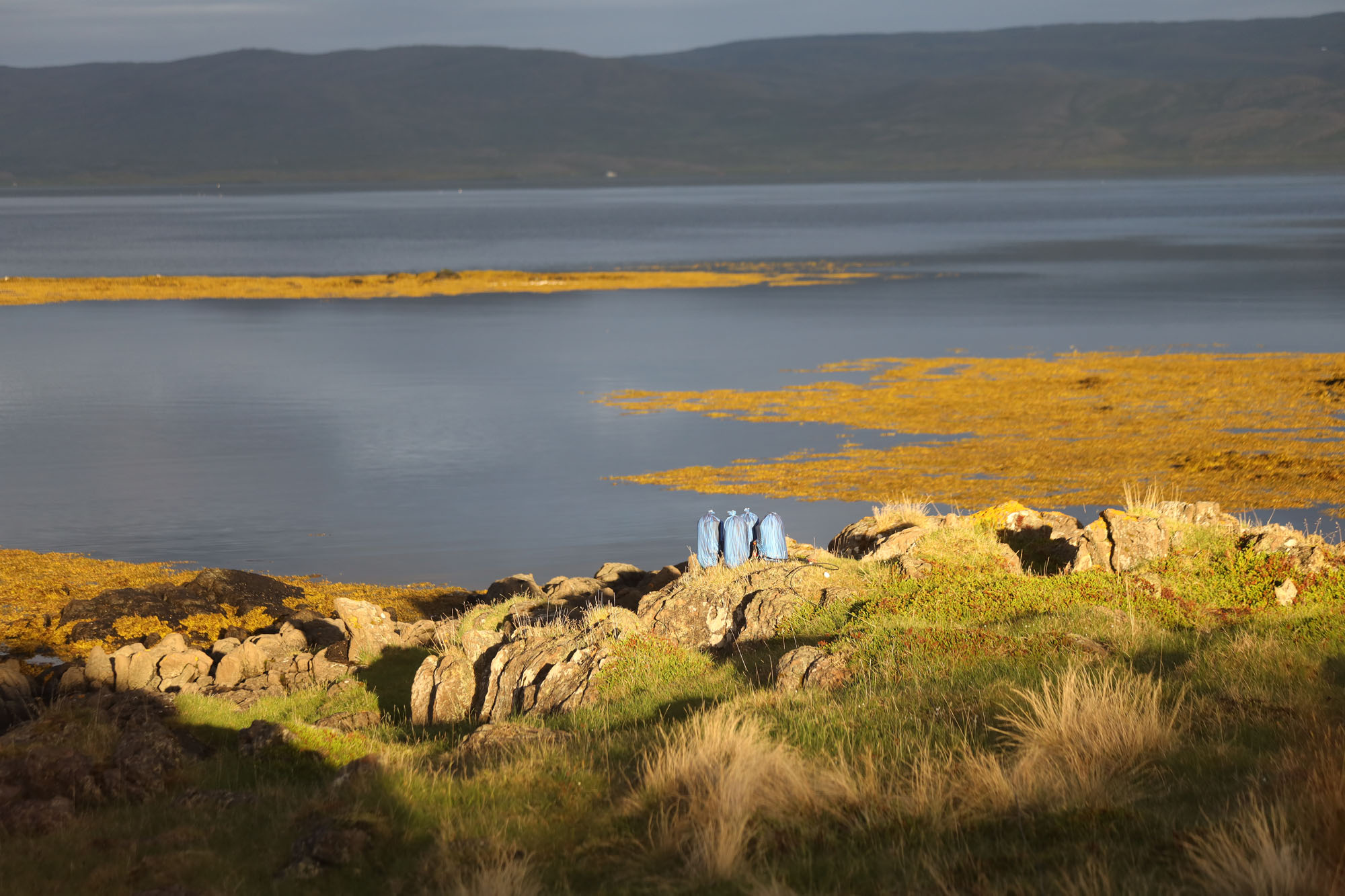
There you can hear me getting in and out of the car to take pictures. Including the accompanying picture. At least one truck can be heard from across the fjord. It can also be heard in small fishing boats at the beginning and end of the recording.
It is clearly a new day rising.
Quality open headphones are recommended while listening at low to mid volume.
If the media player doesn’t start to play, please reload this individual blog in a new tab or frame.

(mp3 256kbps / 64Mb)

Recorder: Sound Devices MixPre6 24/48
Mics: Lewitt LCT540s (IRT quad 90°/30cm)
Pix: Canon Eos R

Weather: Calm to 3m/sec, cloudy, about 7°C
Location: 65.692816, -21.558576

Read Full Post »

IMG_2200

Last summer 2023 I went to a place I haven’t recorded much. Was it at Strandir in northwest Iceland. A friend invited me to stay in an apartment for a few days in Drangsnes, so I tried to use the time as well as I could for field recordings in the area.
It actually didn’t go very well. I had come down with a bad flu the same week as summer vacation started so I had little to no energy for many weeks. I was also facing another problem. The whole time I was in the area there was a strong wind except for maybe 1-2 hours during some nights. It was also rather cold, so nature was rather silent. Much of the material I caught these days was therefore not particularly interesting.
However, I had the opportunity one calm night to record a nice peace at the coastline. Part of it is here below. It’s very likely that I will put more of this recording on the web later, because the soundscape changed a bit during the 3-4 hours I was recording.
It is the summer solstice so it is therefore bright all day long. The recording starts at 23:45 and ends at 00:20 o´clock.
This is a typical soundscape in fjords in northern Iceland and in fact everywhere around the arctic circles.
This is a high gain recording.  Recorded at +50 db. Then add about 20dB up to -7dB peak RMS. No noise reduction in post. Just fade in and out.
Many bird species are in this recording. There was several gull species, at last great black backed gull. Arctic tern, common eider, whimbrel, European golden plover, red throated loon, Common loon, arctic puffin and Eurasian oystercatcher. Sheep were not far away and seals were lying on rocks near the beach.
Quality open headphones are recommended while listening at low to mid volume.
If the media player doesn’t start to play, please reload this individual blog in a new tab or frame.

(mp3 256kpps / 63Mb)

Recorder: Sound devices MixPre6
Mics: Lewitt LCT540s (IRT cross – 30cm/90°)
Pix: Samsung S22

Weather: Calm, cloudy, about 7°C
Location: 65.692865, -21.558621

Read Full Post »

IMG_2200

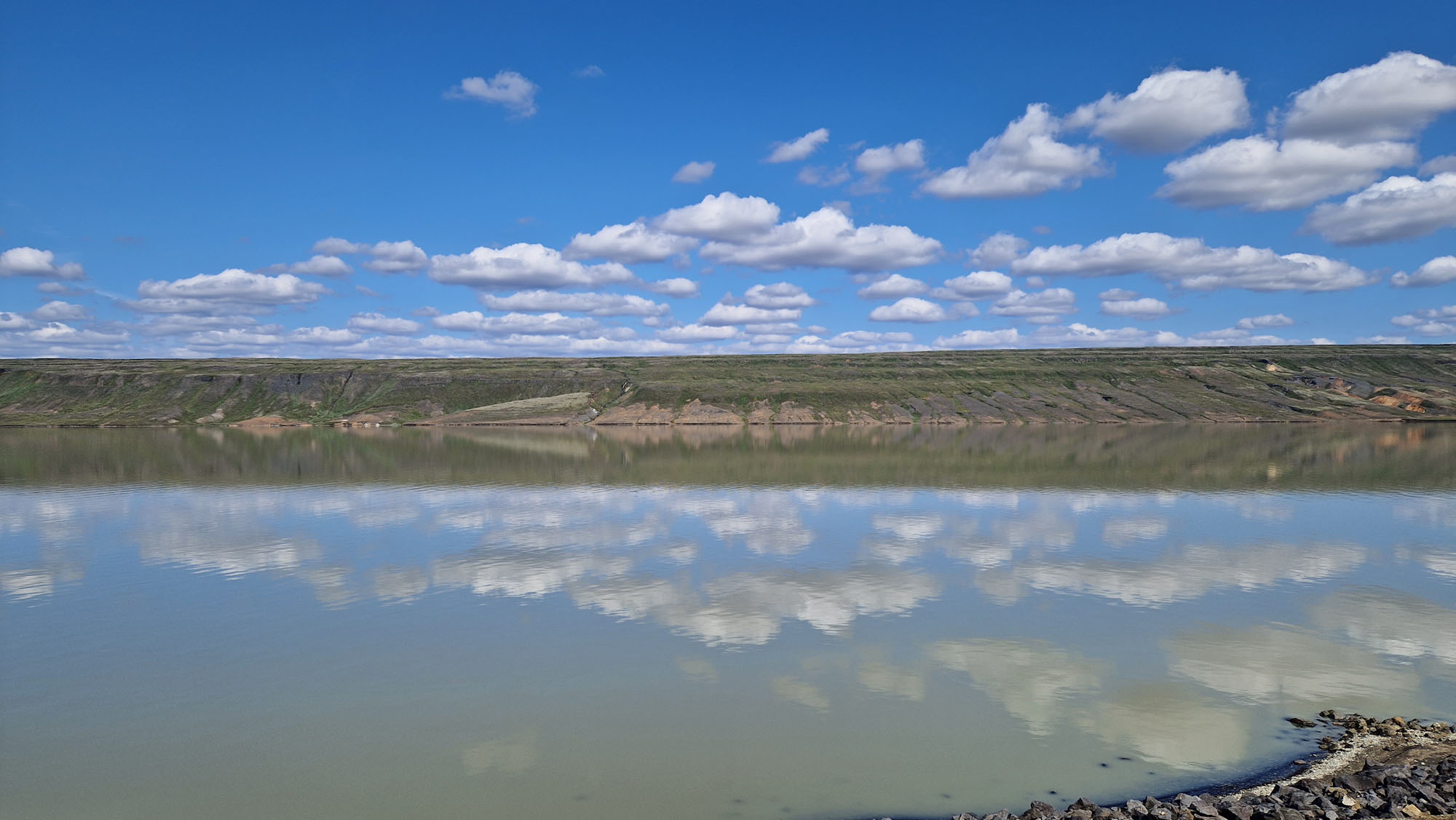
Early in July 2023 I spent one night at Sultártangalón lagoon recording in three locations.
In the morning when I was leaving, it was sunny, calm and very hot, in the Icelandic way. The sight over the mirror smooth lagoon made me stop the car and enjoy the view. The recorders were ready and connected in the car, so I quickly set them up by the reservoir and took a short walk while they were recording.
The result was this. Typical Icelandic highland silence. Nothing interesting as an audio recording, but what caught my attention was the background noise of waterfalls and streams across the lagoon. This noise changed the EQ slowly in a variable thermal upstream due to the influence of the sun radiation.
Several bird species can be heard in this recording. These include Raven, Golden Plover, Dunlin, White Wagtail, Meadow Pipit and Red Throated Loon.
This was recorded with MKH8020/8040 in a fur wind shield, which was not the best choice, because the silence was considerable. Audio was recorded on MP6 with 50dB gain and in post-processing the gain was increased by another 20dB so they reached -10dBu.The MKH microphones were therefore not the most suitable for this moment. It would have been better if I had recorded with the LCT540s in IRT, to better capture all the small details all around.
To cancel out the loss of certain frequencies due to the fur wind shield, I raised the mid frequency by +2dB.
This is a rather sensitive recording. So I wasn’t using RX de-noise. But instead since nothing in the recording reaches frequencies higher than 8Khz, I lowered the EQ above 10Khz by a few dB to reduce the self noise in the microphones.
Quality open headphones are recommended while listening at low to mid volume.
If the media player doesn’t start to play, please reload this individual blog in a new tab or frame.

  (mp3 256kbps/56Mb)

Recorder: Sound Devices MixPre 6
Mics: Sennheiser MKH8020/8040 (Baffled AB)
Pix: Samsung S22

Location: 64.230420, -19.383488
Weather: Sunny, clear sky, calm, around 20°C

Read Full Post »

IMG_2200

Hólmavatn is a heath lake in the interior in west of Iceland between the two valley Kjarrárdalur and Hvítársíða. It is a part of a big lake system on a heath named Arnarvatnsheiði.
I have once before record the soundscape by this lake before. That was mostly a struggle with wind all the time, so I did not get anything interesting.
But at 22nd of June 2019 the weather forecast was perfect for this area, clear sky and calm most of the night.
I arrived with my gear around 9 pm at my previous recording place. It was still windy and some anglers about 500m away east of the lake. I quickly put up my rigs knowing that a calm weather meant just lot of gnats. I decided to put a two stereo pairs close to the shore, facing out to the lake. LCT450s in NOS about 60 m east from my car and MKH20 pair 70 m in the west. Suddenly around 11pm the wind stopped to blow and I started the recording.
What glorious soundscape. All those small tiny things and all those bird species. The LCT540s sounds much cleaner and brighter than MKH20, I guess mainly because of the different location.
But there was a big problem which I did not notice with my bare ears. The anglers made so much noise it was clear they would destroy my „natural silence“ recordings this night. They were playing a radio all the time, talking, starting car engines, and even worse, soon after I started the recording two of them started a motor boat. All this noise lasted for about two or two and a half hours.
Later that night when this noisy anglers were gone, all the birdsong became calm and less active. I am not sure why, but afterwards when I listened to the recordings it seemed like the anglers on the boat were disturbing birds on their habitat.
Following recording is a part of this „anglers moment“, probably the best part because the motorboat was mostly far east on the lake most of this time.
In the beginning of the recording you can clearly hear tiny sparks. It is coming from foam which forms between stones in the shore during windy days. When the bobbles in this foam blows, they make this tiny sparking sound. During the recording the sparks get fewer and lower because the weather is calm and no waves on the lake.
But there are so many bird species I guess I will not know them all. Great Northern Diver, Read Throated Diever, Arctic Tern, Whooper Swan, Pink Footed Goose, Black Headed Gull, Golden Plower, Dunlin, Whimbrell, Common Snipe, Common Redshank, Arctic Skua, Rock Ptarmigan and probably some other which you are welcome, if you know, to name in comments below.
You will hear the fish jumping and Arctic Tern hunting on the lake surface. Other background noise other than human noise from anglers is mainly from the river Kjarrá which flows in the Kjarrárdalur valley 4Km north of the lake .
This recording got a gently noise reduction, mainly because of high gain.
It was recorded with 47dB gain. In post the gain was normalized +26dB up to -5dB
Quality open headphones are recommended while listening at low to mid level, or in speakers at medium level.

(mp3 256kbps / 68Mb)
If the media player doesn’t start to play, please reload this individual blog in new tab or frame

Recorder: Sonosax SX-R4+
Mics: Lewitt LCT540s (NOS setup)
Pix: Canon EOS M50
Location: 64.799603, -20.895132
Weather: Dry. Mostly calm up to 5m/sec

Read Full Post »

IMG_2200

This two midsummer recordings were made around four o´clock in the morning 15th of July 2017 nearby Arnarholt farm in Stafholtstungur, in west of Iceland. It is recorded on two stereo channels with two different microphones because usually every time I recorded in this place the recordings has been disturbed by traffic noise all night long. But somehow for some unexplained reason no car went around nearby road for more than two hours, so I got a wonderful recording this morning.
I placed those two microphone rigs very close to each other and pointed them toward north. Afterwards I could not decided which of those recordings were better so it is yours to decide which you like.
There are many bird species in this recording. Common Snipe, Golden Plover, Whimbrel, Common Redshank, Black Taled Godwit, White Wagtail, Black headed Gull, Winter Wren, Northern Wheatear, Snow Bunting, Rock Ptarmigan, Common Starling, Redwing, Great Northern Dever, Whooper Swan, Graylag Goose and probably other species. Birds like Starling and Redwing are flying between branches in nearby trees.

My favorite microphones for nature recordings are Sennheiser MKH20 an omni-directional condenser microphone and Rode NT1A (slightly modified), a large capsule cardioid polar pattern studio condenser microphone. Both these mics have lowest self-noise available on the market.
I am used to use MKH20 in AB setup which mean the mics are in 40-45cm spaced parallel position (AB40). Then I turn the capsules 2-5° outward which gave me sometimes slightly „wider or more open space feeling“. This setup give me a stereo recording, 360° surround the rig.
My second best omni-directional ultra low noise mic for nature recordings is AT4022 but it does not sound as „musical“ or „natural“ as MKH20, so it is not as often in my tool box,
Cardioid mic detect sound mainly from one direction. so I use NT1A in different circumstances.
Lets say I like to record a birdsong. At the same time it is disturbed with unwanted noise, coming from another direction like waterfall, river flow, surf or traffic noise. I can place the backside of the cardioid mic to the noise source which mean I will get less of the unwanted noise and more of the birdsong.
In last two or three years I have not used NT1A in ORTF or NOS setup for outdoor recordings. But instead use AB4, same as for MKH20, which seems to give less phase error for the sound behind the rig.

These two recordings are NOT good examples for this two different mics in critical circumstances because no car passed by behind the rigs and most of the birds activity was also front of the rigs. But it gives a nice insight how this two different mics sounds and how the self-noise act in „quiet“ nature recordings.
NT1A was inside Rycote Cyclone + fur. MKH20 was inside Rycote WS2 windshield + fur. Both rigs are in AB40 +3°
I use MixPre6 in this recording. There is no doubt, the new Sound devices Kashmir mic preamplifier is ultra low noise and a sweet step forward to get better field recordings.
The HPF was at 40Hz and the gain was at 50dB for NT1A and 43dB for MKH20. The gain settings mainly get this arrangement because then both rigs sounds have equal level in the headphones while I was recording. In post the gain was increased almost 30dB on both stereo channels, up to -10dB.
Specrogram shows „all“ frequencies was bellow 8Khz so to lower unwanted mic self-noise I pull everything above 10Khz down with EQ (-5db @ 11Khz & -30dB @ 15Khz) .
This is a „quiet“ recording which mean you should listen to it at low level in quality headphones or speakers in quiet place.

NT1A recording
(mp3, 256kbps / 50,6Mb)

MKH20 recording
(mp3, 256kbps / 50,6Mb)

Here are two shorter version of this recording but now without high frequency cutoff and the gain level is normalized up to 0dB, so it should be easy to hear the mic self-noise in low quality headphones and PC amplifiers.
It is also easy to notice that MKH20 is covering 360° of the surround soundscape, while NT1A is only covering 180° with less bird songs and other activity.

NT1A. Without high freq cut off, normalized to 0dB
(mp3, 256kbps / 11Mb)

MKH20 Without high freq cut off, normalized to 0dB
(mp3, 256kbps / 11Mb)

Recorder: Sound devices MixPre6
Mics: Rode NT1a and Sennheiser MKH20 (AB40 setup)
Pix. Canon EOSM

Location: 64.673460, -21.629304
Weather: Calm, cloudy, ca. 7°C

Read Full Post »

IMG_5637

During Icelandic independence day, 17. of June 2012, I was in Önundarfjörður fjord in the Westfjords, the north west peninsula of Iceland. This fjord lies deep between steep mountains with high cliffs. After midnight I entered an Arctic tern colony to record their sounds. The recording conditions was as good as it gets. The weather was calm, dry but cloudy, and the temperature was about 7 °C. Almost no traffic was in the fjord so most of the background noise was only coming from falling water in the mountains and sea waves at the shore.
This Arctic tern colony is big and has been there for decades, even centuries. This bird is very territorial and aggressive protecting the colony and many other bird more passive species feel safe to nest among the Arctic tern. So this recording includes sounds from many other bird spaces such as Whimbrel, Black-headed Gull, Black-tailed Godwit, Common Redshank, Oystercatcher, and Golden Plover… and many more
The recording contains also human and sheep voices from a nearby farm. Swans, Red-throat Diver, and common Eider at the shore side and a some sound from a Gull colony high in the cliffs all around the fjord.
During the recording the Arctic Terns attack many times the furry microphones. Sometimes you may hear their excrement fall to the ground around the microphones, but at this time they never hit or peck the Blimps.
The duration of the recording was almost 80 minutes. Following recording contains the last 36 minutes so my disturbing visit is not much audible. This is just a nice ordinary summer night in the north west of Iceland.

Krían í Önundarfirði 17. júní 2012.

Upptaka þessi var gerð í kríuvarpi nærri Holtstanga innst í Önundarfirði.
Veður var stillt, þurrt en skýjað og hiti um 7°C. Það var því varla hægt að kjósa sér ákjósanlegra veður til upptöku á fuglalífi. Allt iðaði af lífi. Fyrir utan kríu mátti sjá og heyra í hettumáfum, spóa, lóu, stelk, tjaldi og fleiri fuglum, Efst í fjöllunum mátti sjá allt fullt af fuglum á sveimi björgunum. Í flæðamálinu voru álftir, lóm og æðarfugl.

Download mp3 file (192kbps / 50,7Mb)

Recorder: Sound devices 744t
Mics: Rode NT1a
Pics: Canon D30

Read Full Post »