Feeds:
Færslur
Athugasemdir

Posts Tagged ‘Lundi’

IMG_2200

I have tried to visit bird cliffs every year to make sound recordings. However, I have had very little success, largely due to the wind. In fact, it has gone so poorly that I have only posted one or two recordings on this audio blog over the last 15 years.
It was while working on a small audiobook project for a young Polish girl that I began digging through my recordings from bird cliffs. I came across a short segment that is suitable for sharing online, not least because I have never before posted a recording from that particular cliff.
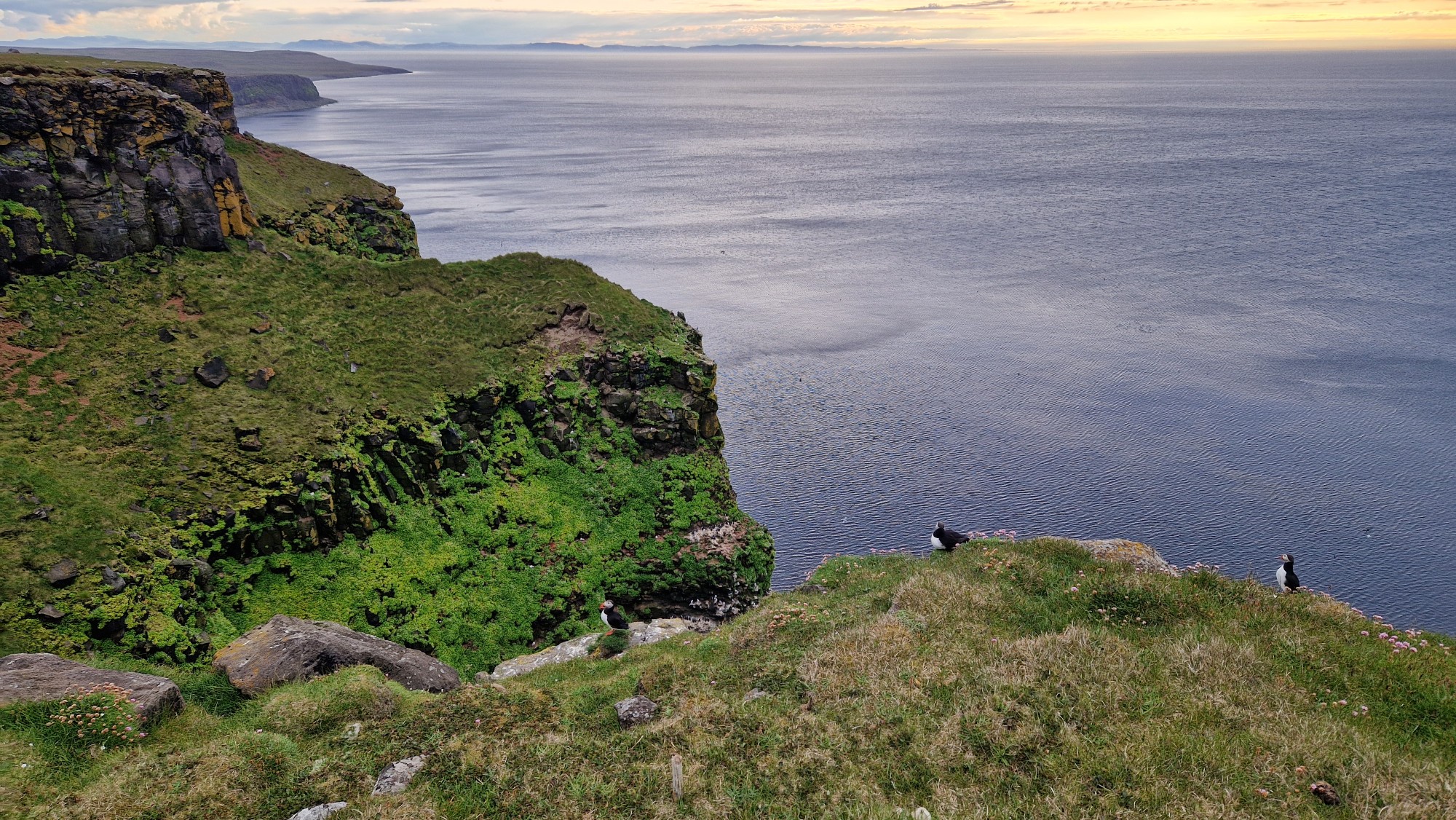
This one is from the westernmost part of Skoruvíkurbjarg on the Langanes peninsula.
The cliff is home to Atlantic puffins, common guillemots, razorbills, black guillemots, northern fulmars, and black-legged kittiwakes.
Further east, below Skoruvíkurbjarg, stands an isolated sea stack called Stórikarl (Big Men), which hosts a colony of northern gannets. I have yet to manage a decent recording there—despite many attempts due to the weather conditions at the cliff.
The methods I use to record at these cliffs may not be the best, but they are likely the safest, given that I am usually working alone. I have tried using a parabolic microphone, but it is not suitable for windy conditions. I therefore mounted a stereo microphone on a boom pole and extended it out over the edge of the cliff.
In the accompanying recording, you can clearly hear gusts of wind striking the microphone from time to time, even though all frequencies below 95 Hz have been filtered out.
However, the wind does more than just batter the windscreens; it distorts sound waves, resulting in a rather muddled sound in the recording.
The best way to capture high-quality recordings would be to descend further down the cliff to a sheltered spot during a period of calm weather.
Furthermore, different areas in the cliff can yield varying acoustic results, and most bird species tend to congregate in specific zones where they are the dominant species. Recording bird cliffs is, in fact, a massive undertaking, especially given the significant shifts in avian ecosystems in the North Atlantic, driven by changes in the Gulf Stream and climate patterns over the last few decades.

  (mp3 256kbps / 24,4Mb)

Recorder: Sound devices MixPre6
Mics: Primo EM172 Baffled stereo rig
Pix: Samsung S22

Location: 66.382990, -14.864643
Weather: Partly cloudy, 2–8 m/s, 13°C
Read Full Post »

IMG_2200

I made the big mistake of formatting an HD disk with photos I took throughout 2023 and into the winter of 2024, but in my absolute stupidity I didn’t have a backup. So I always run into problems if I’m going to post audio from this time period here on this blog.
But I also take photos on my SLR camera which has a fairly large card so I have consciously allowed photos to be on the card precisely to save such accidents and losing photos.
I don’t actually have a lot of good audio recordings from this summer. Both because the weather was boring most of the summer and I had the flu most of the summer vacation.
But there are a few recordings that I think are interesting from this summer. Especially the ones I took in Steingrímsfjörður and around Drangsnes in western Iceland.
I had a few pictures on my SLR SD card that saved me from being able to put these recordings on the web.
This is part 2. But part 1 was recorded at midnight, before the sunlight hit the recording location. Here in part 2 the sun has risen. Just a minute before the recording started I had to move the microphones to a slightly more sheltered spot, because over the night the wind started to increase which unfortunately can still be heard in the recording.
The recording is „unprocessed“. Recorded at +50dB gain, normalized up to -7dB by adding +20dB in post, fade in and out and then converted to mp3.
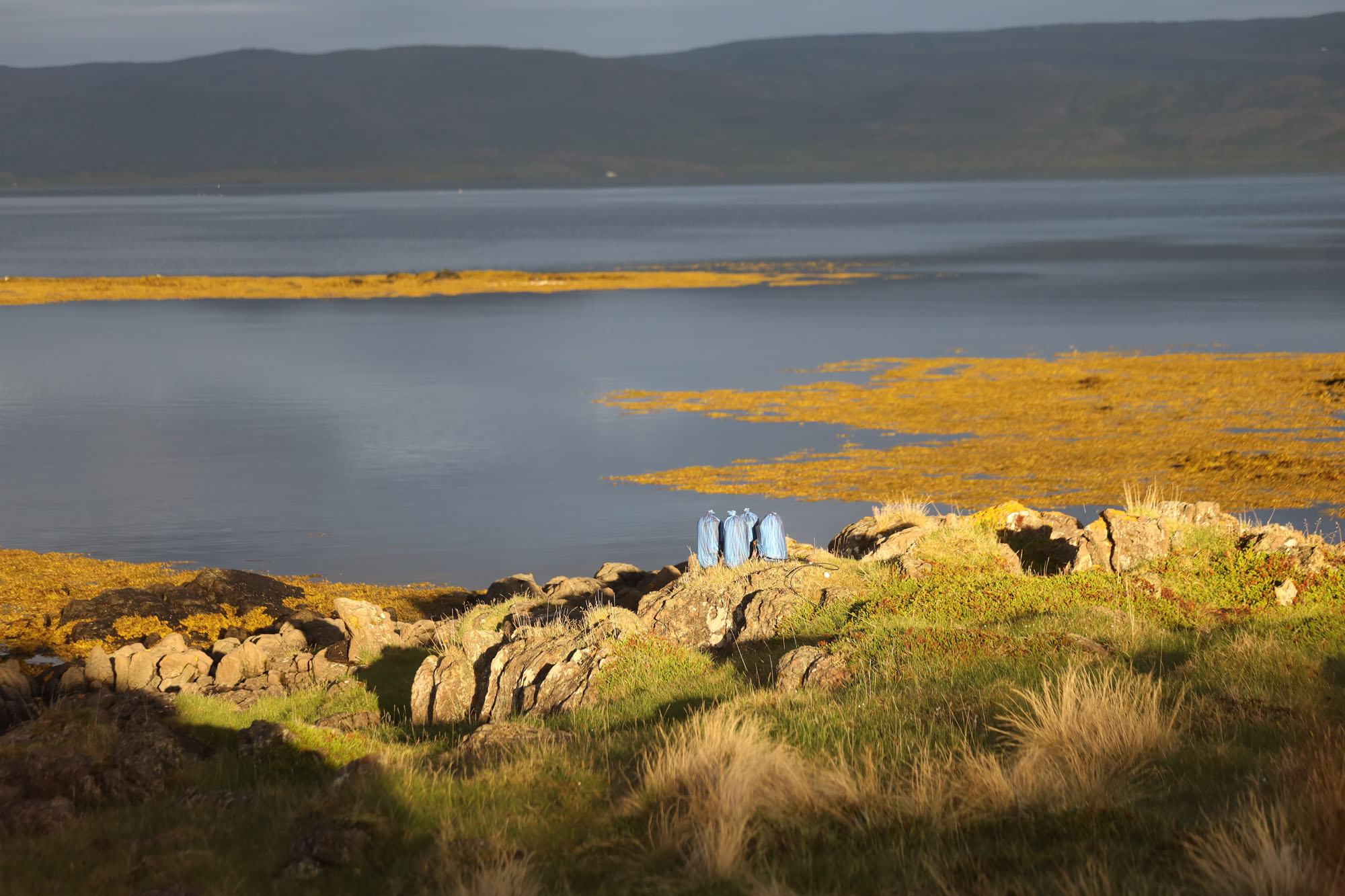
The recording starts exactly at 4:00 in the morning on June 22, 2023 and ends just over half an hour later. After a high tide earlier in the night, the tide was already starting to recede. The seaweed on the shore was still wet, which makes a soft clicking and dripping sound, which can be heard differently well with different headphones. The birds are slightly quieter than earlier this night, but the soundscape is still magnificent.
There was several gull species, at last great black backed gull. arctic tern, common eider, whimbrel, European golden plover, red throated loon, common loon, arctic puffin and eurasian oystercatcher.
There you can hear me getting in and out of the car to take pictures. Including the accompanying picture. At least one truck can be heard from across the fjord. It can also be heard in small fishing boats at the beginning and end of the recording.
It is clearly a new day rising.
Quality open headphones are recommended while listening at low to mid volume.
If the media player doesn’t start to play, please reload this individual blog in a new tab or frame.

(mp3 256kbps / 64Mb)

Recorder: Sound Devices MixPre6 24/48
Mics: Lewitt LCT540s (IRT quad 90°/30cm)
Pix: Canon Eos R

Weather: Calm to 3m/sec, cloudy, about 7°C
Location: 65.692816, -21.558576

Read Full Post »

IMG_2200

Last summer 2023 I went to a place I haven’t recorded much. Was it at Strandir in northwest Iceland. A friend invited me to stay in an apartment for a few days in Drangsnes, so I tried to use the time as well as I could for field recordings in the area.
It actually didn’t go very well. I had come down with a bad flu the same week as summer vacation started so I had little to no energy for many weeks. I was also facing another problem. The whole time I was in the area there was a strong wind except for maybe 1-2 hours during some nights. It was also rather cold, so nature was rather silent. Much of the material I caught these days was therefore not particularly interesting.
However, I had the opportunity one calm night to record a nice peace at the coastline. Part of it is here below. It’s very likely that I will put more of this recording on the web later, because the soundscape changed a bit during the 3-4 hours I was recording.
It is the summer solstice so it is therefore bright all day long. The recording starts at 23:45 and ends at 00:20 o´clock.
This is a typical soundscape in fjords in northern Iceland and in fact everywhere around the arctic circles.
This is a high gain recording.  Recorded at +50 db. Then add about 20dB up to -7dB peak RMS. No noise reduction in post. Just fade in and out.
Many bird species are in this recording. There was several gull species, at last great black backed gull. Arctic tern, common eider, whimbrel, European golden plover, red throated loon, Common loon, arctic puffin and Eurasian oystercatcher. Sheep were not far away and seals were lying on rocks near the beach.
Quality open headphones are recommended while listening at low to mid volume.
If the media player doesn’t start to play, please reload this individual blog in a new tab or frame.

(mp3 256kpps / 63Mb)

Recorder: Sound devices MixPre6
Mics: Lewitt LCT540s (IRT cross – 30cm/90°)
Pix: Samsung S22

Weather: Calm, cloudy, about 7°C
Location: 65.692865, -21.558621

Read Full Post »

IMG_2200

Remote islands are interesting places. Almost every island has it’s own ecosystem which can be interesting to record. One of those islands is Elliðaey, which is a part of Vestmannaeyjar islands, south of Iceland.
I got an opportunity to go there on a 24 hours trip with Bob McGuire, which is recording birds in association with the Cornell Lab of Ornithology, Macaulay Library of Natural Sounds.
I am not a specialist in the ecosystem in Elliðaey so I will not say much about it here. It is slightly different between each island in the region and the bird species can be different from cliff to cliff
Our main target in Elliðaey was European storm petrel and Leach’s storm petrel. Bob was collecting individual calls and songs but I was going to record hours of ambiances. The bird colony gives a strong smell as usual, but this island also has a strong smell of sheep. For decades there have been several landowners and farmers from Heimaey island who keep there several dozens of sheep during the summertime.
Puffins have been in a very difficult situation for many years, especially south Iceland and Vestmannaeyjar islands. Mainly because some annually rhythm changes in the ocean biosphere. That situation was visible in Elliðaey. Probably more than 50% of the Puffins burrows were empty and abandoned and dead chicks were also visible around.
Not all birds have difficulties and many other bird species also live and breed in the island; Atlantic Puffin, Manx Shearwater, Leach’s Storm-petrel, European (British) Storm-petrel, Great Black-backed Gull, Lesser Black-backed Gull, Herring Gull, Black-legged Kittiwake, Northern Fulmar, Common Eider, Common Murre, Black Guillemot, Common Raven, European Starling, White Wagtail
As soon as we arrived I quickly found locations for the recorders and then we walked around in the bumpy landscape for other locations. We were early in the breeding season, 4th of June, so we were even not sure if birds we were going to record, like European storm petrel, had already arrived. What surprised me most was the silence in the interior island. No sound from the ocean waves or cliff birds, only wing flaps from busy birds above our heads, mostly puffins. But there was also a low rumbling noise, which filled the air and was difficult to locate. It took me time to figure out what it was, but it was from ships somewhere far away on the ocean, so far I could not even see them in the horizon. This noise never stopped when I was awake. It was just differently loud during day and the night, and of course louder when ship passed close to the island.
The following recording was made just before midnight on a hill south of the hut in the island, located almost in the middle of a puffin colony.
It is mostly puffins wing flaps, when they fly over, landed close by the microphones and sometimes a „spray & splash sound“ when they poop
Later that night both Leach’s Storm-petrel, European Storm-petrel surprisingly arrived to the island. But that will be for another blog.
Quality open headphones are recommended while listening at low to mid level, or in speakers at medium level.

(mp3 256kbps / 60.3Mb)
If the media player doesn’t start to play, please reload this individual blog in new tab or frame

Recorder: Sound devices MixPre6
Mics: Sennheiser paralell MKH8020/8040 in AB40 (4ch)
Pix. LG G6
Location: 63.466604, -20.176682
Weather: Calm, misty & light shower, ca 12°C

Read Full Post »