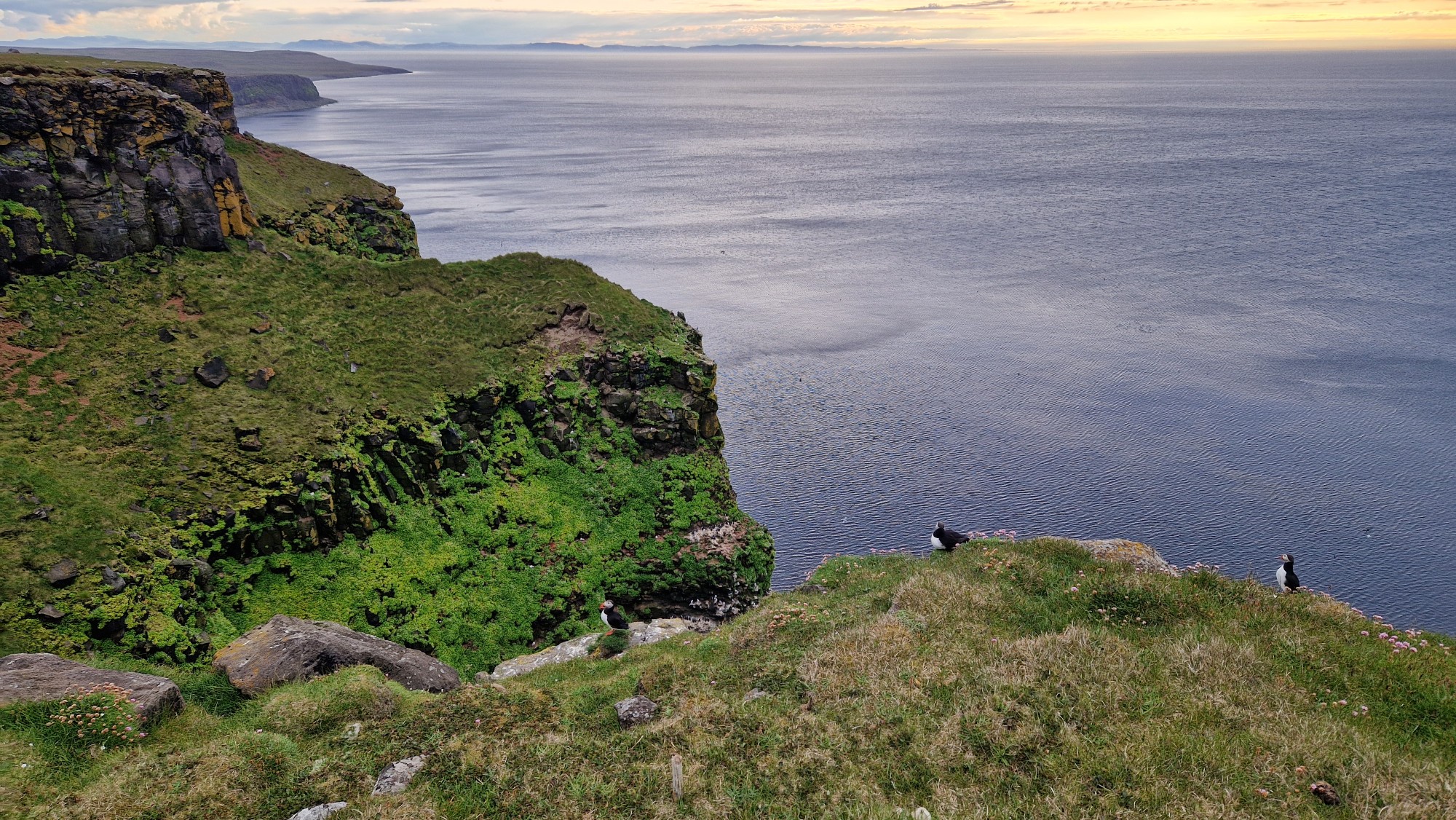
I have tried to visit bird cliffs every year to make sound recordings. However, I have had very little success, largely due to the wind. In fact, it has gone so poorly that I have only posted one or two recordings on this audio blog over the last 15 years.
It was while working on a small audiobook project for a young Polish girl that I began digging through my recordings from bird cliffs. I came across a short segment that is suitable for sharing online, not least because I have never before posted a recording from that particular cliff.
This one is from the westernmost part of Skoruvíkurbjarg on the Langanes peninsula.
The cliff is home to Atlantic puffins, common guillemots, razorbills, black guillemots, northern fulmars, and black-legged kittiwakes.
Further east, below Skoruvíkurbjarg, stands an isolated sea stack called Stórikarl (Big Men), which hosts a colony of northern gannets. I have yet to manage a decent recording there—despite many attempts due to the weather conditions at the cliff.
The methods I use to record at these cliffs may not be the best, but they are likely the safest, given that I am usually working alone. I have tried using a parabolic microphone, but it is not suitable for windy conditions. I therefore mounted a stereo microphone on a boom pole and extended it out over the edge of the cliff.
In the accompanying recording, you can clearly hear gusts of wind striking the microphone from time to time, even though all frequencies below 95 Hz have been filtered out.
However, the wind does more than just batter the windscreens; it distorts sound waves, resulting in a rather muddled sound in the recording.
The best way to capture high-quality recordings would be to descend further down the cliff to a sheltered spot during a period of calm weather.
Furthermore, different areas in the cliff can yield varying acoustic results, and most bird species tend to congregate in specific zones where they are the dominant species. Recording bird cliffs is, in fact, a massive undertaking, especially given the significant shifts in avian ecosystems in the North Atlantic, driven by changes in the Gulf Stream and climate patterns over the last few decades.
(mp3 256kbps / 24,4Mb)
Recorder: Sound devices MixPre6
Mics: Primo EM172 Baffled stereo rig
Pix: Samsung S22
Location: 66.382990, -14.864643
Weather: Partly cloudy, 2–8 m/s, 13°C


Skildu eftir svar - Enter your comment