Feeds:
Færslur
Athugasemdir

Posts Tagged ‘Fýll’

IMG_2200

I have tried to visit bird cliffs every year to make sound recordings. However, I have had very little success, largely due to the wind. In fact, it has gone so poorly that I have only posted one or two recordings on this audio blog over the last 15 years.
It was while working on a small audiobook project for a young Polish girl that I began digging through my recordings from bird cliffs. I came across a short segment that is suitable for sharing online, not least because I have never before posted a recording from that particular cliff.
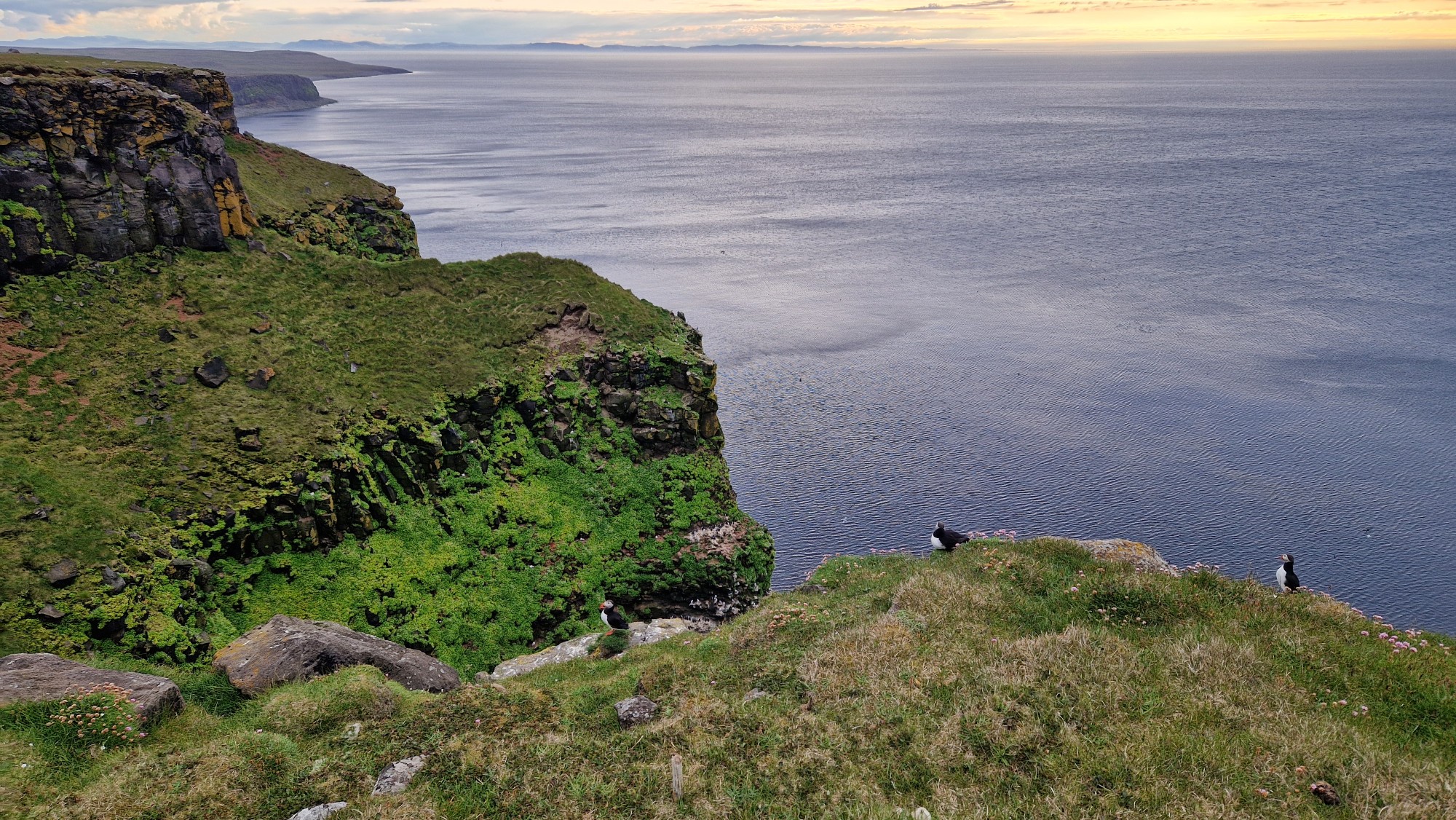
This one is from the westernmost part of Skoruvíkurbjarg on the Langanes peninsula.
The cliff is home to Atlantic puffins, common guillemots, razorbills, black guillemots, northern fulmars, and black-legged kittiwakes.
Further east, below Skoruvíkurbjarg, stands an isolated sea stack called Stórikarl (Big Men), which hosts a colony of northern gannets. I have yet to manage a decent recording there—despite many attempts due to the weather conditions at the cliff.
The methods I use to record at these cliffs may not be the best, but they are likely the safest, given that I am usually working alone. I have tried using a parabolic microphone, but it is not suitable for windy conditions. I therefore mounted a stereo microphone on a boom pole and extended it out over the edge of the cliff.
In the accompanying recording, you can clearly hear gusts of wind striking the microphone from time to time, even though all frequencies below 95 Hz have been filtered out.
However, the wind does more than just batter the windscreens; it distorts sound waves, resulting in a rather muddled sound in the recording.
The best way to capture high-quality recordings would be to descend further down the cliff to a sheltered spot during a period of calm weather.
Furthermore, different areas in the cliff can yield varying acoustic results, and most bird species tend to congregate in specific zones where they are the dominant species. Recording bird cliffs is, in fact, a massive undertaking, especially given the significant shifts in avian ecosystems in the North Atlantic, driven by changes in the Gulf Stream and climate patterns over the last few decades.

  (mp3 256kbps / 24,4Mb)

Recorder: Sound devices MixPre6
Mics: Primo EM172 Baffled stereo rig
Pix: Samsung S22

Location: 66.382990, -14.864643
Weather: Partly cloudy, 2–8 m/s, 13°C

Read Full Post »

IMG_2200

It was a BBC article „’Worrying alarm call’ for world’s birds on brink of extinction“ which reminded me about several recordings I have made of seabirds in cliffs. This recordings are not many or interesting, but who knows how this cliffs will sound in the future when the climate change has changed or destroied the livelihood for many bird species.
So what ever about the quality of this recording is, it can be valuable in the future. Just imagine if we had been given the opportunity to record the Great Auk before it became extinct in the mid- 19th century. It would have been wonderful.
We are loosing some animal species almost every month on the planet. So it is very important to record as much as we can of the biosphere now and in the future…even though it is as likely the recordings will disappeared after several years for just „technical reason“.
„Krýsuvíkurbjarg is a wave-cut cliff that rises from the sea in the lava of Krýsuvíkurhraun.
There are many bird nests found there, approximately 60,000 pairs consisting of 9 kinds of sea birds. The black-legged kittiwak (Rissa tridactyla) is the most common one, a common migrant found in many places in Iceland. It’s population in Iceland is estimated to be about 630.000 birds, what is an interesting fact since the population of people is only 330,000 in the country! The estimated number of kittiwaks in Krísuvíkubjarg is about 21,000 birds.
Common murre (Uria aalge) is a large auk also found in Krýsuvíkurbjarg. They make no nest, their single egg is incubated on a bare rock ledge on a cliff face. Their breeding can be very tight up to 70 birds on each square meter. Interestingly, the young are considered ready to leave their nest only three weeks old, but the male bird teaches the young how to hunt in the beginning. The estimated number of the Common murre in Krýsuvíkubjarg is about 20.000 birds
There are other kinds found on the cliff, but with smaller amounts of birds.The razorbill (Alca torda), The thick-billed murre (Uria lomvia). The northern fulmar (Fulmarus glacialis). The Atlantic puffin (Fratercula arctica) can be found there, but is not as common as it is in Vestmannaeyjar. The European shag (Phalacrocorax aristotelis). The European herring gull (Larus argentatus) is there and the black guillemot or tystie (Cepphus grylle). Above the cliff edge other kinds can be found like the purple sandpiper (Calidris maritima) and The snow bunting (Plectrophenax nivalis).“ (discover.is)
This recording was made 11th of July 2016.
Quality open headphones are recommended while listening at low to mid level, or in speakers at low level.

(mp3 256kbps/39Mb)

Recorder: Sound devices 744
Mics: DPA4060 in „binaural“ setup
Pix: Canon EOS-M
Location: 63.832656, -22.091189
Weather: Cloudy, NW 3-5m/sec, 13°C

Read Full Post »