Feeds:
Færslur
Athugasemdir

Posts Tagged ‘AB40 recording’

IMG_8059

The Jökulsá á Fjöllum river was a large obstacle in the past. River crossings on horseback were not possible so ferries were used at three different locations. The refuge hut was built at one of these locations, intended to house the travellers. The river was first bridged here in 1948. The road through Mývatnsöræfi was partially buried underneath the lava flow during the Mývatnseldar eruption in 1875. A few years later a new road was laid though this wilderness. The cairns indicate the location of this road, which is one of the earliest examples of a public road making. This was also used as a postal road.
The refuge hut was built in 1883 from dressed stone quarried from the surrounding area and bound with lime. A number of men participated in transporting the timber, lime and cement for the construction, all the way from Vopnafjörður, Húsavík and Akureyri. The low ceilinged cellar was used as a stable, its entrance having once been protected by a lean-to. The suspected haunting of the hut prevented a proper use of it.
The refuge hut at Jökulsá á Fjöllum plays a role in the novella Aðventa (The good Shepard) by Gunnar Gunnarsson.
Not only was this a period of intense volcanic activity, it was also a time of innovation in building techniques in Iceland, of which the construction of stone houses was a part. Prior to the construction of the refuge hut, stone houses had been built in a few places in the North-east. These included Þverárkirkja in Laxárdalur (1878) and a vicarage in Sauðanes (1879). The construction of the Althing Parliament House in Reykjavík in 1881 also had a considerable impact on the propagation of stone houses in Iceland.
The refuge hut was previously managed by the Icelandic Road Administration, but has been a part of the National Museum of Iceland‘s Historic Buildings Collection since 1988 (*National Museum of Iceland)
The recording starts under the hut´s wall. The wind gently wipes the surface around the hut when a lonely Snow Bunting gives a weak song to the empty black desert.
Then the recording slowly moves from the hut to the river’s bank, to a place that could tell many stories from the past if the stones could speak. The recording ends with a squawk from two Pink Footed Goose that overfly close over river’s surface on the way to the north.
Quality headphones are recommended while listening at low- to mid level.

Sæluhúsið við Jökulsá á Fjöllum.

Fyrr á öldum var Jökulsá á Fjöllum víðfeðmur farartálmi. Áin var hvergi talin reið og voru lögferjur á þremur stöðum. Sæluhúsið var reist við einn slíkan ferjustað en fyrst var brúað hér árið 1948. Þjóðleiðin um Mývatnsöræfi fór að hluta undir hraun í Mývatnseldum árið 1875. Nokkrum árum síðar var ráðist í að leggja nýjan veg um öræfin og var Jakob Hálfdanarson, síðar kaupfélagsstjóri kaupfélags Þingeyinga, valinn til að stýra verkinu. Vörður sýna legu vegarins en þessar vegleifar eru með elstu minjum um opinbera vegagerð á Íslandi en þetta var jafnframt póstleið.
Sæluhúsið var reist árið 1883 úr tilhöggnu grjóti úr nánasta umhverfi. Timbur, kalk, sement og önnur byggingarefni í húsið voru flutt alla leið frá Vopnafirði, Húsavík og Akureyri með aðkomu fjölda manna. Lágreistur kjallarinn var notaður sem hesthús og var inngangsskúr, bíslag, áður yfir kjallaratröppum. Notkun hússins varð þó ekki sem skyldi sökum frásagna um reimleika. Húsið er hluti af sögusviði Aðventu eftir Gunnar Gunnarsson, þar sem greinir frá ferðum Fjalla-Bensa, Benedikts Sigurjónssonar.
Gamalíel Einarsson var fenginn að byggingu sæluhússins sumarið 1883 sem aðalsmiður hússins en Sigurbjörn Sigurðsson, Jakob Sigurgeirsson og Friðrik Guðmundsson áttu þar einnig stóran hlut. Jakob Hálfdanarson mun hafa ráðið staðsetningu og útliti hússins. Landssjóður veitti fé til smíðinnar.
Þessi umbrotatími jarðskorpunnar var einnig tímabil nýrra hugmynda um byggingatækni á Íslandi og var bygging steinhúsa hluti af þeirri nýbreytni. Steinhlaðin hús voru tekin að rísa hér og þar á Norðausturlandi nokkru áður en sæluhúsið reis af grunni. Meðal þeirra voru Þverárkirkja í Laxárdal (1878) og prestsbústaður á Sauðanesi (1879). Bygging Alþingishússins í Reykjavík árið 1881 hafði einnig umtalsverð áhrif til frekari fjölgunar steinhúsa á Íslandi.
Sæluhúsið var áður í umsjá Vegagerðar ríkisins en hefur verið í húsasafni Þjóðminjasafns Íslands frá 1988. (*Þjóðminjasafn Íslands)
Upptakan hefst undir húsvegg sæluhússins þar sem vindurinn gælir við hrjúfa veggi. Einmana sólskríkja gefur tóninn út á eyðisandinn. Upptakan færist síðan hægt og rólega niður að árbakkanum á stað sem eflaust gæti sagt margar fornar raunasögur ef steinarnir gætu talað.
Mælt er með því að hlusta á þessa upptöku í góðum heyrnartólum og á lágum- til miðlungs hljóðstyrk.

Download mp3 file (192kbps / 33,7Mb)

Recorder: Sound devices 744
Mics: Sennheiser MKH20 (AB40)
Pics: Canon EOS M (see more pictures)
Recording location: 65.638964, -16.224181
Weather: Cloudy, gusty, ca. 6°C.
Read Full Post »

IMG_5242 (1400x933)

It is shocking how hard it is to find quiet places. Our planet is completely rumbling of humans machines. It does not matter where it is, in the ocean on land or in the sky. The situation just goes worse every year.
But „quiet nature“ is not „nothing“. It can be a glorious soundscape with lot of details that can be really wonderful to listen. That is one of the reasons why „quiet nature“ is my favorite recording material. It is hard to find and always difficult to record.
It is a luck to get a nice recording of ¨quiet nature“ It must be all in one, right place, correct time and specific calm weather.
Most of Iceland is without trees or forest. It is mostly bare open landscape so sound can travel in long distances. Sometimes is it possible to hear traffic up to 30 km away. So just one car can cover a huge area with noise pollution for a long time.
In October 2013 I was recording over night in Stafholtsunga, west Iceland. I located the microphones in a ditch to avoid traffic noise as much as possible. But traffic noise all over the county and air conditioner at nearby farm infected this recording most of the time.
The recording starts between 6 and 7am.
If you have quality headphones and sound card you will hear many other things than noise. You will hear in several bird species like raven, starling and swans and birds activity near the microphones. Also barking dog, sheep and horses in distance. You will hear some dripping sound from the groundwater in the ditch. Gust will also gently weep grass and nearby bush.
Quality headphones are recommended while listening at low level in relaxed position.

Dögun í Stafholtstungu, fyrsti hluti

Það er orðið skelfilegt hversu erfitt er að komast í „náttúrulega þögn“ án vélrænna hljóða frá manninum. Það skiptir engu hvar maður er og á hvaða tíma dags, hávaðinn er alls staðar frá vélum mannsins, í sjónum, á landi og í lofti.
En stundum kemst maður í ágætis færi við „þögula náttúru“ svo langt sem það nær. Auðvitað mætti komast í þessa þögn fjarri mannabyggð en áskorunin er mest að ná þeim í byggð, enda er þar mjög margt áhugavert sem spennandi er að hlusta á án vélahljóða.
Þann 20. október 2013 var ég í Stafholtstungum í Borgarfirði. Setti ég hljóðnema í skurð svo að umferðin í sveitinni kæmi sem minnst inn á upptökuna.
Þarna má heyra ýmsilegt svo sem í húsdýrum, fuglum sem og ýmsu sem fer fram hjá flestum í dagsins önn.
Mælt er með því að hlusta á þessa upptöku í góðum heyrnartólum og á lágum hljóðstyrk um leið og slakað er á í þægilegum stól eða rúmi.

Download mp3 file. (256kbps / 56.6Mb)

Recorder: Sound devices 744
Mics: Sennheiser MKH20 (AB40)
Pix: EOS-M
Rec. Location: 64.672699, -21.629450
Weather: Clear sky, calm, -4°C

Read Full Post »

IMG_3890

About 30km east of Reykjavik capitol is Hellisheiðarvirkjun a geothermal power station. This power station uses energy from drilled wells in the surrounding area.
In the drilling process it is necessary to let the wells “breath” or “blow” for a while. When it happens it is extremely noisy when the energy is wasted into the atmosphere, mostly as a hot steam in mixture with toxic gas like carbon dioxide (CO2), hydrogen sulfide (H2S) and also substantial quantities of hydrogen (H2). Other gases such as nitrogen (N2), methane (CH4) and argon (Ar) are in the gas mixture, but in lesser extent.
The rumbling noise from blowing wells is so loud that it can be easily heard in far distances (up to 20-30km, depends of condition).
It was easily audible when I was on my way east of Reykjavik on a cycle trip last summer. I was cycling Nesjavallavegur (road) when I decided to record this noise. The power station was in about 10 km distance, but the blowing wells were somewhere between in 10-15km distance, probably behind the mountain Hengill.
This recording was made at 3am, 24th of July 2013 at Mosfellsheiði. The weather was calm, but cold, very humid and fogy.
Keep in mind, this is a “quiet nature recording” so you should not play it loud. On the field the birdsong was barely audible.

Orkusóun

Hér er á ferðinni upptaka frá því 24. júlí 2013, þegar ég fór í stutt helgarferðalag austur fyrir Fjall. Þegar ég lagði af stað var vel liðið á kvöld og skollin á blaut og köld þoka.
Þegar á Nesjavallaveginn var komið varð ég var við miklar drunur ofan af Hellisheiði en þar blés borhola út orku og eiturgasi engum til gagns. Drunurnar virtust fylla loftið fremur en að koma úr tiltekinni átt svo ímyndunaraflið fékk að blómstra. Það var ekki laust við að maður léti hugann reika, því þar sem maður átti að venjast þögn á þessum tíma sólahringsins voru nú þungar drunur allt um liggjandi sem hér um bil kaffærðu söng sumarfuglanna. Nálægð við helvíti eða heimsendi var manni efst í huga þar sem maður sniglaðist einsamall eftir veginum fremur kaldur og blautur í dimmri þokunni.
Rétt eftir að hæstu hæð Mosfellsheiðar var náð ákvað ég að staldra við og taka upp þetta sérkennilega andrúmsloft sem þarna ríkti þessa júlínótt.

Download Mp3 file (192kbps / 28,2Mb)

Recorder: Sound devices 788
Mics: Sennheiser MKH20 (AB40 setup)
Pics: Canon EOS M (see more pictures)

Read Full Post »

IMG_3965

In 27th July I decided to cycle with recording gear out of Reykjavik. It was late in the evening when I left my house. Just after I left the street lights, I cycled into dark, wet fog.
I was both whet and cold when I passed the fog on the highest peak of the road in the mountain Hengill.
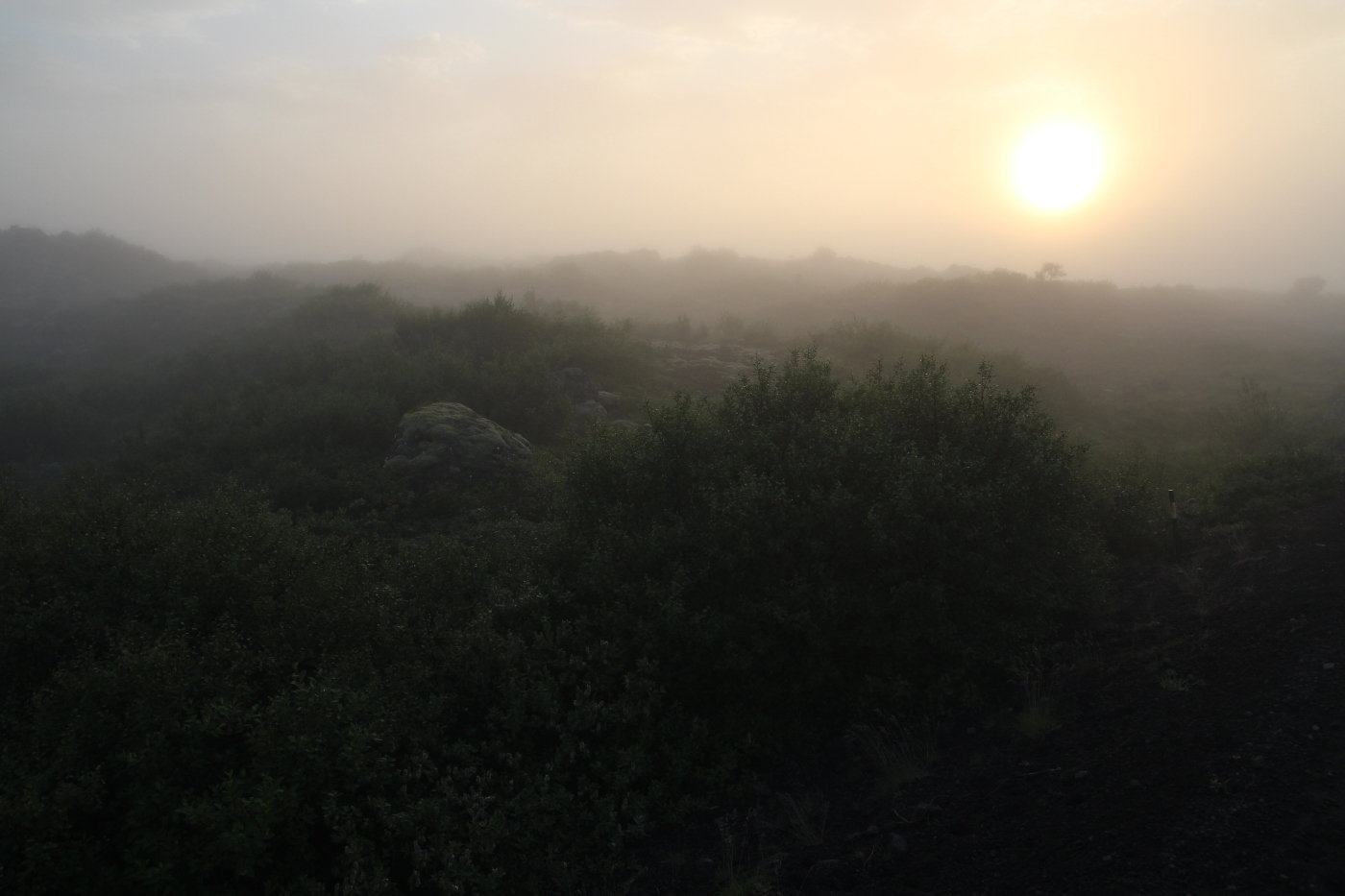
I waited there almost for two hours in a very calm weather, just to enjoy the prospect. Noise from nearby hydroelectric plant filled the air with a powerful rumbling noise. Below, all around me, was this thick fog and a clear sky above.
I was getting tired when I saw the sun rice above the horizon around 4 am.  After several photo shots I decided to find a place to sleep and feed my recorder with “early morning summer sound”.
On my way, was a place named Hagavik, a very nice cove in the southwest of Þingvallavatn lake. When I arrived, the fog was still very thick. I spread out my bivi sack on a place I remembered I put up my tent for about 35 years ago, when this place was not so popular. It was now a filthy motorist parking and fish hunting place. But, just as in the past, the soundscape was glorious.
Two MKH20 was placed close to the lake and I went to sleep 10 meters away.
The time was about 5:40 in the morning and the atmosphere was very quiet in the fog when the recording start.

Hagavík við Þingvallavatn. 1. hluti

Þann 27. júlí nýtti ég síðustu daga sumarfrísins til að hjóla með upptökutækin austur fyrir fjall. Við Hagavík fann ég mér náttstað snemma morguns. Hljóðnemana setti ég við fjöruborðið en lagðust sjálfur í Bivi poka á grasbala sem var illa troðin eftir marga bíla. Veiðisóðar höfðu greinilega verið þarna á ferð því úldin beita, sígarettustubbar og annað rusl lá þar um allt. En hljóðmyndin og kyrrðin var dásamleg eins og vanalega, alveg þangað til bílaumferðin fór að aukast síðar um morguninn.

  Download mp3 file (192kbps / 35,2Mb)

Recorder: Sound Devices 788
Mics: Sennheiser MKH20. AB40 setup
Pics: EOS M (see picture from this bicycle trip)

Read Full Post »

« Newer Posts