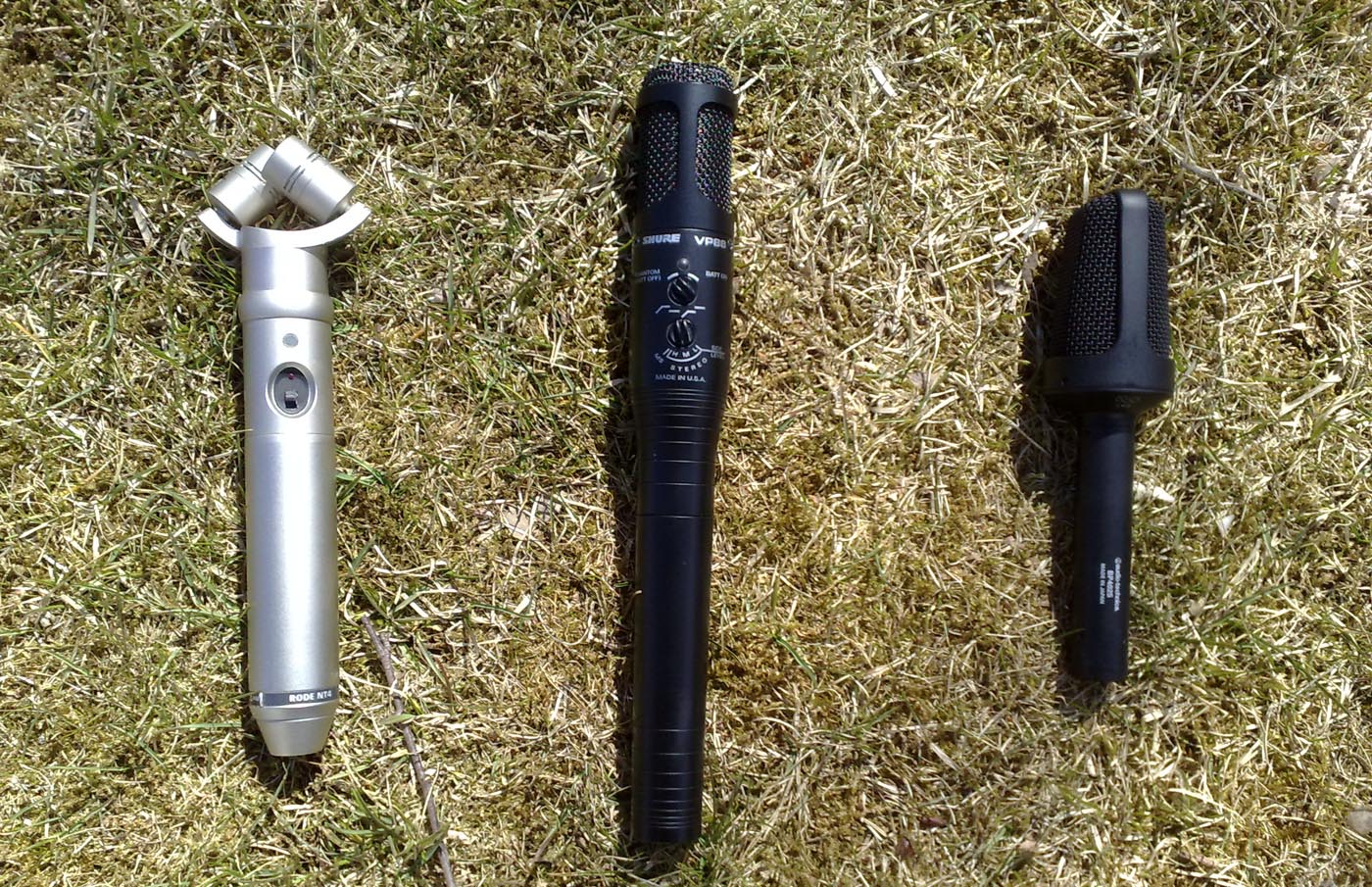
Three stereo microphones noise and sensitivity comparison.
Shure VP88 – Rode NT4 – Audio Technica BP4025
This recordings include a spoken word from pocket radio at very low volume and ticking alarm clock in 1,6m distance. The volume settings on the radio was so low, the sound was hardly audible with bare ears. Noise from radiator pipeline is audible in the background. Miscellaneous bird life is outside and should be also clearly audible.
Keep in mind. This test is only noise and sensitivity comparison. High sensitivity and low noise is VERY important for nature recordings. This comparison does not give any information how this microphones sounds for music recording or how they withstand high pressure sound level. See spectrogram and pictures
Quality headphones recommended while listen.
Shure VP88, Rode NT4 and Audio Technica BP4025 direct from recorder. All at same gain level at 55dB.
All three recordings are now independently level normalized up to 0dB.
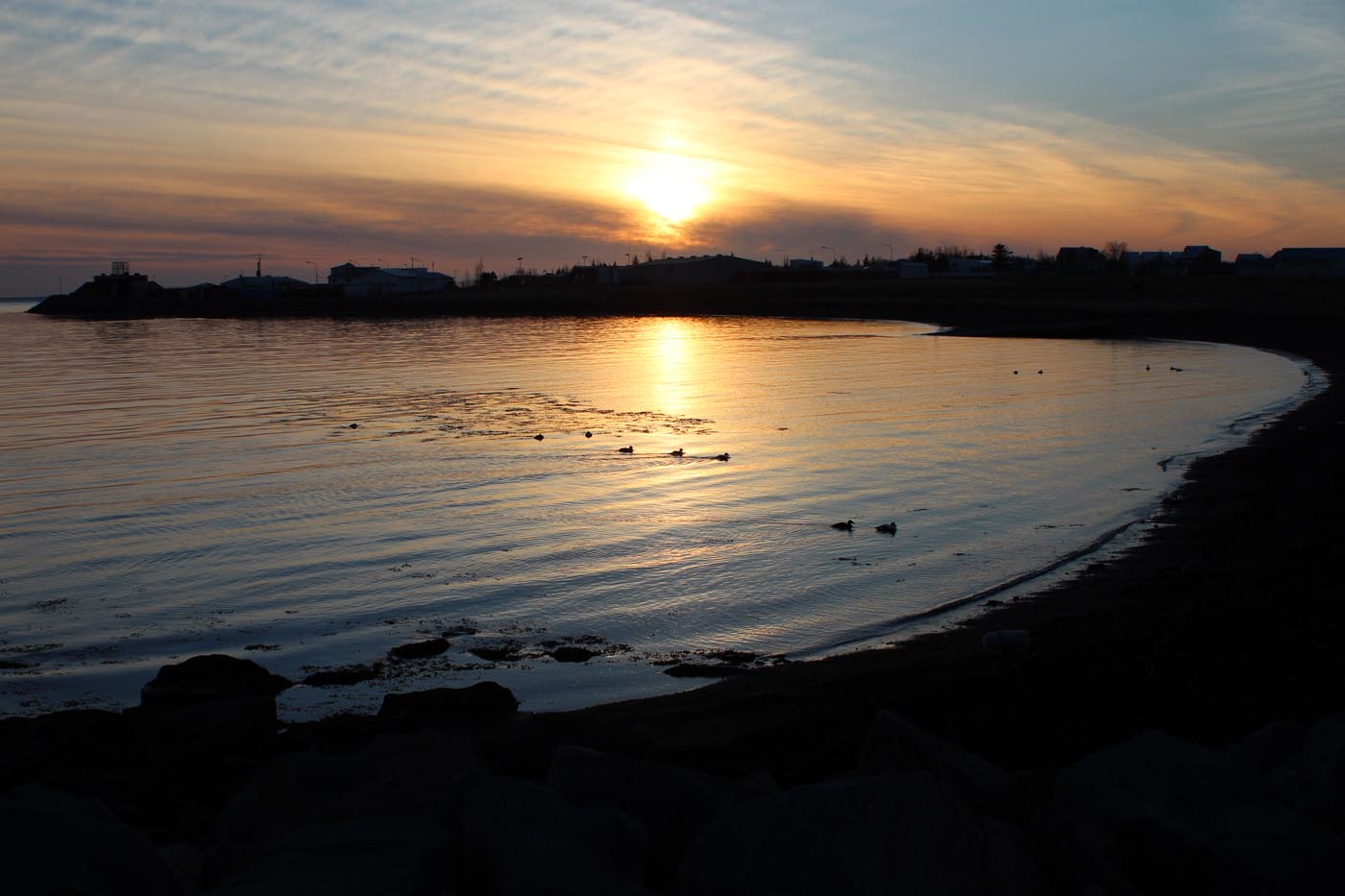
At 13th of May I cycled to the shore, west side of Reykjavik to make some microphones setup test in quiet environment. It was sunny and calm, but cold as it has been all this year’s spring.
This coastline is mostly unspoiled from humans works so there is miscellaneous birdlife. Along is a very popular walking and cycle path. Some places can be very quiet like the beach south of Skildinganes where I have recorded many times nature sounds…as far as it goes.
As usual where nature are close to humans automotive world there is a deep rumbling noise, a terrifying noise from burning fossil fuel. It does not only disturb my ears or recordings, it is a very clear warning about our stupid lifestyle that will sooner or later destroy our planet within a century.
Drunurnar frá Mordor
Upptaka af notalegri vorstemmningu í Grófinni sunnan við Skeljanes.
En í bakgrunni heyrast drunur frá vítisvélum borgarbúa sem fyrr en síðar munu breyta þessum ljúfu vorhljóðum í fjörunni.
In 10th of February 2013 I recorded a concert with Amateur symphony orchestra.
The program contained a wonderful melody “Senur” composed in four chapters by Sigurður Sævarsson. It was composed for string orchestra and obo. Both the orchestra and the soloist, Guðrún Másdóttir, played it flawless. Hereby is the first chapter of Senur without any post work.
I was pretty happy with the recording result, even though the concert hall (a church) sounded terrible for recording. It has a very harsh sound and difficult peaks in some resonance frequencies.
Over the orchestra I used a Jeclin disk with a double pair of mics, parallel MKH8020 and MKH20 in 45°+45° (as shown on the picture).
Close to the soloist there was a pair of MKH8040 and far behind in the hall was a pair of SE4400 with spaced Omni (70cm).
Past months I have got a few emails where people ask me for a sound sample with my Jecklin disk. So here are two samples, both almost the same, but one is recorded with MKH20 in 45°+45° and the other one with parallel MKH8020.
“Senur” fyrsti kafli
Sigurður Sævarsson hóf söngnám við tónlistarskólann í Keflavík undir handleiðslu Árna Sighvatssonar. Þaðan lá leiðinn í Nýja tónlistarskólann, þar sem hann nam hjá Sigurði Demetz Franzyni og Alinu Dubik. Hann lauk þaðan prófi vorið 1994. Sama ár hóf Sigurður söng- og tónlistarnám við Boston University í Bandaríkjunum, þar sem kennarar hans voru William Sharp, Charles Fussel, Sam Hendrick og Martin Amin. Hann lauk þaðan meistaraprófi í báðum greinum vorið 1997.
Helstu viðfangsefni Sigurðar hafa verið óperur og kórverk. Tveir geisladiskar haf verið gefnir út með verkum hans. Hallgrímspassía kom út árið 2010 og Missa Pacis kom út 2011. Nýjasta verk Sigurðar er Jólaóratórían sem var frumflutt 2. desember 2012.
Sigurður samdi “Senur” upphaflega fyrir óbó og strengjakvartett, að tilhlutan Eydísar Franzdóttur óbóleikara. Verkið var frumflutt á Myrkum músíkdögum 2012 og hefur verið flutt nokkrum sinnum síðan í Tékklandi og Þýskalandi. Sigurður umritaði verkið fyrir skömmu fyrir óbó og strengjasveit og er sú gerð verksins frumflutt hér. Guðrún Másdóttir hóf að læra á óbó í Tónskóla Sigursveins D. Kristinssonar 14 ára að aldri. Hún lauk þaðan fullnaðarprófi árið 1992 undir handleiðslu Daða Kolbeinssonar. Hún sótti nær öll námskeið Sinfóníuhljómsveitar æskunnar undir stjórn Paul Zukovsky á árunum 1985-1991 og hefur nokkrum sinnum leikið með Sinfóníuhljómsveit Íslands. Guðrún hefur leikið með Sinfóníuhljómsveit áhugamanna óslitið frá byrjun árs 1991. Hún er í stjórn hljómsveitarinnar og hefur umsjón með vefsíðu hennar, en aðalstarf Guðrúnar er staða tölvunarfræðings hjá fyrirtækinu Mentor.
Víðgelmir is a lava tube situated in Western Iceland in the Hallmundarhraun lava field, ca. 2 km. Southeast from Fljótstunga farm in Hvítársíða, Borgarfjörður. The roof of the lava tube has collapsed, creating two large openings near its north end which are the only known entrances. Viðgelmir is 1585m long, the largest part of the cave passage is 15.8m high and 16.5m wide making it by far the largest of its kind in Iceland. The cave has a wide entrance but narrows down in some places. An iron gate was installed at the first constriction in 1994 to preserve the delicate lava formations or speleothems which haven’t already been destroyed. Evidence of human habitation, probably dating to the Viking age, has been discovered in the cave and is preserved in the National Museum of Iceland. Long stretches of the cave floor are very rough and shouldn’t be navigated without a guide. Access and guided tours are provided at nearby Fljótstunga.
Lava tube caves are formed when a low-viscosity lava flow develops a continuous and hard crust which thickens and forms a roof above the molten lava stream. When the eruption subsides, the still molten lava moving beneath the crust will continue to drain downhill, leaving an open lava tube cave. Many other lava tube caves have been discovered in Hallmundarhraun (formed around 900 AD), most notable Surtshellir and Stefánshellir.(*)
This recording was made 30th of June 2012, close to the entrance, where ice from last winter was still melting. Water drops from the cave roof are falling into differenet places on the floor, in holes in the ice and on stones on rough surfaced floor.
Deeper in the cave there is no dripping water so it is completely quiet. For most people it could be an interesting experience. During the summer people can have guided tour in Viðgelmir, just contact Fljótstunga farm.
Hljóðin í Víðgelmi í Hallmundarhrauni
Víðgelmir er einn af lengstu (1.585 m) hellum landsins og rúmtaksmestu (148.000 m³) hraunhellum heims. Hann er í Hallmundarhrauni, u.þ.b. 2 km suðaustur af Fljótstungu í Hvítársíðu. Þak hellisins hefur hrunið á allstórum kafla, nærri norðurenda hans, og er það eini inngangurinn. Hellirinn er víður fremst en þrengist á köflum þegar innar dregur. Þar var, í október árið 1991 sett upp járnhlið af félagsmönnum í Hellarannsóknafélagi Íslands til að vernda þær dropasteinsmyndanir sem ekki hafa þegar verið eyðilagðar. Mannvistarleifar sem fundust í hellinum eru varðveittar í Þjóðminjasafninu og eru að líkindum frá víkingaöld. Hellirinn er á köflum afar erfiður yfirferðar og tæpast ráðlegt að fara um hann nema með leiðsögumanni. Leiðsögn og aðgangur að innri hluta hellisins er fáanleg frá Fljótstungu.
Hellirinn var lokaður af ís frá árinu 1918 til ársins 1930 en hann lokaðist aftur um veturinn1972-1973. Í apríl1990 fór hópur á vegum Hellarannsóknafélags Íslands með tól og tæki og freistaði þess að opna hellinn. Ekki tókst það að þessu sinni en árið eftir tóku nokkrir heimamenn af bæjum í Hvítársíðu og Hálsasveit sig saman, undir forystu Kristleifs Þorsteinssonarbónda í Húsafelli og kláruðu verkið (*)
Recorder. Sound devices 788
Mic: Rode NT1a (NOS)
Pic: Canon 30D. See more pictures at Google. My camera did not work perfectly in the cave, but anyway here is my picture
(*) Information about the cave is copied from Wikipedia.


 HLJÓÐMYND - SOUNDIMAGE