I have posted a protest against the western genocide in Palestine twice in the last few months and will continue to do so while the ruling elite of the West is killing people and ethnic groups to serve its imperialism in Palestine and all over the world.
A few days before I recorded this protest, the police had used tear gas on the protesters, so I also expected it could happen again. But it didn’t, except protesters use a smoke bomb.
These protests were held in front of the Icelandic Parliament during a parliamentary session. Icelandic parliamentarians are ALL puppets of the government in Washington, so the Icelandic government is complicit in the horrors that are taking place in the Middle East, both today and in the past, and elsewhere where Western imperialism attacks the world’s inhabitants.
This recording is about 35 minute long, but the whole protest lasted for approx. two hours.
The sound quality in the speaker system that was used by the protestors was terrible, but they were directed towards the parliament building. So I decided to stand behind them rather than in front so therefore It can be heard a little better in the people themselves.
(mp3 256kbps / 66Mb)
Recorder: Sound devices MixPre6
Mics: Primo EM172 parallel double capsule in baffled – binaural setup
Pix: Samsung S6
Last summer 2023 I went to a place I haven’t recorded much. Was it at Strandir in northwest Iceland. A friend invited me to stay in an apartment for a few days in Drangsnes, so I tried to use the time as well as I could for field recordings in the area.
It actually didn’t go very well. I had come down with a bad flu the same week as summer vacation started so I had little to no energy for many weeks. I was also facing another problem. The whole time I was in the area there was a strong wind except for maybe 1-2 hours during some nights. It was also rather cold, so nature was rather silent. Much of the material I caught these days was therefore not particularly interesting.
However, I had the opportunity one calm night to record a nice peace at the coastline. Part of it is here below. It’s very likely that I will put more of this recording on the web later, because the soundscape changed a bit during the 3-4 hours I was recording.
It is the summer solstice so it is therefore bright all day long. The recording starts at 23:45 and ends at 00:20 o´clock.
This is a typical soundscape in fjords in northern Iceland and in fact everywhere around the arctic circles.
This is a high gain recording. Recorded at +50 db. Then add about 20dB up to -7dB peak RMS. No noise reduction in post. Just fade in and out.
Many bird species are in this recording. There was several gull species, at last great black backed gull. Arctic tern, common eider, whimbrel, European golden plover, red throated loon, Common loon, arctic puffin and Eurasian oystercatcher. Sheep were not far away and seals were lying on rocks near the beach.
Quality open headphones are recommended while listening at low to mid volume.
If the media player doesn’t start to play, please reload this individual blog in a new tab or frame.
On October 15, 2023, a solidarity meeting with Palestine was held at Austurvelli in downtown Reykjavík. I think I could estimate that about 5-6 hundred people came to the meeting, which can be considered quite good by Icelandic standards
The week before, on October 7th, western propaganda media had reported some vague attack by „Hamas“ forces that was considered terrorism against civilians of the so-called „state of Israel“. Much is still unclear about what will happen on this October day. Even the occupiers themselves were not all on the same page about what really happened that day, as it became clear that Apache military helicopters from the occupying forces had probably caused more damage and killed even more people than „Hamas“ forces in some places.
But if Hamas had done something, it was enough for the „Israeli“ occupation authorities to think they had the right to let bombs rain on innocent civilians in the world’s most densely populated area, the Gaza strip. Gaza is nothing more than a concentration camp, fully controlled by this „Israel“ fascist colony state, supported by the west since 1948.
More about this conflict: The untold history of Hamas. The ‘Hamas human shield’ justification for Israeli war crimes Why does the US support Israel?
I am not going to comment further on these miserable conditions that the Palestinians have had to withstand for 75 years. It is quite clear that the legacy of Hitler and the imperialist policies of the West is ruling the occupied Palestine.
At Austurvöllur on October 15, several speeches were given as well as songs. To be able to stick to the time frame, I took out one speech and the songs.
(mp3 256kbps / 60Mb)
Recorder: Sound devices MixPre6
Mics: DIY Stereo mic. Double Primo EM172 capsules in AB baffled/binaural setup
Pix: Samsung G22
Weather: Cloudy, wind up to 4m/s, about 2°C
Location: 64.147308, -21.940289
I far too rarely go out to sea or lakes to record underwater soundscapes. The problem is probably that I need to get to a depth of 30 meters or more, be calm and smooth seas and be free of ship and boat traffic. In places where currents can be expected, I prefer to be able to attach to a buoy, because I want to be able to record for an hour or more.
Such situations are not directly accessible around me, but sometimes places are discovered in the most unlikely places. I found one not far from my workplace, which is the largest shipping port in Iceland.
There were no cargo ships in port, so I was probably free from engine noise. Not far away were 3 large cruise ships. But the remarkable thing about these ships was that there was no engine noise from them, although I know that the ships are not connected to land. There was only a strong 22Khz signal, probably from a sonar which I could easily delete in post processing so it shouldn’t bother those with good hearing.
In my opinion, this is not a remarkable recording, but still you can hear a „natural silence“ even if there were some waves on the surface, which usually produces white noise. I settled on a pontoon dock south east of Viðey island during the high tide, to be able to have the maximum depth which was 6-7 meters.
It was a good place to be able to sit on the pier for a while and forget myself while listening to the soundscape of the sea below while the recorder recorded.
It had been raining heavily hours before so the loudest thing in this recording is the raindrops falling from the pier floor to the sea above the hydrophones.
Shortly after the recording starts, there is a light rain shower which is clearly heard as added noise. Behind all this noise from water drops and rain, you can hear soft clicks and sparks that I suspect are coming from Blue Mussels and a low-short „fart“ sound that I think is coming from Pollock. At one point in the recording, you can hear bubbles, possibly methane gas, coming up from the ocean floor. Other strange sounds similar to birdsong can also be detected, which are not easy to identify where they are coming from. It is therefore important to pay attention while listening.
This is a recording made at midnight. Perhaps more life would have been heard on a bright, sunny day. But since I have made some nice recordings in the sea in the last months in several places, this recording seems to describe a rather typical acoustic environment inside the fjords along the coast of Iceland.
Quality open headphones are recommended while listening at low to mid volume.
If the media player doesn’t start to play, please reload this individual blog in a new tab or frame.
Early in July 2023 I spent one night at Sultártangalón lagoon recording in three locations.
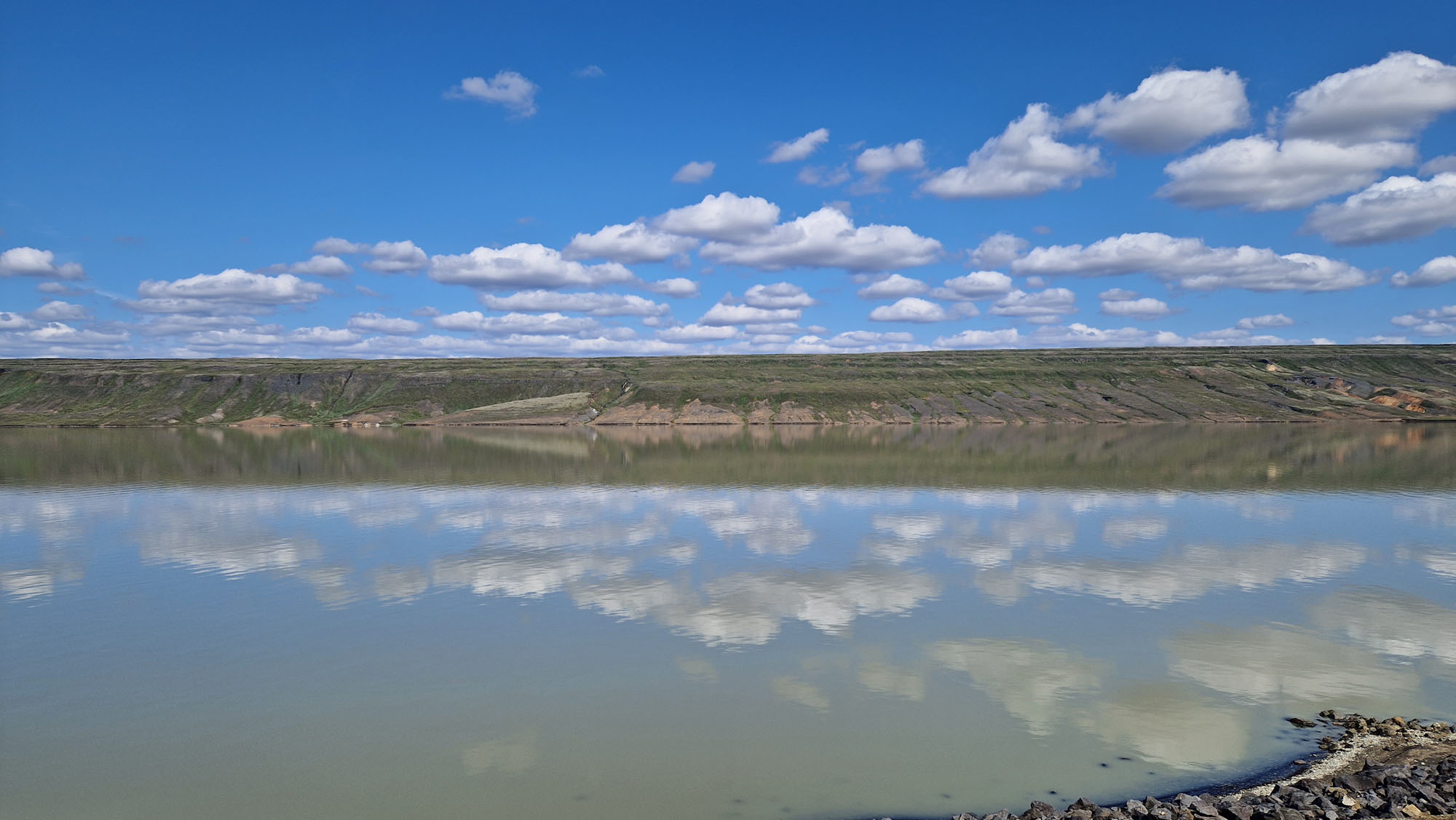
In the morning when I was leaving, it was sunny, calm and very hot, in the Icelandic way. The sight over the mirror smooth lagoon made me stop the car and enjoy the view. The recorders were ready and connected in the car, so I quickly set them up by the reservoir and took a short walk while they were recording.
The result was this. Typical Icelandic highland silence. Nothing interesting as an audio recording, but what caught my attention was the background noise of waterfalls and streams across the lagoon. This noise changed the EQ slowly in a variable thermal upstream due to the influence of the sun radiation.
Several bird species can be heard in this recording. These include Raven, Golden Plover, Dunlin, White Wagtail, Meadow Pipit and Red Throated Loon.
This was recorded with MKH8020/8040 in a fur wind shield, which was not the best choice, because the silence was considerable. Audio was recorded on MP6 with 50dB gain and in post-processing the gain was increased by another 20dB so they reached -10dBu.The MKH microphones were therefore not the most suitable for this moment. It would have been better if I had recorded with the LCT540s in IRT, to better capture all the small details all around.
To cancel out the loss of certain frequencies due to the fur wind shield, I raised the mid frequency by +2dB.
This is a rather sensitive recording. So I wasn’t using RX de-noise. But instead since nothing in the recording reaches frequencies higher than 8Khz, I lowered the EQ above 10Khz by a few dB to reduce the self noise in the microphones.
Quality open headphones are recommended while listening at low to mid volume.
If the media player doesn’t start to play, please reload this individual blog in a new tab or frame.
I was reminded this winter that I should record more street life. I’ve always had that in mind, but somehow it’s always something in nature that fascinates me more.
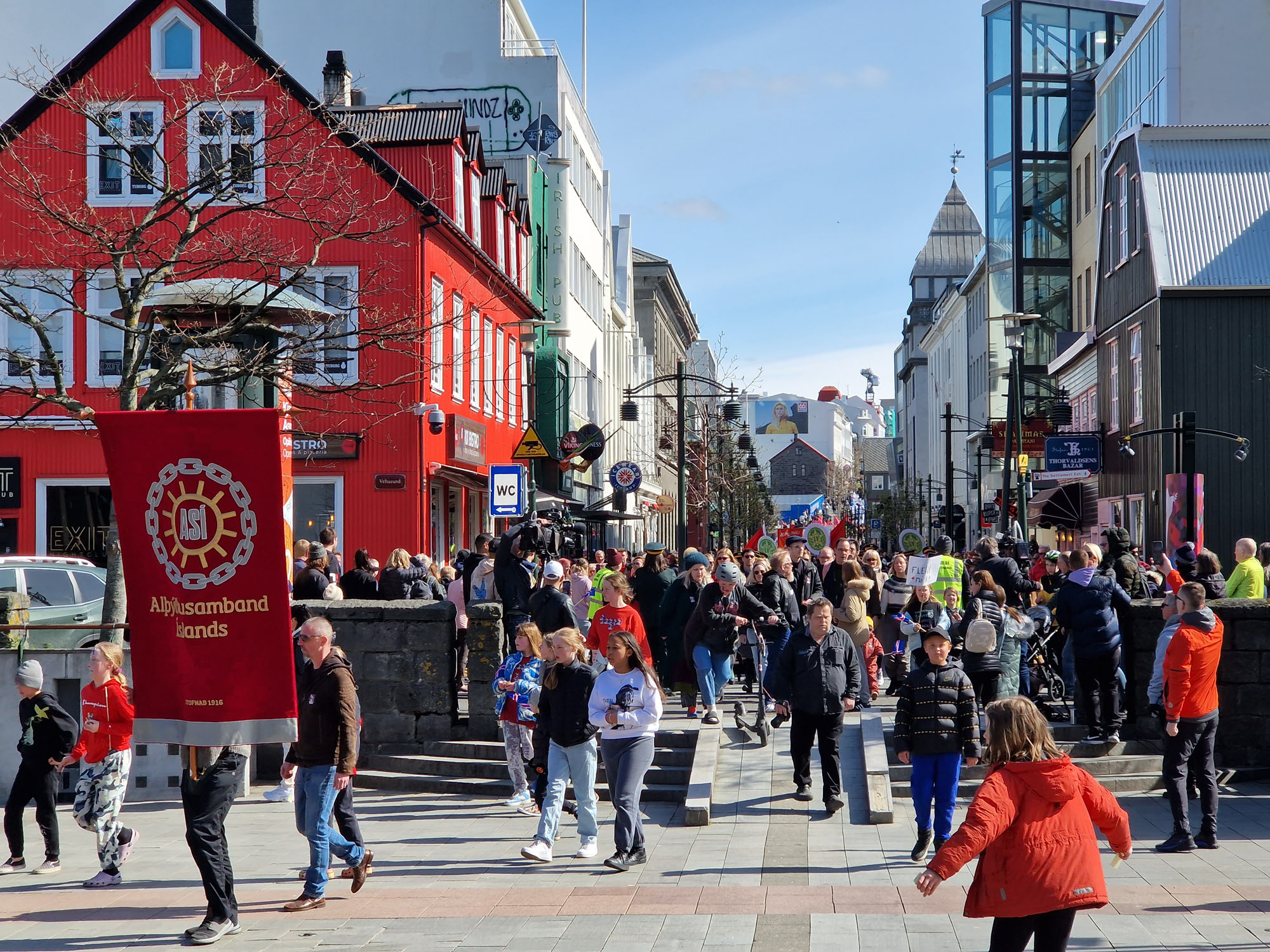
On Labor Day earlier this month, I went down to the center of Reykjavík to record human life and the traditional program on this great day. Instead of going on a mass march through the streets of the city, I went straight down to Hallærisplan square and waited for the marchers and brass bands..
A large stage with a sound system had been set up in the square and there were only a few people. But shortly after I had started the recording, marchers and brass bands came rushing onto the square. The speeches of the day were nothing special, but the music was fine. It will not be audible here, except of course the brass bands that accompanied the mass march.
It took me a while to decide to put this recording on the web. It sounds bad in HD650 headphones, but slightly better in MDR7506.
But the remarkable thing about this recording in my opinion is the hum, noise or tone at 4Khz, 6Khz 8Khz and 10Khz. Anyone with trained hearing can hear these tones in this recording below, although an unrelated fan hum is also evident in the recording.
I first noticed this noise when I was recording COVID silence in the same square during the „lock down“ in the first weeks of the COVID, in the spring of 2020. Then it only came from one direction and also contained 15khz which is not audible now.
However, I have never been able to locate the source of this noise. I thought for a long time that this noise was coming from a broken transformer for the LED lighting. But here it was a clear day and all lights were off so this noise is coming from something else.
(mp3 256kbps / 61,2Mb)
Recorder: Sound devices MixPre6
Mics: Primo EM172 / EM272 capsules v. LOM phantom power amps (Baffled AB)
Pix: Samsung S22
The remarkable thing happened in the winter of 2022-2023 in Iceland, at least in the southwest, that there were many consecutive days with severe frost. The winter was undeniably reminiscent of the winters of the 1970s and 1980s, when catastrophic or global warming had neither become tangible nor existed in the dictionary.
This gave me the opportunity to record under ice, which I hadn’t done before.
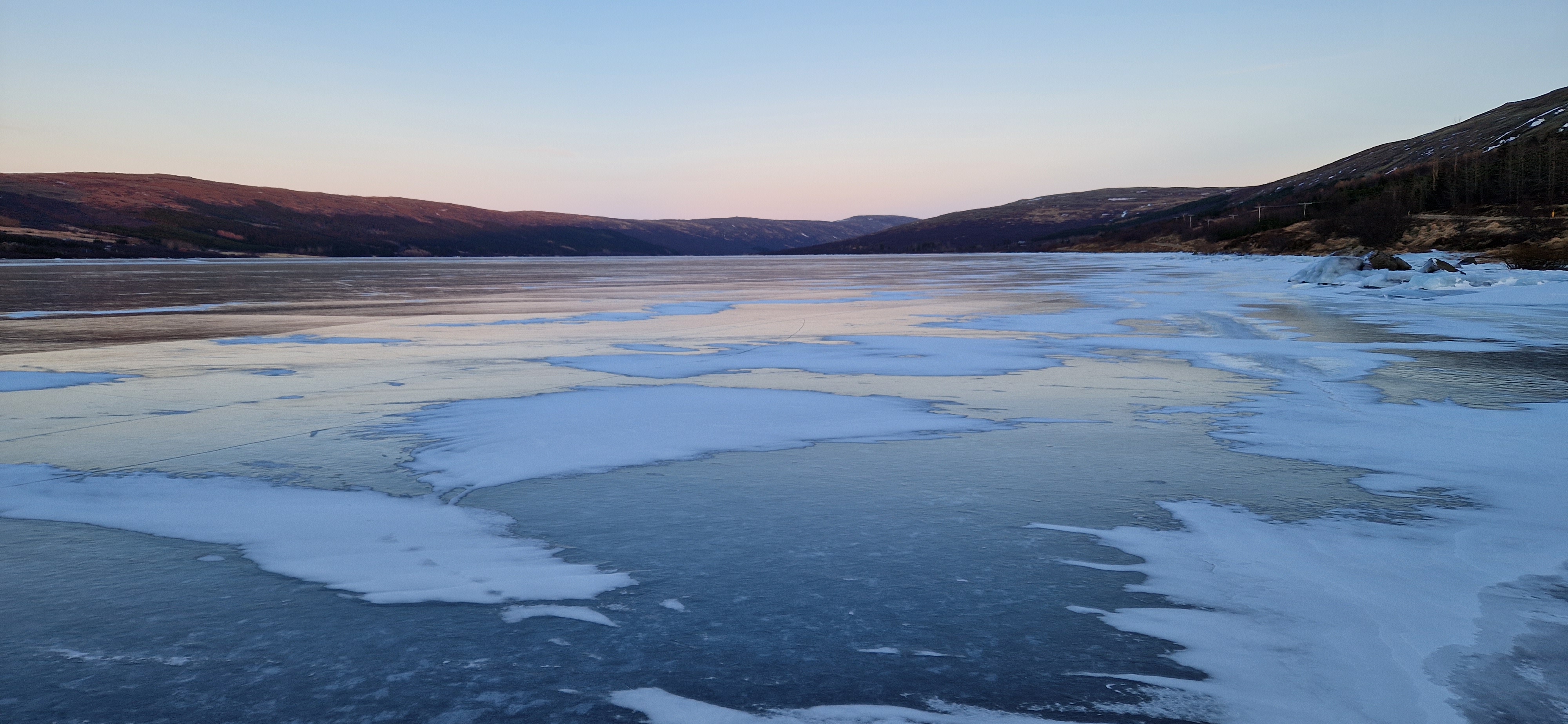
I invested in a proper ice drill and managed to make three trips to Skorradalsvatn lake to record under and over the ice. But the lake is located about an hour’s drive from Reykjavík.
It was surprising that the sounds from frozen lakes are not produced by the frost alone and the variable expansion of the ice. Rather, it primarily depends on the wind strength, size and depth of the lake.
Although everything seems flat and there are no waves visible on the ice surface, there is a lot going on. Especially under the ice, where there is clearly significantly more noise than on the surface. On the surface, you hear mainly „drone squeals“ and occasional clicks and breaks, which are also interesting to record.
The following recording was recorded approx. in 8 meters depth, not far from the place where the lake is deepest, or about 60 meters. Many things can be said about this recording. I’m not entirely happy with it, which I’m not going to mention here. But recording ice on lakes is clearly a very interesting subject. Something I hope to be able to do much more often in the future.
Depth and size of the lake. Shape of the lake and lake bed, volume of wind and snow, ice thickness and ice temperature, everything matters if I like to catch these amazing sounds.
I’m always traveling alone, so I didn’t take any risks by going far out on the ice this time. But I will definitely try it sometime if mother nature and luck gives me such a perfect winter again.
Quality open headphones are recommended while listening at low to mid volume. There are a lot of very powerful sounds in this recording that can easily damage your hearing and speakers. I therefore do not recommend high volume
If the media player doesn’t start to play, please reload this individual blog in a new tab or frame.
I have spent 40 years of my life as an electrician at the same workplace at Eimskip and have seen incredible changes in the development of various equipment and devices. I remember electric forklifts where the speed control was just a few huge resistors and sparking DC contacts. Then came forklifts with Triac controllers, then FET controllers, and most recently computer-controlled with three-phase speed controllers. I have seen the same in the development of harbor cranes. The oldest ones with 32T lifting capacity and Ward Leonard DC controls, where „feedback or drop“ energy is wasted in heat in large resistors. But today, all harbor cranes are computer controlled, with lifting capacity up to 125T, three-phase motors and some return the feedback energy into the electricity grid. During the years I have recorded the crane at Eimskip and some of them have found its way into this blog. In most of these cranes, which are driven by electricity, almost nothing can be heard other than a loud fan noise. In the oldest crane, you can also hear repeatedly clapping relays, large DC contacts and spark pops, which have been sound for 40 years. You can also hear the difference and feel the pain when the crane is struggling with heavy load. From the latest cranes, you can hear a high-frequency „song“ from the coil in the motors, similar to tweeter in speakers, which changes little or nothing at different loads. It has therefore been tempting me for quite some time to record these motors with Geophone and contact microphones so other noise in the crane could not be heard. But after doing some experiments with contact microphones in this modern cranes, I found out that I can spend many hours recording all kinds of sounds there. Here are the sounds in hoist motors in the two new cranes. In both cases, the cranes are loading containers to ship It was recorded simultaneously with two contact microphones and two Geophones in four channels. First comes the Liebherr CTC crane P148L (WS)- Super with two 400Kw motors with a registered 70t lifting capacity under hook beam. mp3 256kbps / 11,4Mb
Then comes the Konecranes Gottwald ESP ,8 with one 290 kW motor and lifting capacity up to 125 tons. Because of the compact design of the motor, gearbox and rope drum, this recording include the sound in the gearbox which have internal brake. mp3 265kbps / 11,4Mb
It really doesn’t matter where you turn on the microphone or other sensors, there seems to be life everywhere.
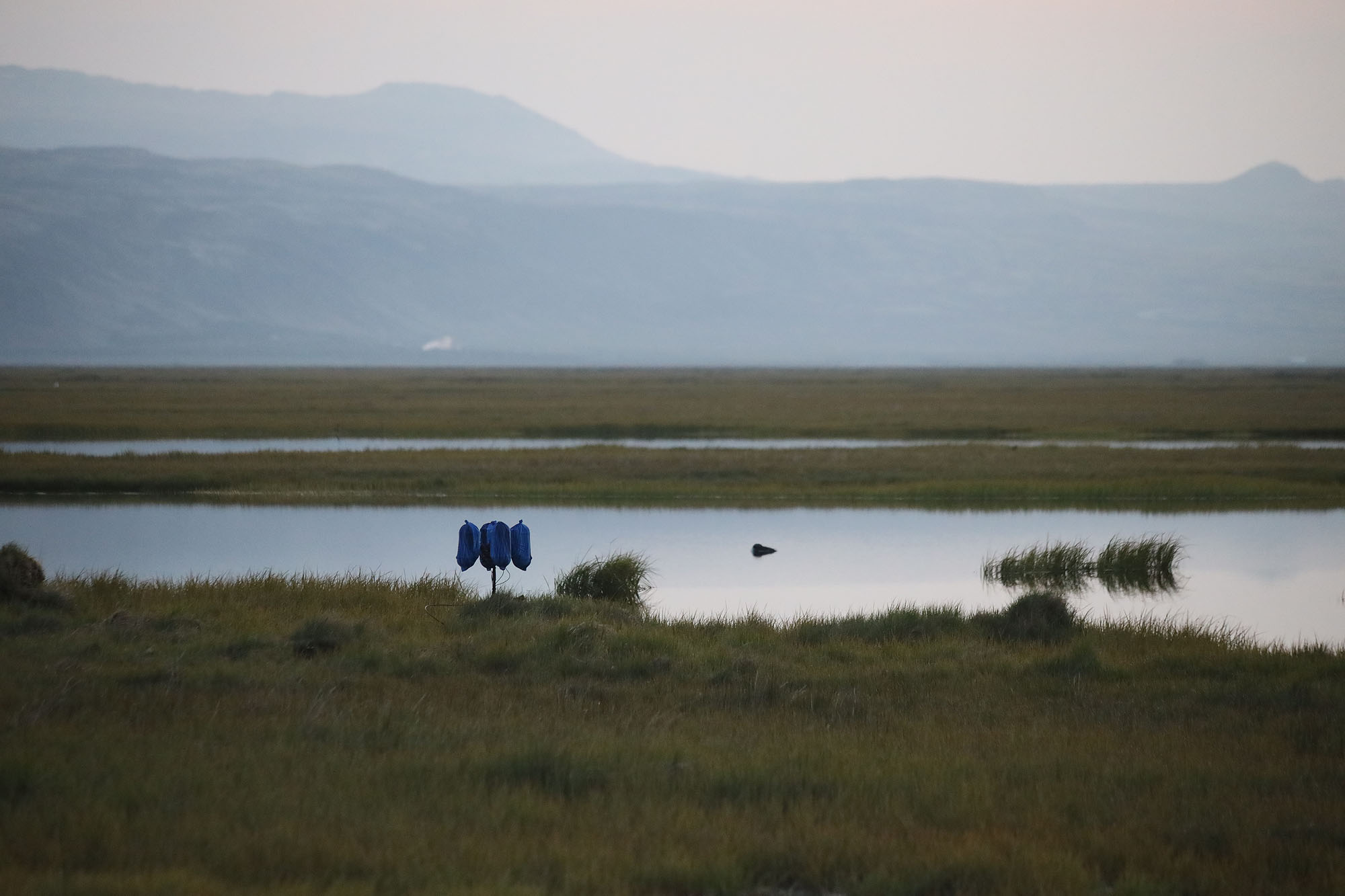
There was no exception to this in the nature reserve in Flói, southwest Iceland 17th July 2022. All night I had been recording the bird life in the same place as I have done every year for over a decade. I had gathered all the equipment about noon and was ready to go, when I decided to prepare a coffee before heading to the next recording location.
So it was the perfect time to dip the Hydrophones in the next pond while waiting for the coffee.
The pond was full of life, although it could not be seen or heard on the surface. The soundscape was so interesting it turned out I was recording there for almost three hours.
After a short investigation I saw Agabus and Spined Stickleback. I am sure there were also moth larvae of different species, even some kinds of shrimp, where the sea is not far away. Some of these sounds may also be methane gas being released from the bottom of the pond.
The soundscape in the pond was similar to birdlife. The chorus from the biosphere in the pond came in waves. Sometimes the sounds were few and quiet, but then there came a time when the whole biosphere in the pond needed to be heard.
Below you can hear one such period.
The recording was recorded in 24bit/48Khz, but a lot of these sounds seem to be able to go well above 24Khz. It tells me that the next time I record in this pond, I should do it at a higher resolution, 96Khz or even higher.
It is always quite difficult to record with hydrophones. The sensitivity is such that, once they are in water, the cables must not touch anything that might move, not even the wind. Although the Hydrophones were well immersed in the pond, you can hear many things in the recording, e.g. in planes, car traffic, footsteps and a Black Headed Gull that probably made a sound as it flew over the pond.
This recording didn’t require a lot of editing. However, 20Hz was taken down by -20dB. I thought it was necessary since these Hydrophones have flat frequency range down to 0.4Hz and the MixPre6 down to 10Hz. Most of the rumble that was heard in the original recording was therefore vibrations from cars and air traffic and possibly also from the waves along the south coast. The recording got a very gentle noise reduction and normalized about +7dB, up to -8dB peak level.
Quality open headphones are recommended while listening at low to mid volume.
If the media player doesn’t start to play, please reload this individual blog in a new tab or frame.
In recent years, I have been on the evening shift on December 23 (Þorláksmessa). So I haven’t been able to go downtown Reykjavík to record the ‘mood for Christmas’. But this December I was on a day shift which gave me the opportunity to record.
The last time was 5 years ago when I recorded this beautiful song on December 23, 2017.
It was a different atmosphere in the city center this year. I didn’t understand what it was, at least now there were more foreign tourists and the streets were covered in salt-slush and ice. This year there were no beautiful singing voices in the crowd as so often before. However, music comes from some street stalls and bars. On the ice skating rink at Hallærisplan (Ingólfstorg square), music was played loud during the skating dance.
After total 1Km long walk the recording ends rather quietly in a bar where I bought a beer.
In this recording I am using the same ultralight stereo microphone as I did in 2017. Baffled double capsule EM172/272 with a LOM Phantom power amp,
But today I have filled the empty space inside the wind shield between the microphones with a sponge of different density which has improved the separation between the right and left channels. It reduced the audible phase error between the channels which was clearly audible in the 2017 recording.
In addition, in the space between the microphone, outside the Rycote WS2 windshield and under the HWC2 Hi-wind fleece cover, is also a sponge. That sponge stops most of the vibration in the windshield due to wind, without affecting the sound quality.
This stereo microphone is very light, can withstand incredibly high winds, as well it has almost no „handling noise“. It is therefore good for booming where strong winds can be expected.
In this recording I did not use HPF. Between the houses and out in the open spaces where I walked, there was a considerable amount of wind that probably few, if any, microphones would have been able to withstand without wearing a good fur windshield plus additional HPF.
The more I use this DIY mic, which is mostly made from scrap materials, the happier I am with it.
Earlier that same night, I also recorded with simple EM172 binaural microphones. In many ways, that recording was very funny because no one around me noticed that I was recording, unlike the recording below. But that recording will have to wait to be published until later.
I also recorded for over an hour at the bar a nice mood recording, but I will never be able to publish it because the bar was playing copyrighted music.
Quality open headphones are recommended while listening at mid to mid+ volume.
If the media player doesn’t start to play, please reload this individual blog in a new tab or frame.
(mp3 256kbps / 48Mb)
Recorder: Sound Devices MixPre6
Mics: Primo EM172 / EM272 capsules v. LOM phantom power amps (Baffled AB)
Pix: Samsung S22