Although Iceland produces the most electricity per capita of any nation, wind turbines are not common in Iceland. They have either burned or overturned or something else. They are also not eye-catching, so fortunately there are no more than two that come to mind.
But that could change. Many energy oligarchs, domestic and foreign, have worked hard to be allowed to do what they want when it comes to building power plants of all kinds in Icelandic nature. They are mainly interested in it because the price of energy to the Icelandic public is not yet as extreme as in most other parts of the western world. So these Oligarchs see great profit prospects by imposing dividend taxes on the public in the future.
But stop now talking about this miserable situation and future in Iceland. I’m going crazy just thinking about it.
Let’s talk about the recording below.
Although this is a sound that is heard in many places, especially in the Western countries, these sounds from wind turbines are not yet common in Iceland. I therefore allow myself to share this recording.
It wasn’t until I started listening to it that I noticed the wide variation in the sounds, or noise coming from such structures. This is one of Iceland’s two 900KW wind turbines, of the type Enercon E-44. This wind generator reaches a height of 77 meters, with a rotor blades width of 44 meters and a generator height of 55 meters.
The wind was quite stable and directional, but you can clearly hear the hydraulic pumps that are either turning the rotor blades into the wind direction, or changing the rotation of the blades to get maximum energy each time. You can also hear when the wind sounds change in the blades after such control. Then you can hear quite a lot of „electrical noise“ which is either vibration from the generator or from the energy regulators up in the generator carrier. You can also hear that one blade make more noise than other two. It is either because that blade has a scratched surface, or that blade is dirtier than the other two.
More than 5 months have passed and the genocide is still going on in Gaza in occupied Palestine. Since the Western-backed Zionists started destroying Gaza and the West Bank and the genocide of the people of Gaza, the Iceland-Palestine Association and other peace activists have been holding actions in various places in Reykjavik almost every week all this winter.
I myself have not been able to attend all these solidarity marches, but I did so here when they marched through the center of Reykjavik to the British and German embassies on March 2, 2024.
I encourage people to attend such solidarity marches with Palestine around the world and record them. We must end the horrors that Western imperialism and colonialism have cost the rest of the world for centuries, and most recently in Palestine.
It was quite cold but sunny, and sometimes there was a gust of wind that sometimes interrupted the recording because I didn’t use HPF. Here I am recording in binaural and using Primo EM 172 capsules which are located near my ears and point 180° in each direction.
The recording was done on a Sony PCM-D100 so the equipment fit in a pocket, was light and compact.
At the first peace meeting I attended in October, I used a Baffled-AB-Binaural microphone set based on 2×2 EM172 capsules, which can withstand much higher winds, but at the same time requires more bulky and heavier equipment.
(mp3 256kbps / 53Mb)
Recorder: Sony PCM-D100
Mics: Primo EM172 binaural
Pix: Samsung S22
Weather: Clear sky. Gust 1-10 m/sec -2°C
Last summer 2023 I went to a place I haven’t recorded much. Was it at Strandir in northwest Iceland. A friend invited me to stay in an apartment for a few days in Drangsnes, so I tried to use the time as well as I could for field recordings in the area.
It actually didn’t go very well. I had come down with a bad flu the same week as summer vacation started so I had little to no energy for many weeks. I was also facing another problem. The whole time I was in the area there was a strong wind except for maybe 1-2 hours during some nights. It was also rather cold, so nature was rather silent. Much of the material I caught these days was therefore not particularly interesting.
However, I had the opportunity one calm night to record a nice peace at the coastline. Part of it is here below. It’s very likely that I will put more of this recording on the web later, because the soundscape changed a bit during the 3-4 hours I was recording.
It is the summer solstice so it is therefore bright all day long. The recording starts at 23:45 and ends at 00:20 o´clock.
This is a typical soundscape in fjords in northern Iceland and in fact everywhere around the arctic circles.
This is a high gain recording. Recorded at +50 db. Then add about 20dB up to -7dB peak RMS. No noise reduction in post. Just fade in and out.
Many bird species are in this recording. There was several gull species, at last great black backed gull. Arctic tern, common eider, whimbrel, European golden plover, red throated loon, Common loon, arctic puffin and Eurasian oystercatcher. Sheep were not far away and seals were lying on rocks near the beach.
Quality open headphones are recommended while listening at low to mid volume.
If the media player doesn’t start to play, please reload this individual blog in a new tab or frame.
Recording fireworks is probably like photographing a sunset for a photographer. Nothing special but there is always some duty that calls for it to be done.
It is not the loud sound that fascinates, but the interaction of the sound with the environment. Reflection of a sound wave. e.g. the echoes from houses, mountains or trees that make it interesting to record fireworks. The problem, however, is that I am often confined to staying at home with my family on this day. I am therefore not in different places from year to year, and therefore I have to say that I have not made a good or interesting recording of fireworks, apart from maybe one recording in Tenerife. I’m also always experimenting with microphone setups, which usually don’t work out well when there’s a lot of other things going on.
It is with mixed feelings that I put a fireworks recording on the web this time. Have done it before and therefore not urgent to do it again because it always sounds as a loud noise which is not healthy for the ears or speakers.
But this new year is marked by terrible wars, which unfortunately all have their origins to the western hegemony and imperialism, as usual. Most recently with the targeted genocide in Palestine which as of this writing can easily escalate into an even bigger war, more or less all over the middle east.
The NATO proxy war in Ukraine is still going on after almost ten years conflict. It has destroyed Ukraine and seems to be also destroying Europe in coming years, if not in decades because of politicians stupidity. This time, the West, led by the United States, EU & GB has lost both credibility and the trust of most nations in the world.
The world is changing. US unipolar empire is falling and new multipolar empires are rising. At the same time, the US will drag Europe down in the fall and destroy Europe as a flourishing continent, only because of insane hatred towards Russia.
The new year therefore does not seem to offer anything good for many nations, but only continued with conflict and disaster. Fireworks with all its noise are therefore no longer part of entertainment in my mind, but a reminder of war with destruction, killings and mutilations.
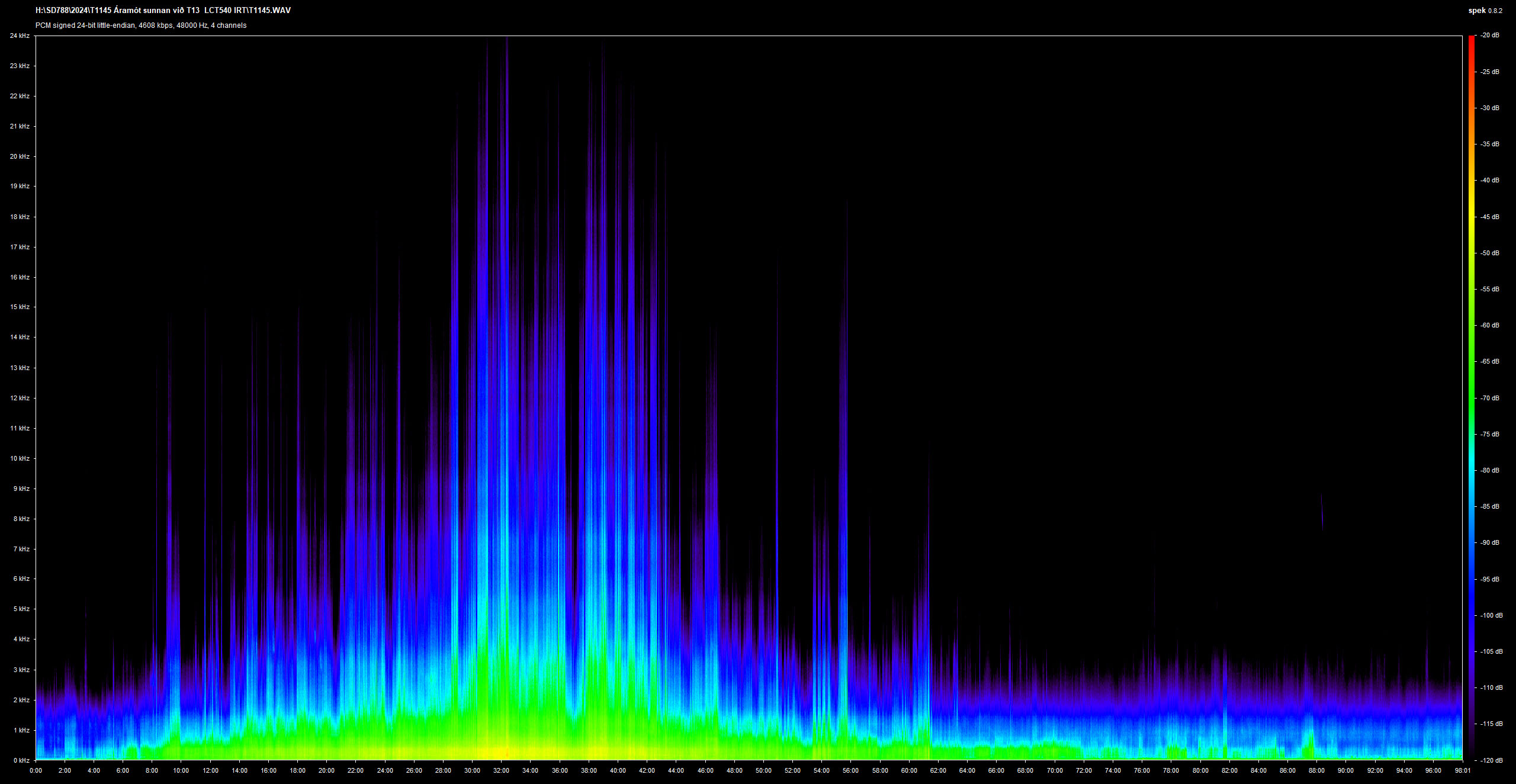
This recording was made in my backyard, between houses with LCT540s in IRT. You can hear that the echo time is short. Some might think it’s because I used a Limiter. But the Limiter was turned off, as always should be done when recording fireworks. Recording sound pressure rose to a peak of +7.7dB (-7.4 LUFS-S) .
Details that can often be heard in fireworks when they are launched are not heard clearly in this recording because they were launched from beyond the houses in this backyard. However, I had another microphone set (MKH20/40 parallel AB) close to a place where people were setting off fireworks, but that recording did not go well for various reasons.
Even though this recording has been downgraded to mp3, be careful when listening to this recording. Don´t put up the volume, especially not when listening with speakers.
Quality open headphones are recommended while listening at mid/high-level.
Following picture shows the spectrogram of the whole recording this new years eve. But following recording start at 22:30min. Midnight is at 30:00min and the recording end at 52:30min
If the media player doesn’t start to play, please reload this individual blog in a new tab or frame.
I do quite a bit of recording music, so it would be nice to be able to publish some of it here, especially music that I think is extremely well played and where the recording has been successful. For example, I have often wanted to put classical music on the web in December and January. But professionals have little interest in giving permission for this, possibly because I only ask these people once.
So I’m going to share different music instead, which is even more beautiful than all music, but it’s birdsong in the spring.
Here is a recording from last spring that I had forgotten I had recorded.
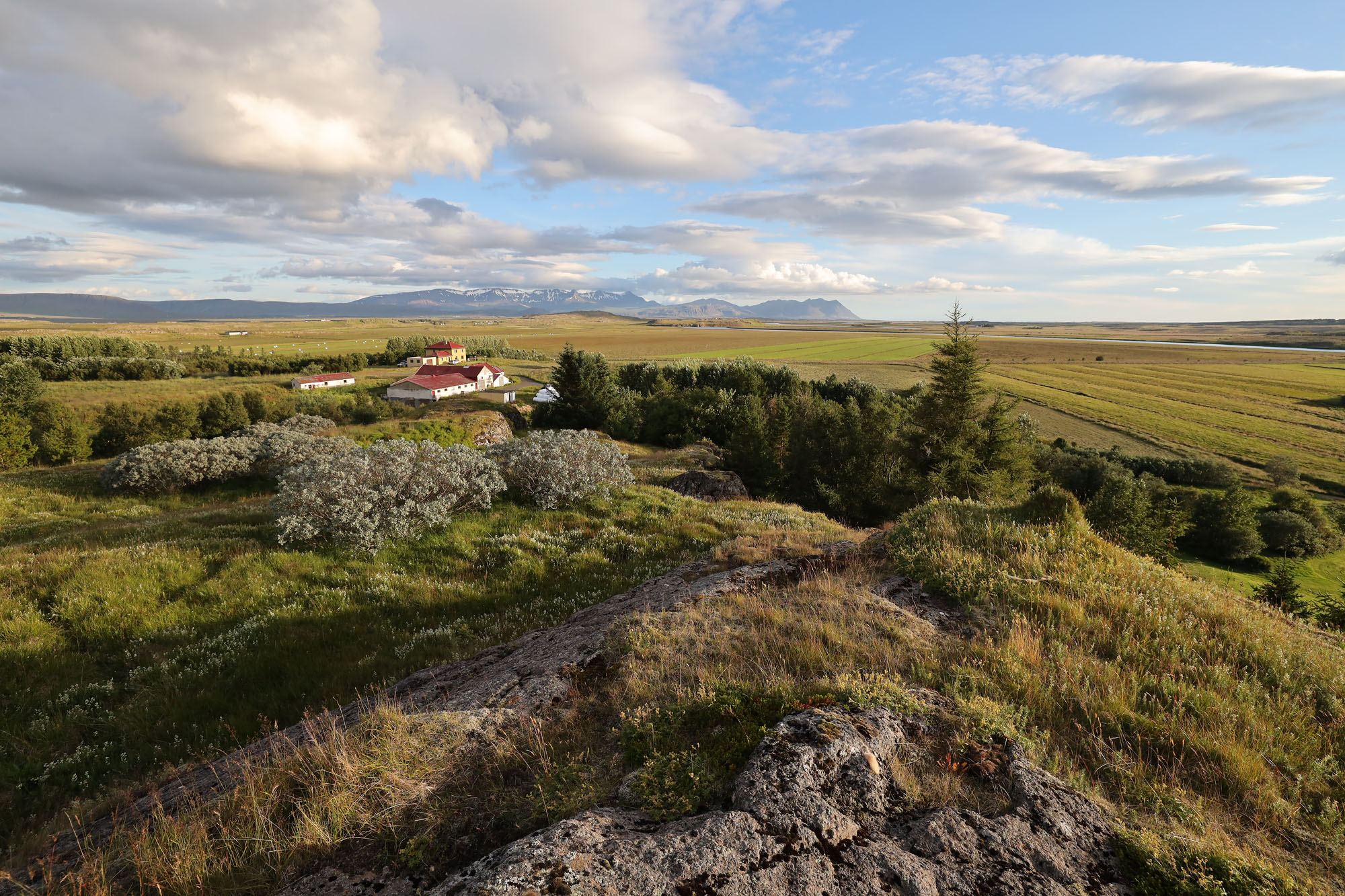
I had a Zoom F3 device recording in several places almost non-stop for several days in Stafholtstungur, western Iceland. I used Rode NT1 microphones and set them up to NOS 90°/30cm. It can hardly be considered the best setup for such long nature recordings. The reason is that sounds such as background noise from the wind, rustling of leaves, running streams and traffic can change a lot in 24 hours, so the sound pressure between channels can easily go out of balance. It can even be detected in this recording. Some traffic can be detected at a distance of 5-10 km in the (left) channel. That’s why it’s usually best to record in AB 40-50cm, if you’re going to record for a long time.
But since I primarily record natural „silence“, there are not many microphones that handle silence well and the ones that do it best are all cardioid, which has led me to start recording a lot in IRT (4ch 90°/30cm)
In some cases, it is possible to set the cardioid up to AB 40-50cm, but you cannot do that unless you intend to record from one direction. In this place the sounds were coming from all directions so it was not available.
It’s a low-key recording, actually amplified silence. Recorded at „Zoom gain at 256“ and HPF 40hz. In post-processing the recording was normalized (+25) up to -7dB
There is a lot of recorded material here that I feel is a shame to be forgotten on hard disks, so I’m going to allow myself to call this „Part 1“ because Part 2 and 3 and more also need to get here on the web.
The footage will therefore not be exactly from the recording location, but not further than 500 meters away.
Quality open headphones are recommended while listening at low to mid volume.
If the media player doesn’t start to play, please reload this individual blog in a new tab or frame.
(mp3 256kbps /66,5Mb)
Recorder: Zoom F3
Mics Rode NT1 (NOS 90°/30cm)
Mics: Canon EOS R
Weather: Calm, partly cloudy, around 7 to 10°C
On October 15, 2023, a solidarity meeting with Palestine was held at Austurvelli in downtown Reykjavík. I think I could estimate that about 5-6 hundred people came to the meeting, which can be considered quite good by Icelandic standards
The week before, on October 7th, western propaganda media had reported some vague attack by „Hamas“ forces that was considered terrorism against civilians of the so-called „state of Israel“. Much is still unclear about what will happen on this October day. Even the occupiers themselves were not all on the same page about what really happened that day, as it became clear that Apache military helicopters from the occupying forces had probably caused more damage and killed even more people than „Hamas“ forces in some places.
But if Hamas had done something, it was enough for the „Israeli“ occupation authorities to think they had the right to let bombs rain on innocent civilians in the world’s most densely populated area, the Gaza strip. Gaza is nothing more than a concentration camp, fully controlled by this „Israel“ fascist colony state, supported by the west since 1948.
More about this conflict: The untold history of Hamas. The ‘Hamas human shield’ justification for Israeli war crimes Why does the US support Israel?
I am not going to comment further on these miserable conditions that the Palestinians have had to withstand for 75 years. It is quite clear that the legacy of Hitler and the imperialist policies of the West is ruling the occupied Palestine.
At Austurvöllur on October 15, several speeches were given as well as songs. To be able to stick to the time frame, I took out one speech and the songs.
(mp3 256kbps / 60Mb)
Recorder: Sound devices MixPre6
Mics: DIY Stereo mic. Double Primo EM172 capsules in AB baffled/binaural setup
Pix: Samsung G22
Weather: Cloudy, wind up to 4m/s, about 2°C
Location: 64.147308, -21.940289
One of the things I’m quite interested in is recording space weather or „auroral chorus“ with a ELF/VLF receiver.
This space weather is electrically charged particles coming from the sun into the upper atmosphere, the same ones that form the northern lights, or Aurora.
The receiver therefore only detects radio frequency on a very long wavelength or at 20hz up to 20Khz
The problem, however, is that I have never been able to devote enough time to this hobby. So I don’t have many recordings of this material.
It is not enough to have a lot of equipment. I really need to have knowledge of the subject to get what I want. To be in the right place and time when events happen in the solar system and in the Earth’s thermosphere. In addition, I am always busy not letting technical ignorance affect the quality of recordings, so knowing antenna theory and receiver design is also important. But in antenna studies I know nothing, especially because of my poor math skills.
Due to lack of time, I did not even build the tuner, which is though very simple, so I bought a tuner from Stephen P McGreevy. That receiver is made for two loop antennas, so it is possible to record in stereo.
Through poor skills, I have prepared two types of antennas. One is built according to Stephan’s specification, which is nice in many ways, but takes on too much wind which sometimes interferes with the recording. Then I have make another one that unfortunately produces (or receives) a lot of „pink noise“. But that antenna is fast to set up and very convenient for finding the right X/Y axis for stereo recording.
But not everything is counted. As well as air and noise pollution from people, there is also an enormous amount of strong electrical pollution everywhere in human settlements, literally in all frequency ranges. So I also need to find places where there is little or no electrical pollution. I’m also not allowed to be near tall trees or high mountains. High voltage lines, radio transmitters and electrical fences must be many kilometers away. It therefore puts a lot of strain on patience and long journeys that are often fruitless. I therefore try to use the time I use for nature recordings to record simultaneously VLF space weather recordings.
It was just the other day that I discovered a place incredibly close to Reykjavík that was remarkably free of electrical pollution, as well as a request from a composer and two musicians for a recording, that made me see if I could pull out the equipment and start recording something. Probably make better antennas.
But as the sun is quite calm these days, actually these months and years according to the „annual solar cycle„, it could be a difficult task to get a good recording.
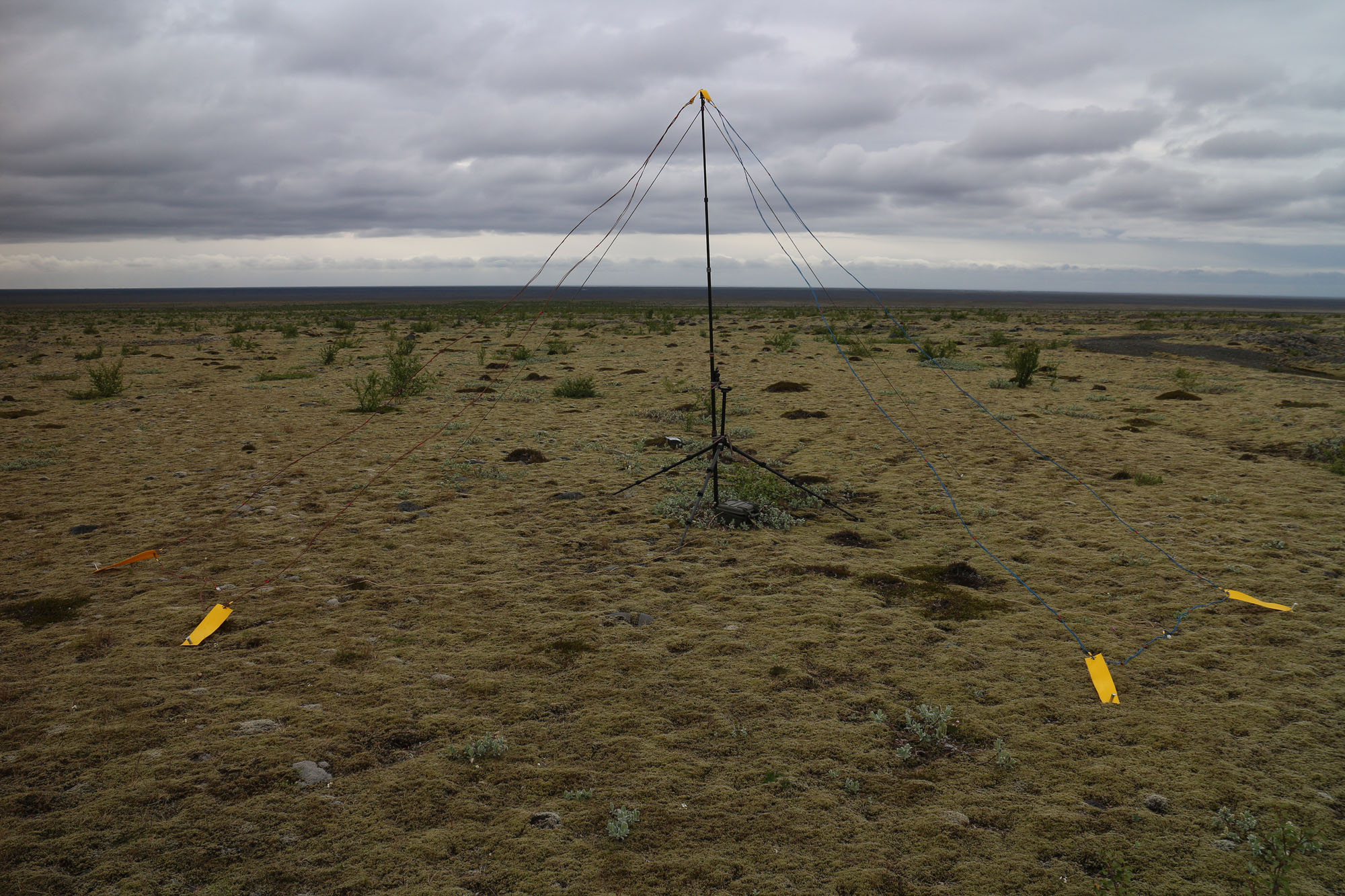
Therefore, here is a recording from mid August 2017, recorded at Skeiðarásandur south east Iceland. The recording location is far from mountains and human settlements, several kilometers from the nearest high-voltage line or electric fence . It was therefore relatively easy to clean electrical pollution from the recording. However, you can see in spectrogram (and hear) various weak radio signals and pulses, but most of them are above 15Khz.
This is not a „strong“ recording. In a real solar storm the „sparking sound“ is more powerful with more depth and colorful sounds. My favorite sound in space weather recordings is „Whistler„. I have only heard it once with my equipment, but Iceland is actually not located on the best latitude.
(mp3 256Kbps / 60,8Mb)
Recorder: Olympus LS10
ELF/VLF Receiver: WR-9STL
Antenna: Two 3 meters high triangle loops, X/Y setup on carbon fiber boom pole
It doesn’t happen often that my recordings are „interrupted“ by animals. But it happened last weekend when I was recording at my traditional place in Stafholtstungur in western Iceland. This time it was mice that seemed to gnaw the rubber on the tripod or the cables that ran up to the microphones. When the recording had been going on for three hours and it was 3 o’clock in the morning, the commotion in the mice started to keep me awake. It was as if they had gnawed a hole all the way into the windshield. So I went out and gave them a piece of cake next to the microphone stand. That made them stop biting the microphones. Instead, they started gnawing on the cake, which you can clearly hear after I brought the slice of cake.
This is traditional night silence. The background noise is mainly the wind in the leaves as well as the traffic of individual cars several kilometers away. I did not clean the internal mic noise in this recording as there is no need for it. Here it was recorded with 48dB gain on SD788 and in post-processing the volume was increased by +10dB up to peak -5dB.
Quality open headphones are recommended while listening at low to mid volume.
If the media player doesn’t start to play, please reload this individual blog in a new tab or frame.
I far too rarely go out to sea or lakes to record underwater soundscapes. The problem is probably that I need to get to a depth of 30 meters or more, be calm and smooth seas and be free of ship and boat traffic. In places where currents can be expected, I prefer to be able to attach to a buoy, because I want to be able to record for an hour or more.
Such situations are not directly accessible around me, but sometimes places are discovered in the most unlikely places. I found one not far from my workplace, which is the largest shipping port in Iceland.
There were no cargo ships in port, so I was probably free from engine noise. Not far away were 3 large cruise ships. But the remarkable thing about these ships was that there was no engine noise from them, although I know that the ships are not connected to land. There was only a strong 22Khz signal, probably from a sonar which I could easily delete in post processing so it shouldn’t bother those with good hearing.
In my opinion, this is not a remarkable recording, but still you can hear a „natural silence“ even if there were some waves on the surface, which usually produces white noise. I settled on a pontoon dock south east of Viðey island during the high tide, to be able to have the maximum depth which was 6-7 meters.
It was a good place to be able to sit on the pier for a while and forget myself while listening to the soundscape of the sea below while the recorder recorded.
It had been raining heavily hours before so the loudest thing in this recording is the raindrops falling from the pier floor to the sea above the hydrophones.
Shortly after the recording starts, there is a light rain shower which is clearly heard as added noise. Behind all this noise from water drops and rain, you can hear soft clicks and sparks that I suspect are coming from Blue Mussels and a low-short „fart“ sound that I think is coming from Pollock. At one point in the recording, you can hear bubbles, possibly methane gas, coming up from the ocean floor. Other strange sounds similar to birdsong can also be detected, which are not easy to identify where they are coming from. It is therefore important to pay attention while listening.
This is a recording made at midnight. Perhaps more life would have been heard on a bright, sunny day. But since I have made some nice recordings in the sea in the last months in several places, this recording seems to describe a rather typical acoustic environment inside the fjords along the coast of Iceland.
Quality open headphones are recommended while listening at low to mid volume.
If the media player doesn’t start to play, please reload this individual blog in a new tab or frame.
Early in July 2023 I spent one night at Sultártangalón lagoon recording in three locations.
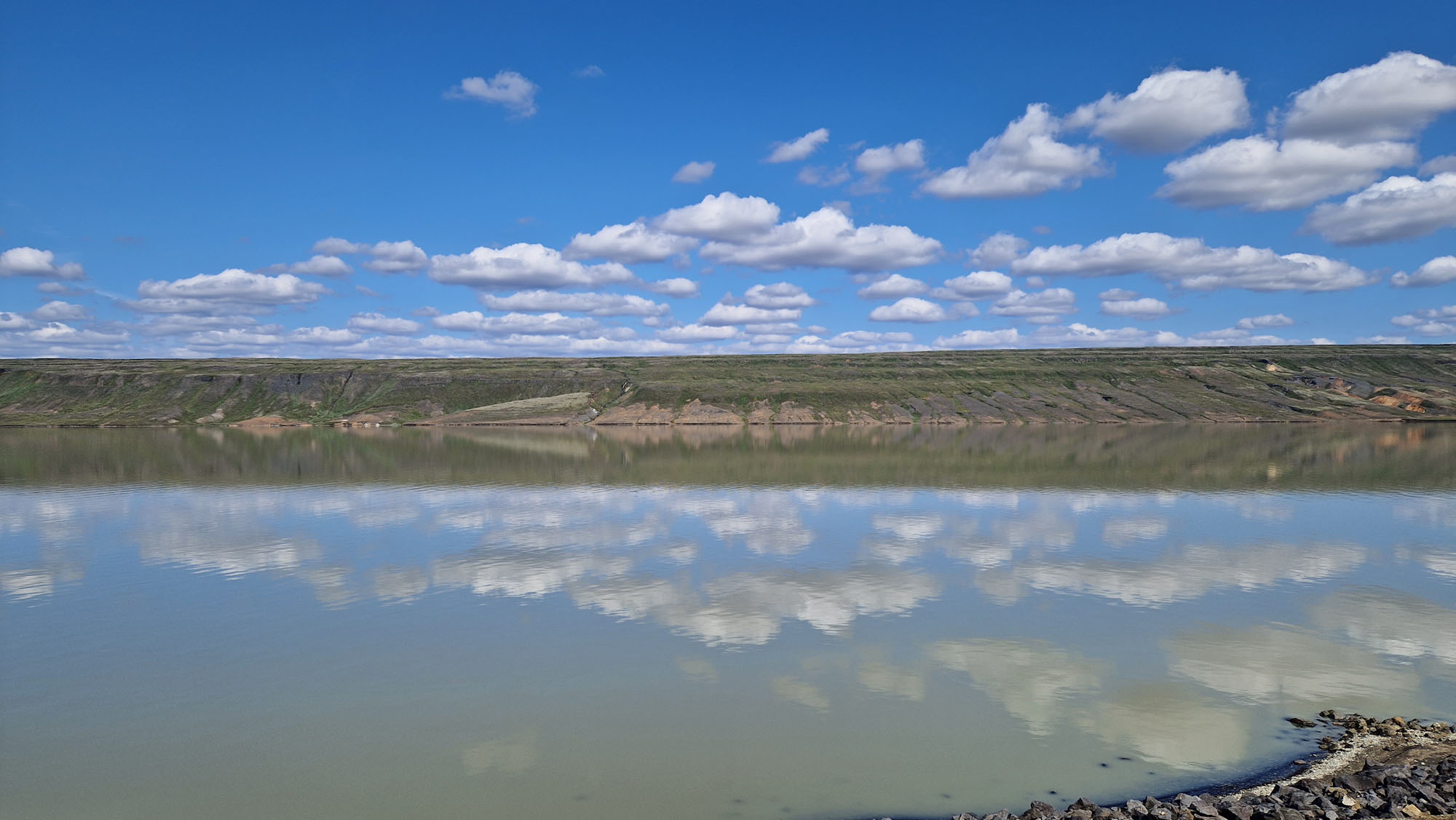
In the morning when I was leaving, it was sunny, calm and very hot, in the Icelandic way. The sight over the mirror smooth lagoon made me stop the car and enjoy the view. The recorders were ready and connected in the car, so I quickly set them up by the reservoir and took a short walk while they were recording.
The result was this. Typical Icelandic highland silence. Nothing interesting as an audio recording, but what caught my attention was the background noise of waterfalls and streams across the lagoon. This noise changed the EQ slowly in a variable thermal upstream due to the influence of the sun radiation.
Several bird species can be heard in this recording. These include Raven, Golden Plover, Dunlin, White Wagtail, Meadow Pipit and Red Throated Loon.
This was recorded with MKH8020/8040 in a fur wind shield, which was not the best choice, because the silence was considerable. Audio was recorded on MP6 with 50dB gain and in post-processing the gain was increased by another 20dB so they reached -10dBu.The MKH microphones were therefore not the most suitable for this moment. It would have been better if I had recorded with the LCT540s in IRT, to better capture all the small details all around.
To cancel out the loss of certain frequencies due to the fur wind shield, I raised the mid frequency by +2dB.
This is a rather sensitive recording. So I wasn’t using RX de-noise. But instead since nothing in the recording reaches frequencies higher than 8Khz, I lowered the EQ above 10Khz by a few dB to reduce the self noise in the microphones.
Quality open headphones are recommended while listening at low to mid volume.
If the media player doesn’t start to play, please reload this individual blog in a new tab or frame.