I do quite a bit of recording music, so it would be nice to be able to publish some of it here, especially music that I think is extremely well played and where the recording has been successful. For example, I have often wanted to put classical music on the web in December and January. But professionals have little interest in giving permission for this, possibly because I only ask these people once.
So I’m going to share different music instead, which is even more beautiful than all music, but it’s birdsong in the spring.
Here is a recording from last spring that I had forgotten I had recorded.
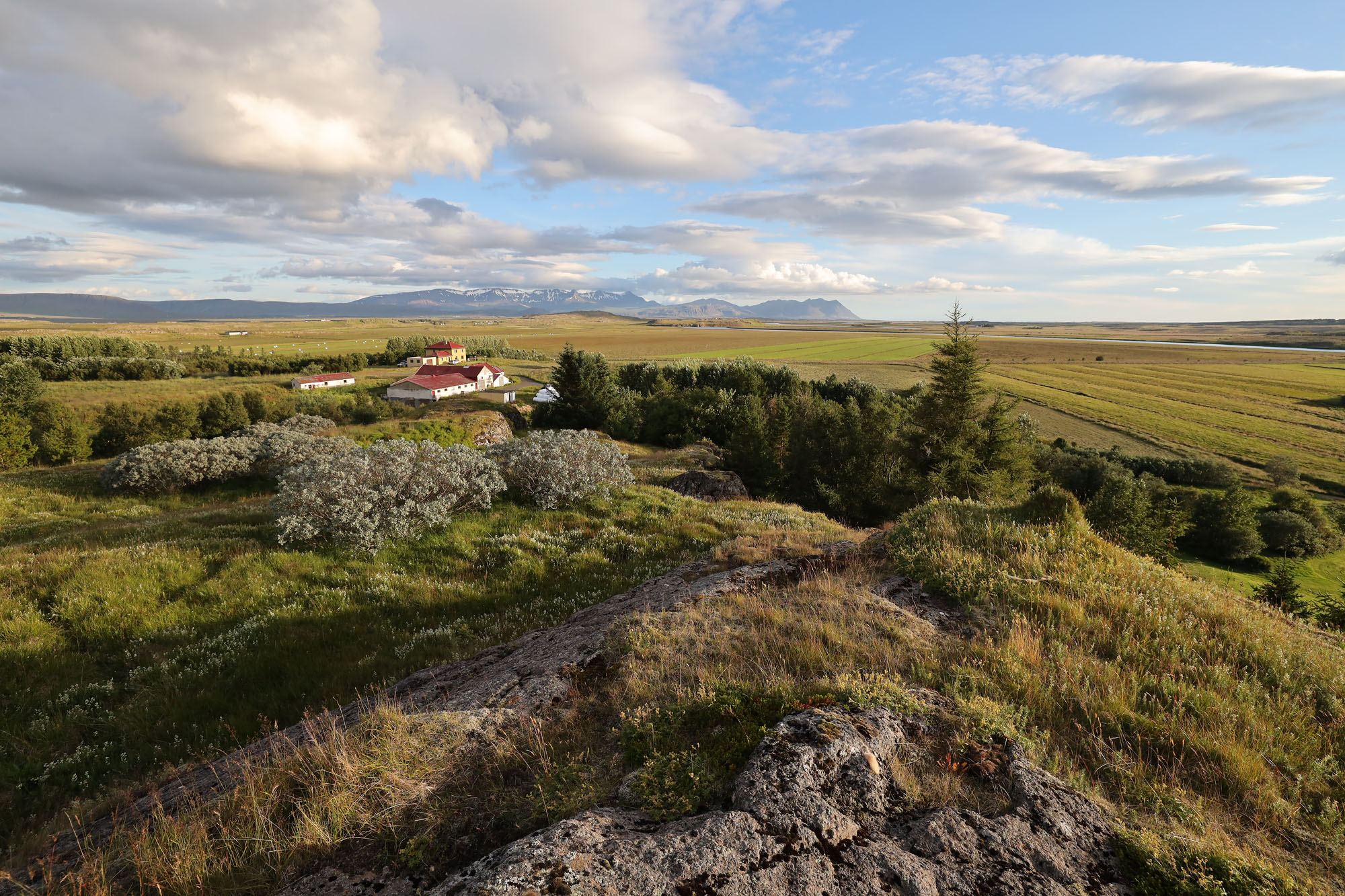
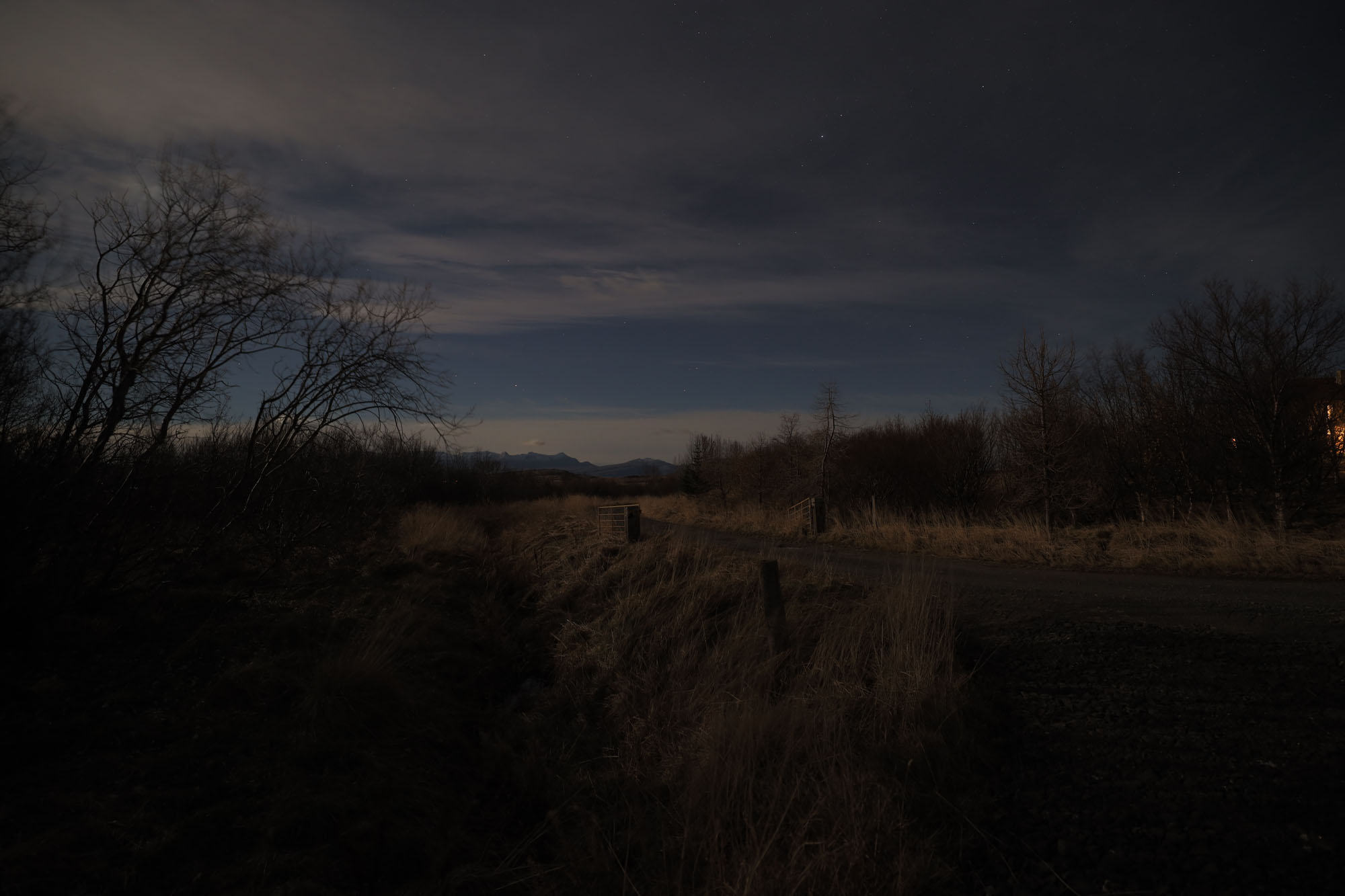
I had a Zoom F3 device recording in several places almost non-stop for several days in Stafholtstungur, western Iceland. I used Rode NT1 microphones and set them up to NOS 90°/30cm. It can hardly be considered the best setup for such long nature recordings. The reason is that sounds such as background noise from the wind, rustling of leaves, running streams and traffic can change a lot in 24 hours, so the sound pressure between channels can easily go out of balance. It can even be detected in this recording. Some traffic can be detected at a distance of 5-10 km in the (left) channel. That’s why it’s usually best to record in AB 40-50cm, if you’re going to record for a long time.
But since I primarily record natural „silence“, there are not many microphones that handle silence well and the ones that do it best are all cardioid, which has led me to start recording a lot in IRT (4ch 90°/30cm)
In some cases, it is possible to set the cardioid up to AB 40-50cm, but you cannot do that unless you intend to record from one direction. In this place the sounds were coming from all directions so it was not available.
It’s a low-key recording, actually amplified silence. Recorded at „Zoom gain at 256“ and HPF 40hz. In post-processing the recording was normalized (+25) up to -7dB
There is a lot of recorded material here that I feel is a shame to be forgotten on hard disks, so I’m going to allow myself to call this „Part 1“ because Part 2 and 3 and more also need to get here on the web.
The footage will therefore not be exactly from the recording location, but not further than 500 meters away.
Quality open headphones are recommended while listening at low to mid volume.
If the media player doesn’t start to play, please reload this individual blog in a new tab or frame.
(mp3 256kbps /66,5Mb)
Recorder: Zoom F3
Mics Rode NT1 (NOS 90°/30cm)
Mics: Canon EOS R
Weather: Calm, partly cloudy, around 7 to 10°C
One of the things I’m quite interested in is recording space weather or „auroral chorus“ with a ELF/VLF receiver.
This space weather is electrically charged particles coming from the sun into the upper atmosphere, the same ones that form the northern lights, or Aurora.
The receiver therefore only detects radio frequency on a very long wavelength or at 20hz up to 20Khz
The problem, however, is that I have never been able to devote enough time to this hobby. So I don’t have many recordings of this material.
It is not enough to have a lot of equipment. I really need to have knowledge of the subject to get what I want. To be in the right place and time when events happen in the solar system and in the Earth’s thermosphere. In addition, I am always busy not letting technical ignorance affect the quality of recordings, so knowing antenna theory and receiver design is also important. But in antenna studies I know nothing, especially because of my poor math skills.
Due to lack of time, I did not even build the tuner, which is though very simple, so I bought a tuner from Stephen P McGreevy. That receiver is made for two loop antennas, so it is possible to record in stereo.
Through poor skills, I have prepared two types of antennas. One is built according to Stephan’s specification, which is nice in many ways, but takes on too much wind which sometimes interferes with the recording. Then I have make another one that unfortunately produces (or receives) a lot of „pink noise“. But that antenna is fast to set up and very convenient for finding the right X/Y axis for stereo recording.
But not everything is counted. As well as air and noise pollution from people, there is also an enormous amount of strong electrical pollution everywhere in human settlements, literally in all frequency ranges. So I also need to find places where there is little or no electrical pollution. I’m also not allowed to be near tall trees or high mountains. High voltage lines, radio transmitters and electrical fences must be many kilometers away. It therefore puts a lot of strain on patience and long journeys that are often fruitless. I therefore try to use the time I use for nature recordings to record simultaneously VLF space weather recordings.
It was just the other day that I discovered a place incredibly close to Reykjavík that was remarkably free of electrical pollution, as well as a request from a composer and two musicians for a recording, that made me see if I could pull out the equipment and start recording something. Probably make better antennas.
But as the sun is quite calm these days, actually these months and years according to the „annual solar cycle„, it could be a difficult task to get a good recording.
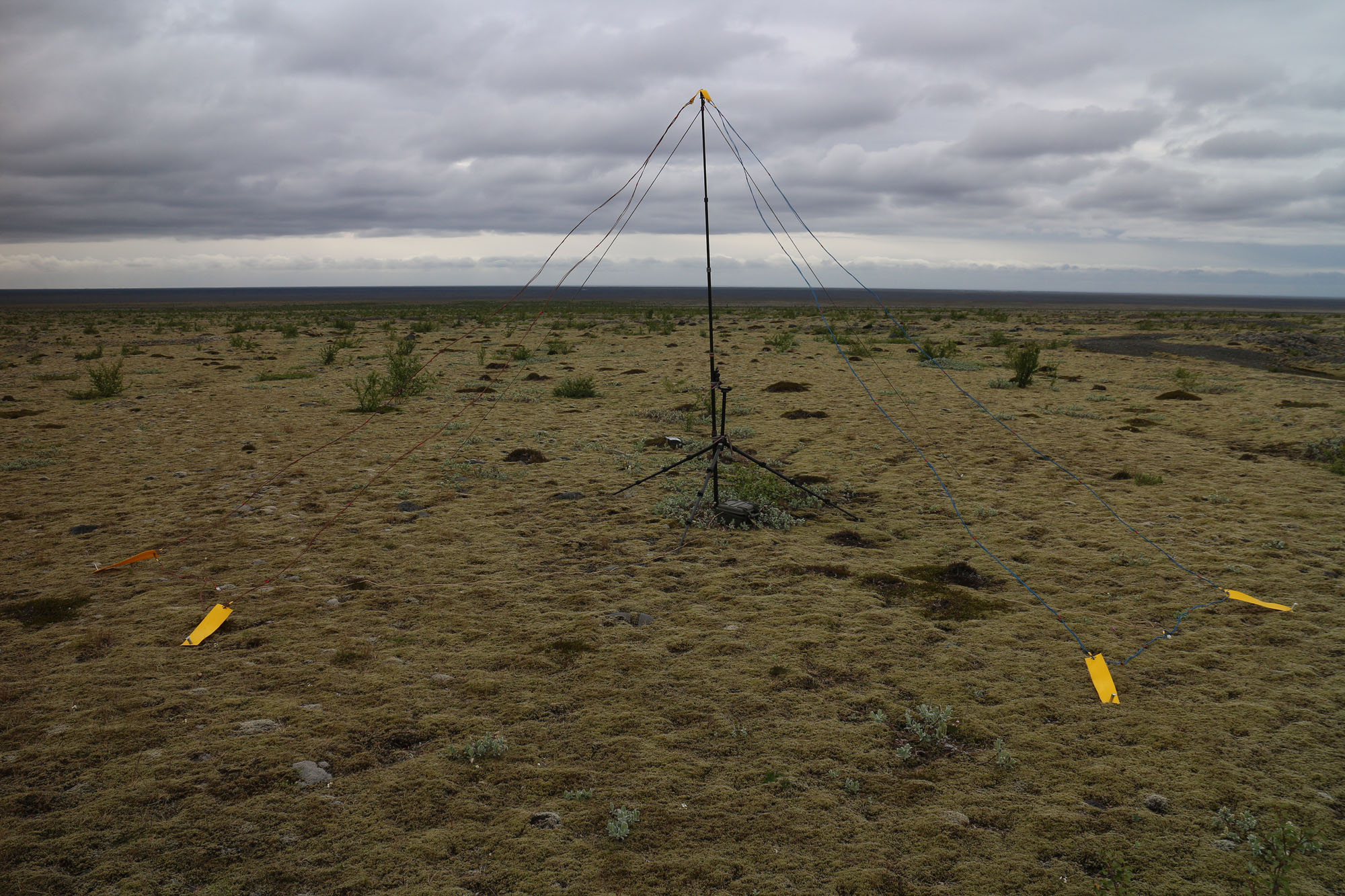
Therefore, here is a recording from mid August 2017, recorded at Skeiðarásandur south east Iceland. The recording location is far from mountains and human settlements, several kilometers from the nearest high-voltage line or electric fence . It was therefore relatively easy to clean electrical pollution from the recording. However, you can see in spectrogram (and hear) various weak radio signals and pulses, but most of them are above 15Khz.
This is not a „strong“ recording. In a real solar storm the „sparking sound“ is more powerful with more depth and colorful sounds. My favorite sound in space weather recordings is „Whistler„. I have only heard it once with my equipment, but Iceland is actually not located on the best latitude.
(mp3 256Kbps / 60,8Mb)
Recorder: Olympus LS10
ELF/VLF Receiver: WR-9STL
Antenna: Two 3 meters high triangle loops, X/Y setup on carbon fiber boom pole
It doesn’t happen often that my recordings are „interrupted“ by animals. But it happened last weekend when I was recording at my traditional place in Stafholtstungur in western Iceland. This time it was mice that seemed to gnaw the rubber on the tripod or the cables that ran up to the microphones. When the recording had been going on for three hours and it was 3 o’clock in the morning, the commotion in the mice started to keep me awake. It was as if they had gnawed a hole all the way into the windshield. So I went out and gave them a piece of cake next to the microphone stand. That made them stop biting the microphones. Instead, they started gnawing on the cake, which you can clearly hear after I brought the slice of cake.
This is traditional night silence. The background noise is mainly the wind in the leaves as well as the traffic of individual cars several kilometers away. I did not clean the internal mic noise in this recording as there is no need for it. Here it was recorded with 48dB gain on SD788 and in post-processing the volume was increased by +10dB up to peak -5dB.
Quality open headphones are recommended while listening at low to mid volume.
If the media player doesn’t start to play, please reload this individual blog in a new tab or frame.
I far too rarely go out to sea or lakes to record underwater soundscapes. The problem is probably that I need to get to a depth of 30 meters or more, be calm and smooth seas and be free of ship and boat traffic. In places where currents can be expected, I prefer to be able to attach to a buoy, because I want to be able to record for an hour or more.
Such situations are not directly accessible around me, but sometimes places are discovered in the most unlikely places. I found one not far from my workplace, which is the largest shipping port in Iceland.
There were no cargo ships in port, so I was probably free from engine noise. Not far away were 3 large cruise ships. But the remarkable thing about these ships was that there was no engine noise from them, although I know that the ships are not connected to land. There was only a strong 22Khz signal, probably from a sonar which I could easily delete in post processing so it shouldn’t bother those with good hearing.
In my opinion, this is not a remarkable recording, but still you can hear a „natural silence“ even if there were some waves on the surface, which usually produces white noise. I settled on a pontoon dock south east of Viðey island during the high tide, to be able to have the maximum depth which was 6-7 meters.
It was a good place to be able to sit on the pier for a while and forget myself while listening to the soundscape of the sea below while the recorder recorded.
It had been raining heavily hours before so the loudest thing in this recording is the raindrops falling from the pier floor to the sea above the hydrophones.
Shortly after the recording starts, there is a light rain shower which is clearly heard as added noise. Behind all this noise from water drops and rain, you can hear soft clicks and sparks that I suspect are coming from Blue Mussels and a low-short „fart“ sound that I think is coming from Pollock. At one point in the recording, you can hear bubbles, possibly methane gas, coming up from the ocean floor. Other strange sounds similar to birdsong can also be detected, which are not easy to identify where they are coming from. It is therefore important to pay attention while listening.
This is a recording made at midnight. Perhaps more life would have been heard on a bright, sunny day. But since I have made some nice recordings in the sea in the last months in several places, this recording seems to describe a rather typical acoustic environment inside the fjords along the coast of Iceland.
Quality open headphones are recommended while listening at low to mid volume.
If the media player doesn’t start to play, please reload this individual blog in a new tab or frame.
Early in July 2023 I spent one night at Sultártangalón lagoon recording in three locations.
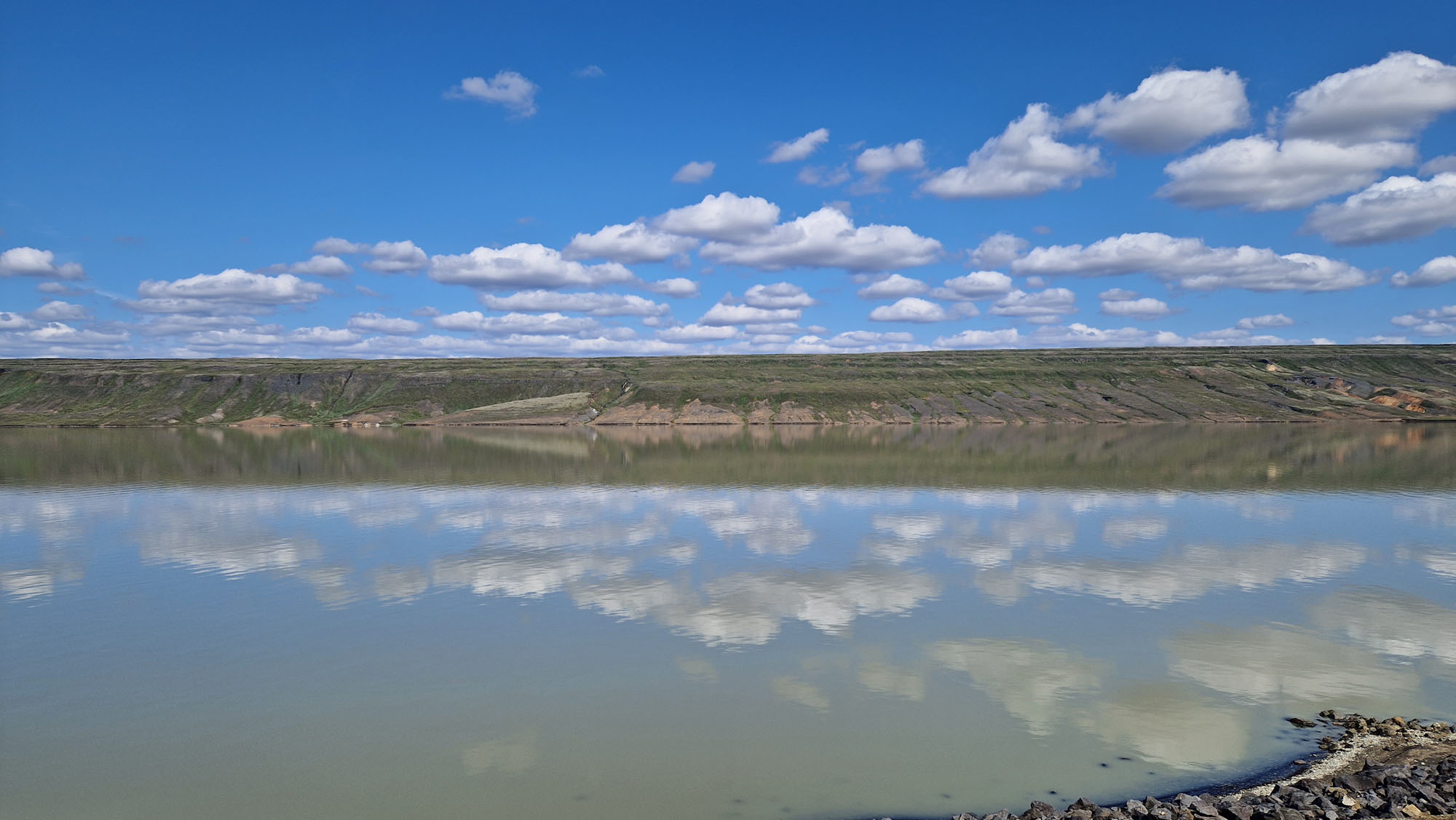
In the morning when I was leaving, it was sunny, calm and very hot, in the Icelandic way. The sight over the mirror smooth lagoon made me stop the car and enjoy the view. The recorders were ready and connected in the car, so I quickly set them up by the reservoir and took a short walk while they were recording.
The result was this. Typical Icelandic highland silence. Nothing interesting as an audio recording, but what caught my attention was the background noise of waterfalls and streams across the lagoon. This noise changed the EQ slowly in a variable thermal upstream due to the influence of the sun radiation.
Several bird species can be heard in this recording. These include Raven, Golden Plover, Dunlin, White Wagtail, Meadow Pipit and Red Throated Loon.
This was recorded with MKH8020/8040 in a fur wind shield, which was not the best choice, because the silence was considerable. Audio was recorded on MP6 with 50dB gain and in post-processing the gain was increased by another 20dB so they reached -10dBu.The MKH microphones were therefore not the most suitable for this moment. It would have been better if I had recorded with the LCT540s in IRT, to better capture all the small details all around.
To cancel out the loss of certain frequencies due to the fur wind shield, I raised the mid frequency by +2dB.
This is a rather sensitive recording. So I wasn’t using RX de-noise. But instead since nothing in the recording reaches frequencies higher than 8Khz, I lowered the EQ above 10Khz by a few dB to reduce the self noise in the microphones.
Quality open headphones are recommended while listening at low to mid volume.
If the media player doesn’t start to play, please reload this individual blog in a new tab or frame.
The remarkable thing happened in the winter of 2022-2023 in Iceland, at least in the southwest, that there were many consecutive days with severe frost. The winter was undeniably reminiscent of the winters of the 1970s and 1980s, when catastrophic or global warming had neither become tangible nor existed in the dictionary.
This gave me the opportunity to record under ice, which I hadn’t done before.
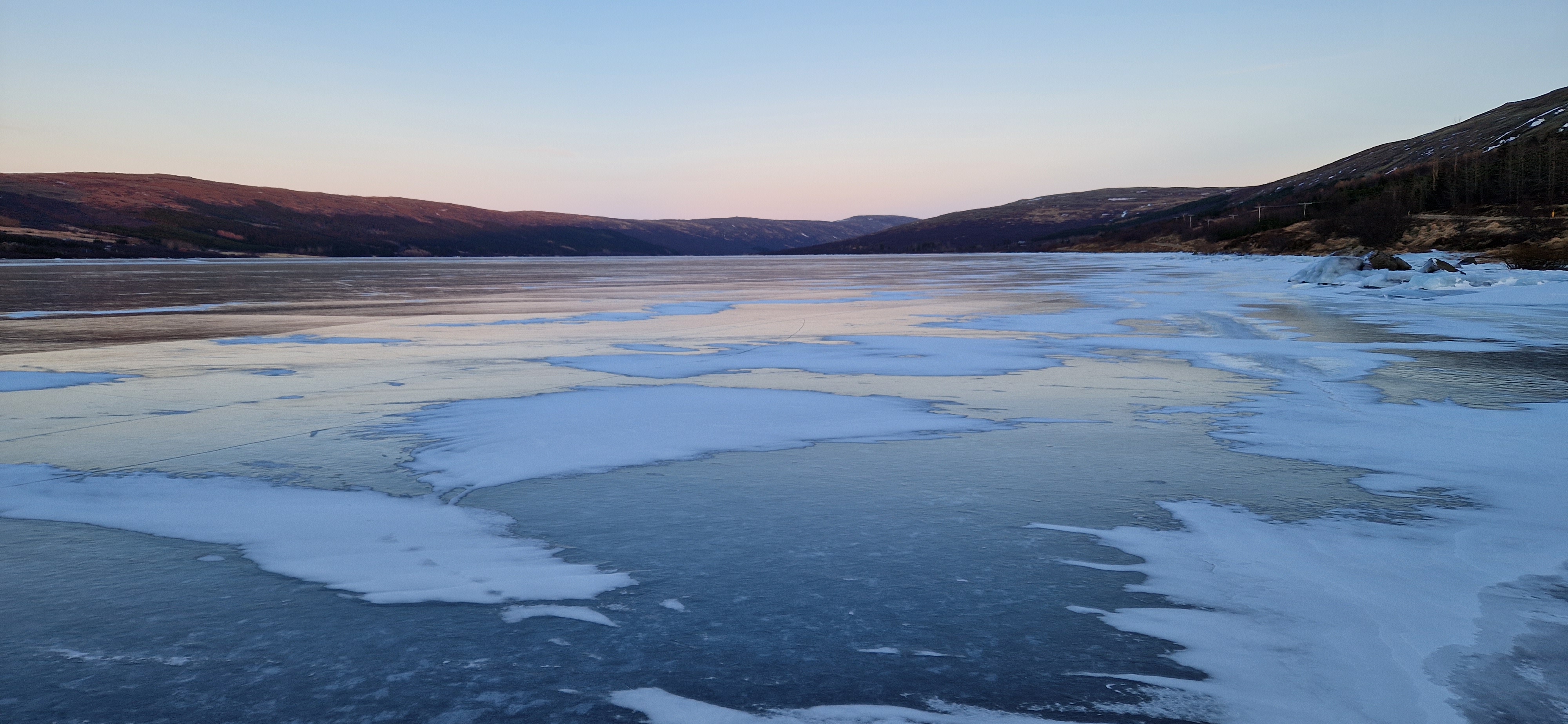
I invested in a proper ice drill and managed to make three trips to Skorradalsvatn lake to record under and over the ice. But the lake is located about an hour’s drive from Reykjavík.
It was surprising that the sounds from frozen lakes are not produced by the frost alone and the variable expansion of the ice. Rather, it primarily depends on the wind strength, size and depth of the lake.
Although everything seems flat and there are no waves visible on the ice surface, there is a lot going on. Especially under the ice, where there is clearly significantly more noise than on the surface. On the surface, you hear mainly „drone squeals“ and occasional clicks and breaks, which are also interesting to record.
The following recording was recorded approx. in 8 meters depth, not far from the place where the lake is deepest, or about 60 meters. Many things can be said about this recording. I’m not entirely happy with it, which I’m not going to mention here. But recording ice on lakes is clearly a very interesting subject. Something I hope to be able to do much more often in the future.
Depth and size of the lake. Shape of the lake and lake bed, volume of wind and snow, ice thickness and ice temperature, everything matters if I like to catch these amazing sounds.
I’m always traveling alone, so I didn’t take any risks by going far out on the ice this time. But I will definitely try it sometime if mother nature and luck gives me such a perfect winter again.
Quality open headphones are recommended while listening at low to mid volume. There are a lot of very powerful sounds in this recording that can easily damage your hearing and speakers. I therefore do not recommend high volume
If the media player doesn’t start to play, please reload this individual blog in a new tab or frame.
I don’t expect many people to be interested in listening to this recording. It is mainly a silence. But this is just a normal natural Icelandic soundscape in calm winter weather, so I have a lot of stuff like that in my collection which I think should be published in this blog
At least I can tell. it is very good to fall asleep from recording like this.
This one was made overnight on 4th of March 2023 and the time is around 5 o’clock. For some reason, there was unusually low traffic that night. Perhaps it had to do with the fact that the television that evening had some musical contest, so lots of folks in the county had been drinking alcohol that night. So there were few people who could or had to drive unnecessarily around the countryside that night.
But anyway it is a traffic noise in this recording. Mainly from the main road no:1 for about 5km away and one car will pass by the recording location, 250 meters away. So don’t play this too loud.
As expected at this time of year, silence was something that was significant from nature’s side. Fortunately, the weather was completely calm. It gave me the opportunity not to use low pass filter LPF, which gave me the ability to listen for a variety of low-frequency sounds that I’ve often encountered on this recording site before but has been hard to explain. Was it an earthquake or something else?
When silence is greatest, there is little or nothing that attracts attention in this recording. Two foxes can be heard calling. Rock ptarmigan, ducks and swans in the distance. But as ears sink deeper into the material and every sound is separated from each other and from the background noise, there is the „sound of water“. Sound of wet grass. Maybe an ice crystal transformed to a drop of water. At times, you may hear a „flow of water“. Probably a small creek far away or maybe as well an underground water flow because there is no stream nearby. But the ground in this place has thin soil on a rocky glacial soil
The background noise is equally fascinating. Some of them are known and could best be considered as „technical problems“. But there are also intriguing things to be found because sometimes it is hard to figure out where this noise comes from.
So let’s talk about „background noise“
At the lowest frequency, the vibrations caused by the wind are usually almost always detected, i.e. “Brown noise”. Hence, it is usually necessary to use HPF for all outdoor recordings, except in recordings like this where the weather’s so calm that it’s like being in a wardrobe. This recording, as well as others I’ve done at this location, may include rumbles or knocks that may come from a horse or horses from a great distance, possibly some kilometers away. I think this noise coming this distance travels through the ground. It might be earthquakes, but it is unlikely in this recording. Apart from the distinctly low frequency of sounds that take place in a particular setting, I suspect that the constant rumblings that can be heard in the recording have both technical and natural explanations, which mostly though is related to turbulence in the air.
On the other side of the frequency curve, at the highest frequencies, “blue noise”.
It is usually only self noise from the microphones and recorder’s amplifiers. I tried very carefully to use RX for noise reduction, but there is always a limit to what is possible to do without spoiling the recording.
In the middle is “Green noise,” something that always interests me. This is a background noise that normally includes sounds that may come from far away and be heard only in a calm weather.
There is something called “Sea State Zero Noise,” a natural silence, or background noise in the oceans. I believe that something similar is happening here. This is noise, which is due to a number of natural factors, but mainly because of the wind and water in the combination of temperature and atmospheric conditions. Today, though, „mechanical traffic“ has constantly been overwhelming the natural noise. The source of this “green noise” like the recording below has a possible origin from car traffic up to 20Km away. From the surf at the beach shoreline 20 to 30 km away as well from a waterfall behind hills, in a canyon 7km away. None of these sounds are discernible to the bare ears. So for me it is often good to identify which direction this theme comes from by recording in IRT setup as this one.
In this recording (or that night) this green noise varies as a calm wave in different frequencies. Whether it is due to variations in air pressures or layering of temperatures or something else, I cannot easily confirm
Therefore, it is best to listen and let the imagination guide you to the course.
For those of you who find a lot of noise in this recording, I would like to remind you that it was recorded with 50dB gain. In post-production the gain is increased by another 25db, up to -10dB peak. So I agree, this recording certainly doesn’t sound good. But I think you can’t do better with the Lewitt 540s and Sonosax SX-R4+ in silence.
Quality open headphones are recommended while listening at low to mid volume.
If the media player doesn’t start to play, please reload this individual blog in a new tab or frame.
(mp3 256kbps / 56Mb)
Recorder: Sonosax SX R4+
Mics: Lewitt LCT540s in IRT setup
Pix: Canon EOS-R
Location: 64.673374, -21.628710
Weather: Calm, partly cloudy, 0°C
Information about „color of noise„
Early last spring I was asked if I wanted to record a 24-hour long recording for Radio Art Zone.
It wasn’t a problem because I’m used to recording 8-14 hours of content whenever I can.
So I made two / three 24hrs recordings in total. All recorded in similar locations on the 23rd-25th. April 2022 in the countryside.
I recorded on four channels with an IRT cross version and in two other locations with two channels in AB & NOS.
If I remember correctly, I sent the IRT recording to Radio art project. The AB recording is already audible on this soundblog, „The brook below Lambaklettur“
The NOS recording was forgotten, until I found it last week.
It was recorded with Rode NT1 microphones and a Zoom F3 recorder.
This recording contains natural „silence“. When I talk about „silence“ I mean that most people would not hear anything with bare ears. Probably only the blood flow in their own body.
But it was not total silence when this recording started here below. The migratory birds had already started to flock to the country. It was also a drizzly rain and therefore quite humid all night while the recording took place. The fur on the windshield got quite wet and you can hear larger drops falling on the wind shield, on the tripod and on the ground around.
This recording starts around the time when birds start to be heard in the early morning. The windshield is already very wet, so it must have adversely affected the recording quality. But surprisingly it is not heard that the NT1 is cracking due to air humidity.
The Zoom F3 had gain set at „256“ and HPF at 40Hz. I’m used to recording with 47 to 50dB gain for such silent recordings. Gain „256“ is therefore not telling me anything, but having worked on this recording, 256 seems to be something similar to 50 to 55 dB gain. This actually needs further consideration because It can be an important issue. The reason why I don’t record with a gain higher than 50dB on the Sound Devices or Sonosax recorders is to prevent additional „amplify noise“ that I feel increases if the gain is over +50dB. It is therefore always better to increase the gain digitally“ in post.
I have a hard time realizing this with the F3 device. The noise seems to go hand in hand with different gain. No matter what the gain is. Whether I should generally record with „256“ gain or „128“, when recording quiet soundscapes needs further testing. I find the noise a bit more in this recording than if I had recorded with the Sonosax for example, but that noise I hear and see on spectrograms could also be a sound from the drizzle, or raindrops when they fall to the ground. It can therefore be assumed that there is some natural noise in that recording. Therefore it is not entirely possible to blame F3 or NT1 for all the noise that can be heard.
The first sound file is over 30 minutes long which has got a gentle noise reduction and then below 5 minutes of original recording for comparison (without NR). Both recordings are normalized up to -10dB. The original files from the recorder had a -38dB peak value which is normal for „quiet“ recording like this.
Bird species in this recording is mainly common snipe, whooper swan, black tailed godwit, redwings, whimbrel, golden plover and eurasian wigeon. Most of them are in the distance in this recording.
I will post the continuation of this recording later. Then the number of birds increases and they come closer to the microphones.
Quality open headphones are recommended while listening at low volume.
If the media player doesn’t start to play, please reload this individual blog in a new tab or frame.
(mp3 256kbps / 62Mb)
Original recording from Zoom F3, only normalized up to -10dB & downgrade to mp3
(mp3 256kbps / 9,4Mb)
Recorder: Zoom F3
Mics: Rode NT1 (NOS)
Pics: Canon EOS R
I was recording at Breiðamerkurjökull when the weather forecast suddenly changed. It was nothing special, except that I had to row a kayak with another one in tow with a lot of recording equipment about 8 km on Jökulsárlón glacier lagoon before the weather would hit the area.
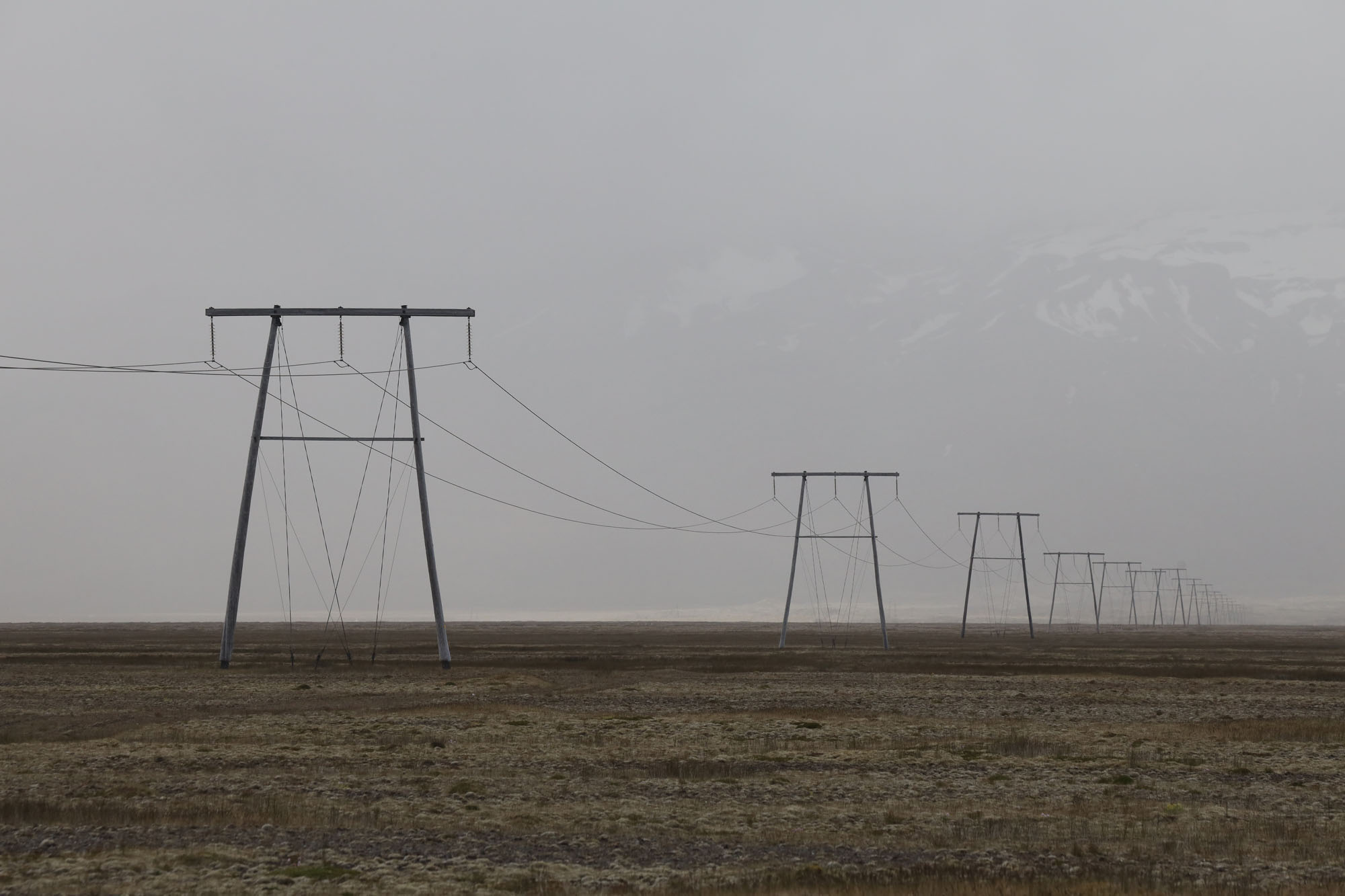
It fit, as soon as I got to land on the other side of the lagoon at midnight the fool weather arrived, so I just managed to pack all the equipment in the car and on the trailer before everything got wet. It was around two in the morning when I was able to leave. But I didn’t go far. I decided to sleep in the car near the high voltage power line (Byggðalína) on Breiðamerkursandi, south of highway no.1.
The next day it was dry, but still very windy. In fact, I could barely see Öræfjajökull glacier through a sandstorm. I decided not to be on the road with the trailer and the kayaks, but to wait until later in the day when it would calm down.
I could not sit idly by, but recorded in several places close to me. Including the high voltage line with all available equipment I had. With Omni & Cardioid microphones as well as Geophone and hydrophone which I use as a contact mic.
The result was quite amusing. By the time this happened, the strongest wind had subsided. But that moment a moisture was in the air, which caused a sizzle noise from the power line, which added a different sound and gave the recording a clearer picture of the recording location.
The recording below starts with the audible sound (microphone). Then slowly the contact mics are added . In the end and microphones faded out and you will only hear the sound from the contact mics (geophone and the hydrophone)
Because the microphone are located close to the ground in grass under the electricity pylons you will hear lot of „gray noise“ when the wind wipe the grass.
If you keep your attention Whimbrel are also audible.
So I explain the name of this blog, „Byggðalína“ is a name of high-voltage line that connects all the main settlements around Iceland. „Breiðamerkursandur“ is a name of a broad sandy wasteland south of Jökulsárlón Glacier lagoon.
At the end of July, a seismic period began on the Reykjanes peninsula, which ended with a volcanic eruption in Meradalar south of Reykjavík, not far from the place that last erupted in Fagradalsfjall during the COVID period.
I recorded for a few days during the earthquakes. Both with microphones and simultaneously with Geophones on four channels. After I had set up the microphones, the big quake stopped, but I did catch one that was 4.8 on magnitude.
When it started to erupt in Meradalir, the seismic activity stopped almost completely.
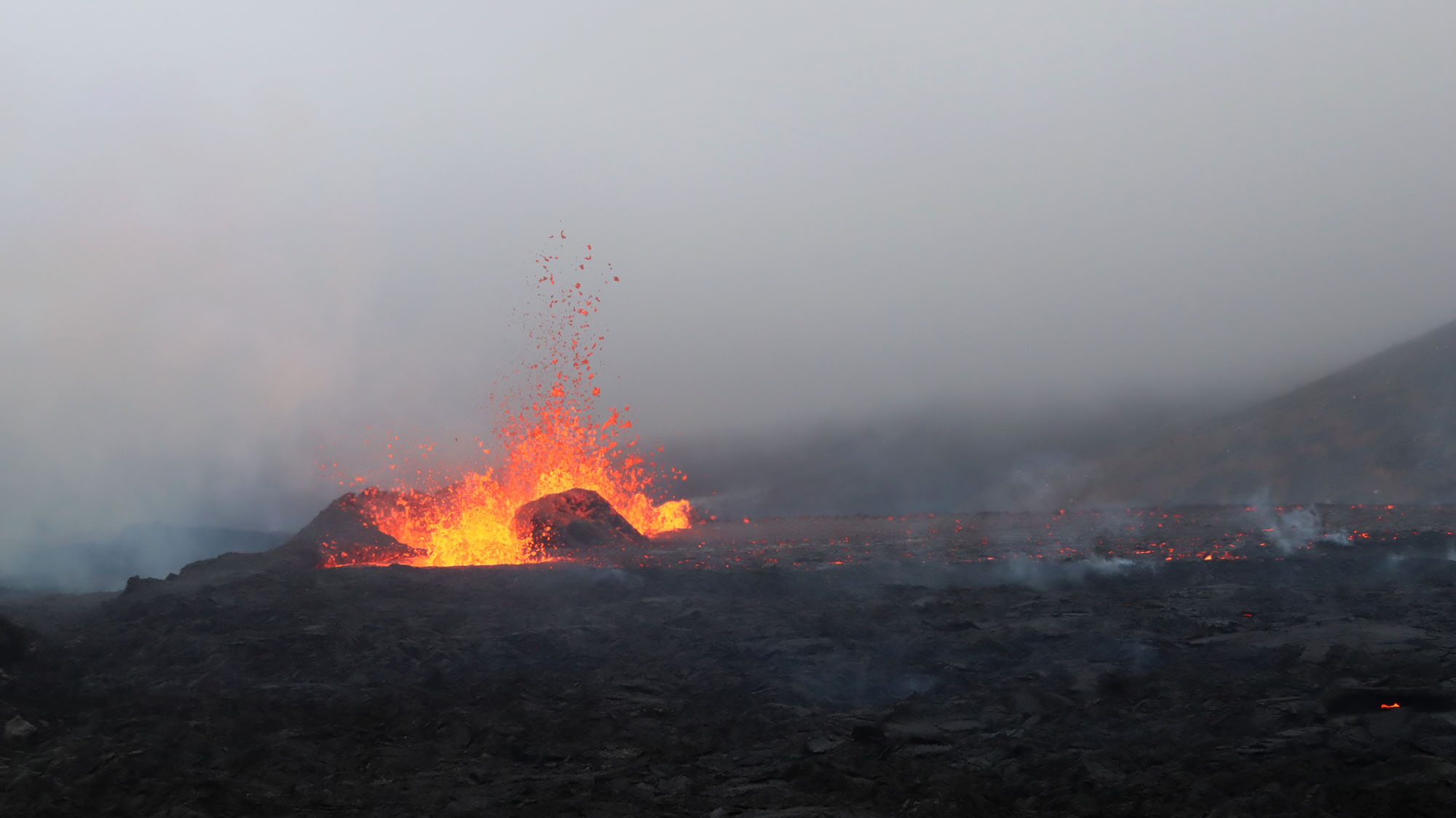
I took advantage of the weekend for a cycle trip to the eruption site and recorded approx. four hours of material. It was not easy. There was a lot of gas pollution and wind that are always characteristic of volcanic eruptions, but tourists and drones in the area never shut up.
I didn’t have a gas mask, which made the situation almost unbearable these four hours. It was therefore also impossible for me to record in places where other visitors could not reach.
I had my second best microphones for this project. It was my parallel MKH8020/8040 rig that gave me a lot of options to record a difficult and different subject. The attached recording is a small composite story of the events of the last few days, starting with an earthquake that then leads to a volcanic eruption.
The earthquake was recorded on four channels with two NT2a in MS configuration and two LOM geophones fixed in X/Y axis in my garage.
The eruption was recorded in AB40 on four channels with parallel MKH8020/8040 mic rig.
In post-processing, 8020 was used for the low frequency and 8040 was used for the higher frequency, which significantly reduced the noise from tourists and wind noise without losing the low frequency which in some places sounded more like a shock waves from the crater.
The recording of the eruption is from three places at the eruption site. You can actually hear it when I move the microphones once.
Then, unfortunately, drones and airplanes can be heard.
During the eruption, sounds are heard that would be worth explaining. There is a lot of all kinds of white noise, which mainly comes from glowing slag that splashes in all directions when it falls to the ground around the crater. It was also interesting to hear when it rained on the lava, an unusually loud white noise filled the air. It may be heard for a while in this recording.
Quality open headphones are recommended while listening at mid volume.
Be careful, this recording starts quietly. But most of it is pretty loud, especially at lower frequencies.
If the media player doesn’t start to play, please reload this individual blog in a new tab or frame.
(mp3 256 kbps / 65,2Mb)
Recorder: Sound Devices MixPre6
Mics: Rode NT2a in MS & LOM geophones in X/Y axis (earth quakes) and parallel MKH8020/8040 in AB40 (eruption site)
Pix: Canon EOS-M50
Weather: Wind 2-4m/sec, drizzle rain, foggy & 5-8°C
(but on the recording site, gust up to 20m/sec and 15-35°C )
Location: 63.900428, -22.246934
Eruption site on Map.is





 HLJÓÐMYND - SOUNDIMAGE