I have published many times recordings from the Nature Reserve Flói in southwest Iceland, so I will not introduce that area again.
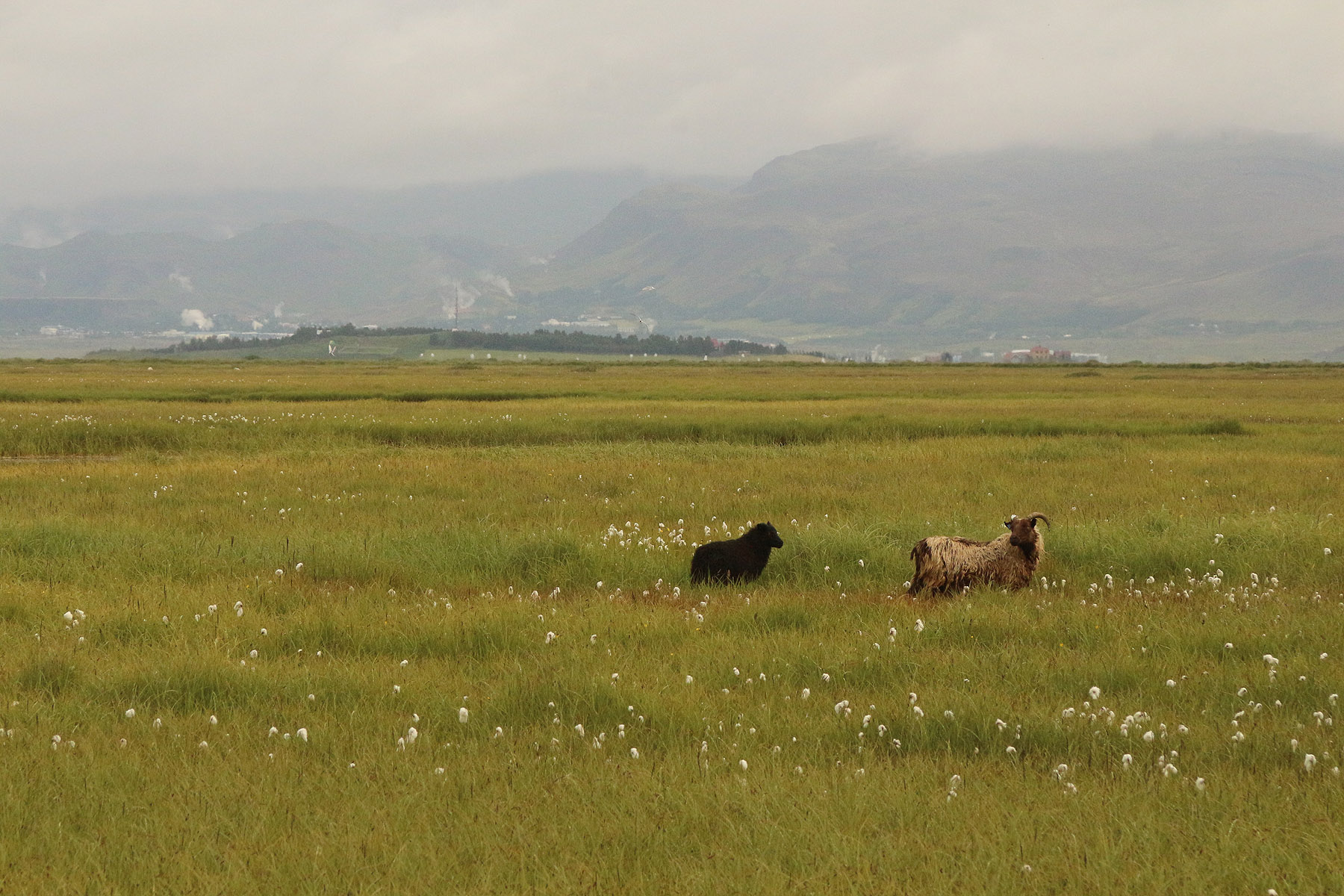
During the years I remember couple of times when curious sheeps have disturbed the recording. This is one of them.
This peace is a 30 minutes of nine hour overnight recording. It was recorded between 7 and 8 o´clock in the morning 25th of July 2015.
The recording is not only disturbed by the sheeps, it is also highly disturbed by tourist traffic, especially in the air. Jets are arriving and leaving the country and smaller planes in sightseeing so this peaceful area is not especially quite this time.
Quality open headphones are recommended while listening at medium level.
(256kbps / 57,2Mb)
Recorder: Sound devices 788
Mics: RodeNT1 (NOS) & MKH20 (AB40) as close together as possible
Pix: Canon EOSM
Location: 63.901026, -21.192189
Weather: Calm, cloudy, around 11°C
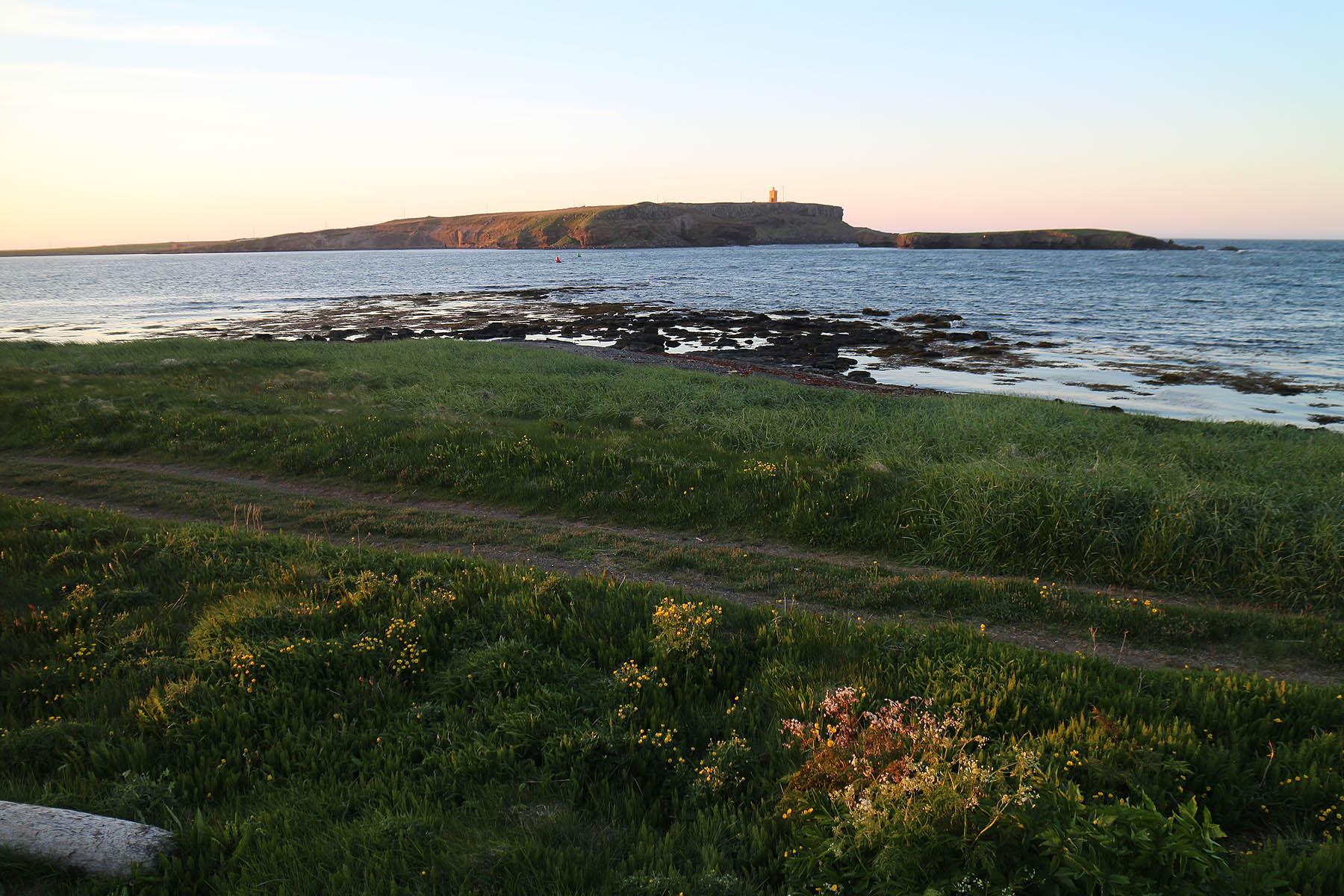
Last summer I spend one week at Raufarhöfn, a small village in north east of Iceland, close to the arctic circle. Most of the time it was a fool‘s weather for „quality“ recording. But anyway, I recorded almost 6 to 10 hours every night close to the sore. Most of theese recordings contains rumbling wind noise, but sometimes – very few times, I got what I was looking for.
Here is one of them, recorded 17th of June 2016.
It is early morning. The clock is around four. Birds are busy to protect and teach their young to search for food. Shortly after the recording starts, you can hear a fisherman pass by on his car on way to the harbor. Then later, the fishing boat goes, and passes by on the way to the sea. It takes a long time for the enginenoise to disrepair.
This is a peaceful recording. A typical midsummer morning soundscape at the arctic circle, where the sun never goes down. Many bird spices are in this recording, but mostly Common Eider and their youngs. Also you can hear Oystercatcher , Golden Plover, Purple Sandpiper, Red Necked Phalarope, Whimbrel, Common Snipe, Redwing, Snow Bunting, Svan, Great Northern Diver, Northern Fulmar, Kittiwake, Raven and probably may other.
Quality open headphones are recommended while listening at low to mid level.
It sounds a bit stupid to record silence. But if the equipment can capture something in the silence you can not hear with your bare ears, then it can be very interesting. For instance, you never know what you will see when you look into the deep space with telescope. You never know what you will hear in the silence with a low noise microphone.
I will not define all my views of different silence, but for sure, silence is never completely quiet and it is my favourite recording material.
Best time to get „silence“ is normally during the night in calm weather after sunny day (like this one). In such moments temperature waves are also calm or in layers, so sound can travel long distances without being disturbed. Noise from one car can travel up to 30 km in open field and if you hear it with your bare ears it will be clearly audible through most quality recording gear today. Amplifying sound with low noise microphone, works like a telescope. It drags weak sound far away closer to your ears. In places where you need to hold your breath to hear probably only your heart beat, it can be a very busy place in your headphones.
But there is also other kind of silence. It is on hot sunny days when wind blows and the air is very unstable. Sound normally does not travel long distances in such circumstances.
One of these days was 18th of July 2016 on the World Listening Day. I was traveling on Kjölur, west highland route in Iceland. The sun was shining all day and the wind was blowing from the south. I took of the main rode and followed a track into Kjalhraun lava field. My plan was to find the mysterious Beinahóll (Bone hill) and the field where Reynistaðabræður (Reynisstada brothers) and almost 200 sheeps lost their lives in a insane weather in September 1780. It is still possible to find bones on this field so for a long time I have bin interested in this tragic story.
But the track through the lava was too ruff for my car so I kept on by food.
Many times for almost three decades it has been my plan to find this place while travelling by bike over Kjölur. I never did it because I was always wearing a green jacket and for superstitions reasons it has been told dangerous.
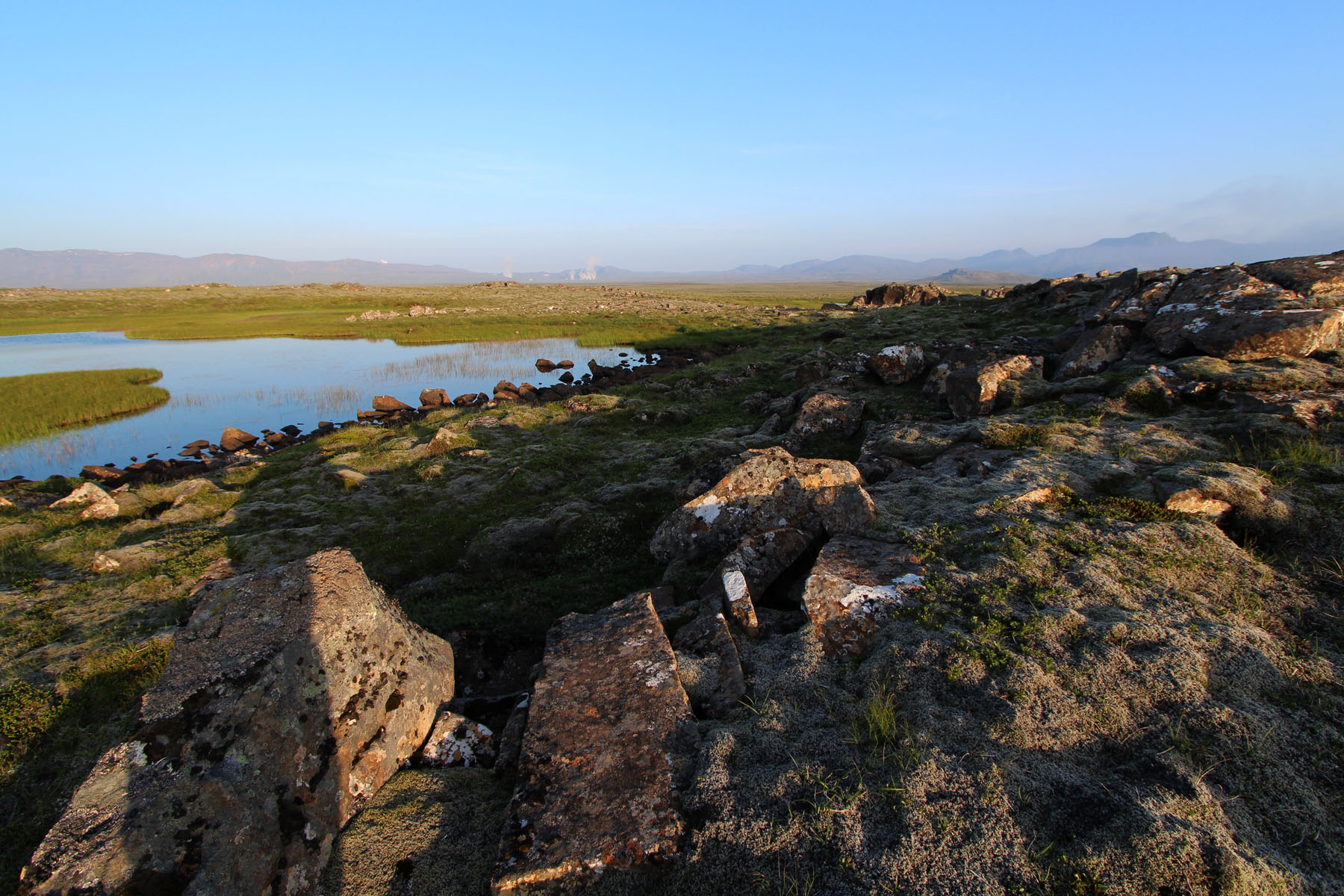
This time I did not find Beinahól. Instead I started recording the silence in the lava.
The weather was a typical sunny „midday silence“, where the thermal heat from the sun makes the air unstable so sound waves did not travel long distances.
This was one of these days I did not hear any plains or car traffic, even though Kjölur main route was not far away. When I held my breath, I only did hear weak bird song in the distance and some flies around. Because the mics are located close to the ground, you will also hear the wind wipe the ruff lava surface.
This recording is captured with MKH20 microphones and SD744 recorder. Gain was set at 56dB and HPF 80Hz. In post the gain was again raised about 25dB. Below 20Hz and above 10Khz the freq. was pulled down by 25dB.
Quality open headphones are recommended while listening at low to mid level, or in speakers at low level. Hold your breath while listening 🙂
(256Kbps / 46Mb)
Recorder: Sound devices 744
Mics Sennheiser MKH20 (AB40 setup)
Pics. EOS-M
Weather. Sunny, about 18°C, calm up to 3 m/s in gusts
Recording location: 64.77883, -19.42805
An outwash plain, also called a sandur is a plain formed of glacial sediments deposited by meltwater outwash at the terminus of a glacier. As it flows, the glacier grinds the underlying rock surface and carries the debris along. The meltwater at the snout of the glacier deposits its load of sediment over the outwash plain, with larger boulders being deposited near the terminal morraine, and smaller particles travelling further before being deposited. Sandurs are common in Iceland where geothermal activity accelerates the melting of ice flows and the deposition of sediment by meltwater.
The original sandur from which the general name is derived is Skeiðarársandur, a broad sandy wasteland along Iceland’s south-eastern coast, between the Vatnajökull icecap and the sea. Skeiðarársandur is the largest sandur in the world, covering an area of 1,300 km2 (500 sq mi). Volcanic eruptions under the icecap have given rise to many large glacial bursts (jökulhlaups in Icelandic), most recently in 1996, when the Ring Road was washed away (minor floods have also occurred since then). This road, which encircles Iceland and was completed in 1974, has since been repaired. The 1996 jökulhlaup was caused by the eruption of the Grímsvötn volcano, with peak flow estimated to be 50,000 m3/s (1,800,000 cu ft/s) compared to the normal summer peak flow of 200 to 400 m3/s (7,100–14,100 cu ft/s). Net deposition of sediment was estimated to be 12,800,000 m3 (450,000,000 cu ft).
The main braided channels of Skeiðarársandur are the Gígjukvísl and Skeiðará rivers, which incurred net gains of 29 and 24 cm (11.4 and 9.4 in) respectively during the 1996 jökulhlaup. In the Gígjukvísl there was massive sediment deposition of up to 12 m (39 ft), which occurred closest to the terminus of the glacier. The erosional patterns of Skeiðarársandur can be seen by looking at the centimeter-scale elevation differences measured with repeat-pass laser altimetry (LIDAR) flown in 1996 (pre-flood), 1997, and 2001. Of the overall deposition during the 1996 jökulhlaup, nearly half of the net gain had been eroded 4 years after the flood. These two rivers on the sandur display drastically different erosional patterns. The difference in sediment erosion can be attributed to the 2 km (1.2 mi) wide trench near the terminus where the Gígjukvísl flows, in contrast with the Skeiðará, which has braided flows directly onto the outwash plain. The Gígjukvísl river is where some of the highest level of sediment deposit occurred and also where the largest erosion happened afterward. This indicates that these massive jökulhlaup deposits may have a large geomorphic impact in the short term, but the net change on the surface relief could be minimal after a couple years to a decade. (*Wikipedia)
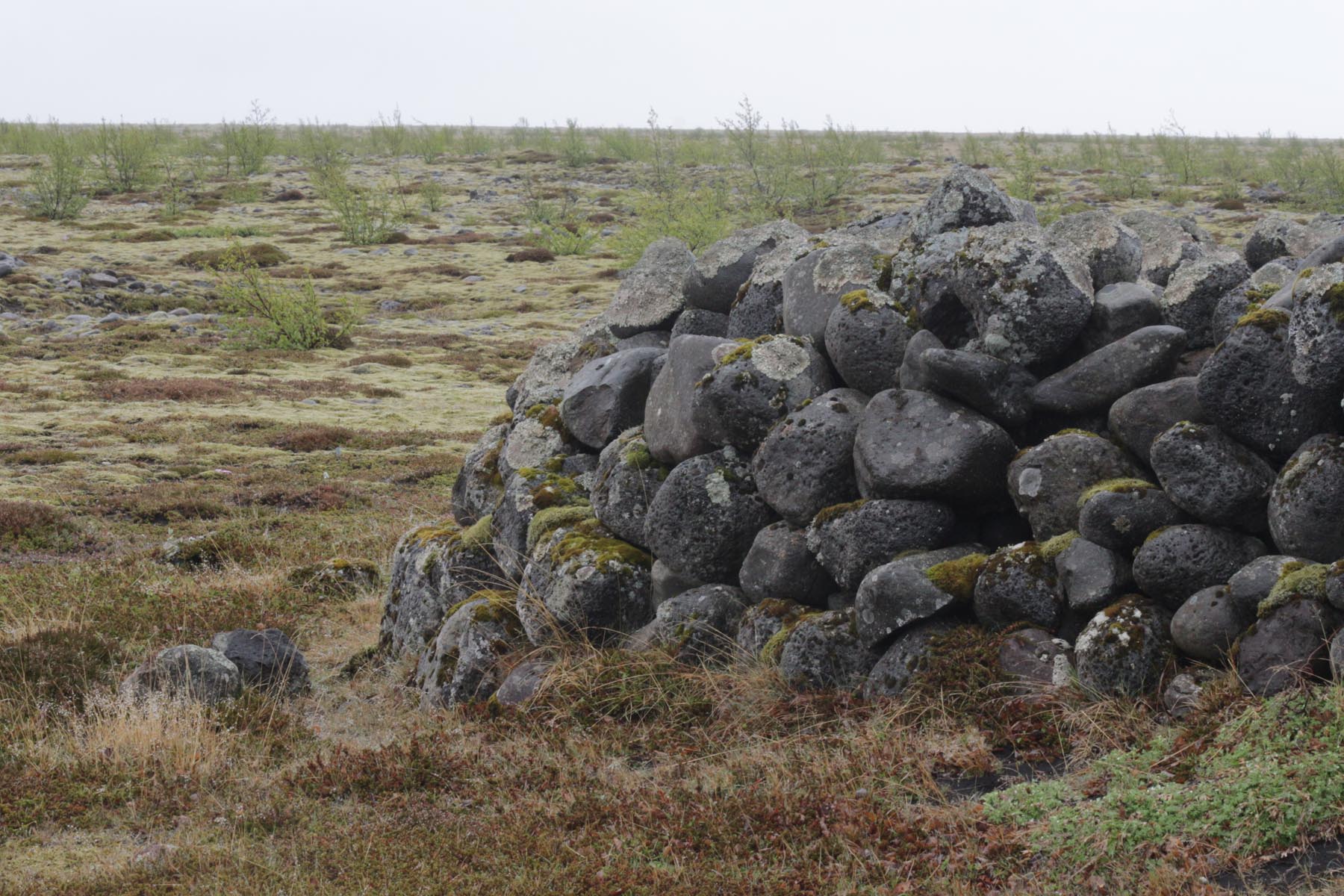
This recording is just 23 minutes of 1o hours long overnight recording. It is very quiet and highly amplified. The microphones are unexpected located near to Northern Wheatear´s nest which is between stones in old ruins in the middle of Skeiðarársandur. You can hear wing flaps and some kind of a conversation between the birds and the youngsters. The birds sounds a little bit out of phase but that could be either because the bird is mostly behind the microphones, or the stone wall, or because the fury windshield was still soaking wet after heavy rain one hour earlier.
At 1:35 min a thunderous boom sounds from glacier in distance. During the recording the weather changed from calm to be windy.
Quality open headphones are recommended while listening at low to mid level, or in speakers at low level.
Sögur af Skeiðarársandi 1. hluti
Hér er á ferðinni rúmlega 20 mínútna löng upptaka sem er partur af 10 klst langri næturupptöku frá því 29. maí 2016 á Skeiðarársandi. Á sandinum svo til miðjum er hlaðin rúst sem líklega hefur gengt því hlutverki að vera fjárrétt áður en árnar á sandinum voru brúaðar. Í upptökunni má heyra að í vegghleðsluni er hreiður Steindepils. Hann pirrar sig eitthvað á óboðnum gesti þessa nótt, hljóðnemunum, en virðist svo líka eiga einhver samskipti við unga sína með lágværu tísti eða muldri. Heyra má að á þessum rúmu 20 mínútum að veðrið breytist frá því að vera logn yfir í rok.
Mælt er með því að hlusta á upptökuna í góðum opnum heyrnartólum og á miðlungs- lágum hljóðstyrk.
The Vestmannaeyjar archipelago is young in geological terms. The islands lie in the Southern Icelandic Volcanic Zone and have been formed by eruptions over the past 10,000–12,000 years. The volcanic system consists of 70–80 volcanoes both above and below the sea.[3]
The largest island, Heimaey, has a population of 4,135. The other islands are uninhabited, although six have single hunting cabins. Vestmannaeyjar came to international attention in 1973 with the eruption of Eldfell volcano, which destroyed many buildings and forced a months-long evacuation of the entire population to mainland Iceland. Approximately one fifth of the town was destroyed before the lava flow was halted by application of 6.8 billion litres of cold sea water.[2]
With extremely high precipitation considering the latitude, Vestmannaeyjar features an ET Tundra climate (closely bordering Subpolar Oceanic (Cfc)) under the Köppen climate classification. It is often very windy in the islands, and the highest wind speed measured in Iceland (61 metres per second;140 mph) was recorded in Stórhöfði. The main wind directions are easterly and south-easterly. The islands enjoy the country’s highest average annual temperature, the Gulf Stream having a strong warming effect, especially in winter. (Text Wikipedia)
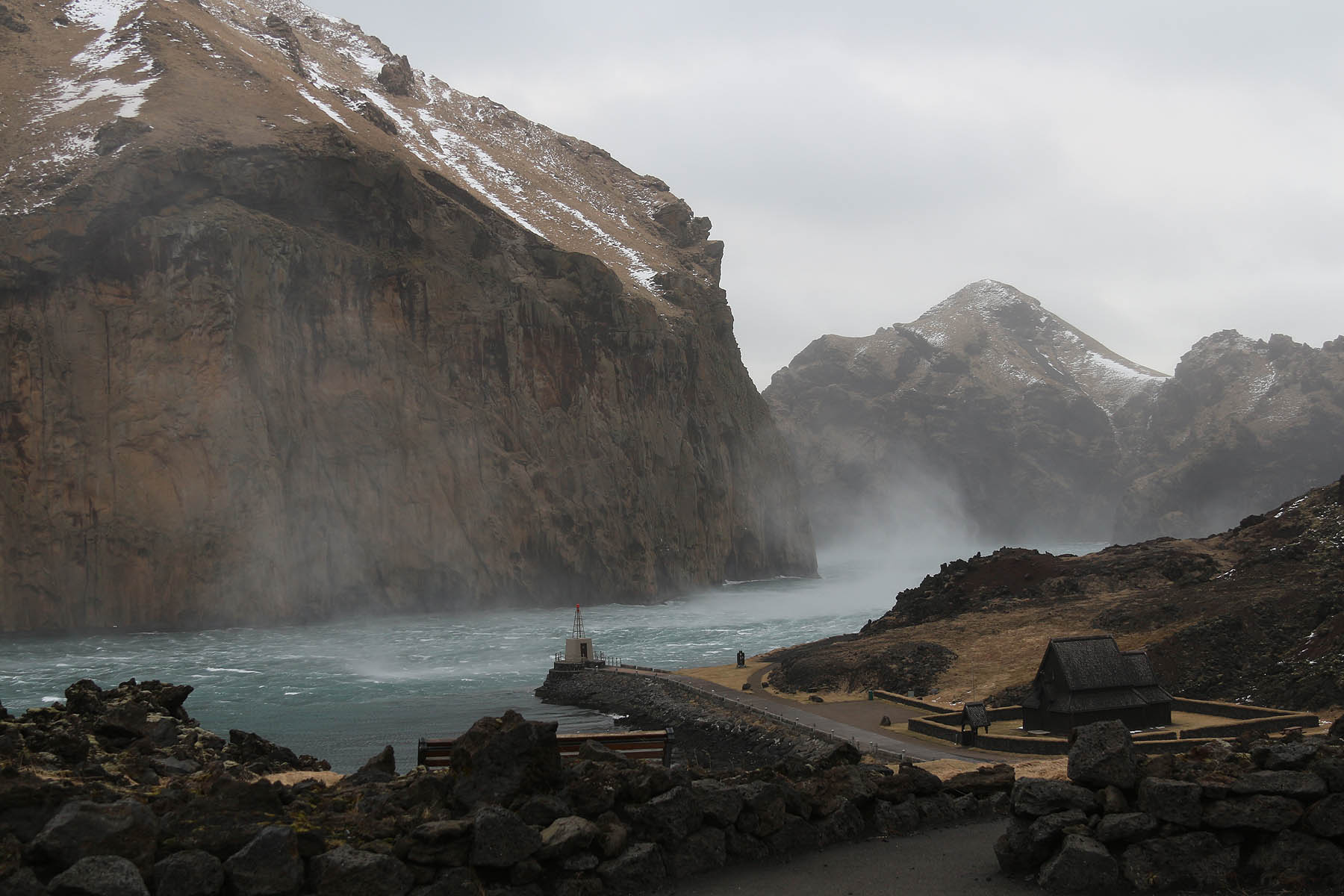
The following recording was made at Stórhöfði 31st of March 2016 in a windspeed around 20 m. pr/sec
Stormur í Vestmannaeyjum
Upptaka þessi var hljóðrituð hádegi á Stórhöfða þann 31. mars 2016 stuttu áður en viðvera á Stórhöfða varð óbærileg vegna veðurs.
Þarna hvín ansi hátt í stögum á loftnetsmöstrum sem eru sunnan við vitahúsið. Hljóðnemarnir voru hafðir skjólmegin við húsið á meðan á upptöku stóð. Gera má ráð fyrir að vindstyrkur hafi náð þarna 20m/sek en síðar um kvöldið komst vindstyrkur upp í 35m/sek og enn meira í hviðum.
Whatever the mainstream media says, the Paris talk COP21 was a fraud. The outcome was almost nothing, just promises. For me and many others is it too late. The chain reaction has already started so radical actions was needed at last sixteen years ago.
Paris talk was tailor made for investors, corporations and politicians with different needs, probably to make different outcome from previous conferences.
I have wait for political actions all times since beginning of this century so I was really hoping for radical actions after COP21.
The only thing that Icelandic politics brought from COP21 was mostly a nonsense. Icelanders were already doing most of the “solutions” for other reasons. Icelanders will just plant trees and fill up drainage ditches to restore swampland. When investors are ready somewhere in the future, Icelanders will change fossil fuel cars into electric cars.
At the same time Icelanders will increase tourism, even though extreme growth in tourism last decade has already damaged the nature with following pollution and intrusion. Icelanders will also keep on making cheap power for antitrust corporations by building more polluting power stations. They are even going to search for oil well in the North Atlantic ocean.
So as so many earthlings Icelanders intend to continue their greedy and polluting lifestyle.
We are in War against Mother nature like we are all brainwashed by Sauron . We are not only polluting the earth´s atmosphere with poison gasses. We are also polluting the ground, the oceans and fresh waters with dangerous materials and gasses. Irritating audible noise is now everywhere, from the sky, on the surface and in the ocean.
Unpolluted space on our planet is now rarer than gold, in fact more valuable too.
I want to dedicate the accompanying recording to our foolish lifestyle. It was recorded on Mosfellsheiði, east of Reykjavik 25th of July 2013. It should be a quiet place, far away from busy roads in beautiful open landscape. But instead a rumbling noise filled the air from all directions. The recording contains “fossil fuel cars and air traffic”. But the loudest steady noise comes from Hellisheiðarvirkjun, a geothermal power station in more than 10 km distance. It normally blows huge amount of gases into the atmosphere. It is mostly hot steam but is mixed with toxic gases like carbon dioxide (CO2), hydrogen sulphide (HS) and also substantial quantities of hydrogen (H2). Other gases such as nitrogen (N2), methane (CH4) and argon (Ar) are in the gas mixture, but in lesser extent.
Quality open headphones are recommended while listening at mid-low level
Erum við heilaþvegin af Souron?
Loftslagsráðstefnan í París COP21 var mér mikil vonbrigði. Ég hafði vonast eftir mjög rótækum aðgerðum STRAX, en niðustaða ráðstefnunnar varð aðeins í grófum dráttum sú, að fyrirtæki og fjárfestar þurfa að huga að í lotslagsmálum á næstu árum. Það er einfaldlega of seint.
Enginn þorir að takast á við vandann. Menn ætla bara að bíða og sjá hvort það sé nauðsynlegt að gera eitthvað og vonast svo til að tæknin bjargi öllu. Flest okkar hafa séð hversu skelfilegt ástandið þarf að verða svo menn taki nýja stefnu. Nægir þar að nefna mengun í iðnaðarborgum Kína. Fátt bendir til annars en að ástandið verði eins á heimsvísu. Það er því eins og mannkynið sé heilaþvegið af “Sauron”
Framtíðn er því ekki beinlínis til að gleðjast yfir. Því vill ég tileinka upptöku hér fyrir neðan viðfangsefninu. Meðfylgjandi mynd er tekin á upptökustað. Allt virðist þar í fljótu bragði óspillt og ómengað. En það er ekki allt sem sýnist. Í loftinu er óvenju mikið af óheppilegum ósýnilegum gastegundum af mannavöldum eins og frá Hellisheiðarvirkjun.
Hljóðritið gefur aðeins til kynna hljóðmengun á stað þar sem ríkja ætti “þögn” ef mannfólkið hefði haft vit og rænu á því að þróast í sátt og samlyndi við Móður náttúru.
Mælt er með því að hlusta á upptökuna í góðum opnum heyrnartólum og á miðlungs- lágum hljóðstyrk.
Recorder: Sound Devices 788
Mics: Sennheiser MKH20 (AB40)
Pics: Canon EOS-M (see more pictures)
Weather: Calm, Sunny, ca. 14°C at 20:00 o´clock
Location: 64.110946, -21.541311
Þeir sem vilja fræðast meira um Loftslagsmál geta hlustað á útvarpsþáttinn Þræði á Rás 1.
En dagana 28. nóvember, 5. og 12. desember 2015 var fjallað um loftslagsmál og ráðsetnuna í París sem þá stóð sem hæst.
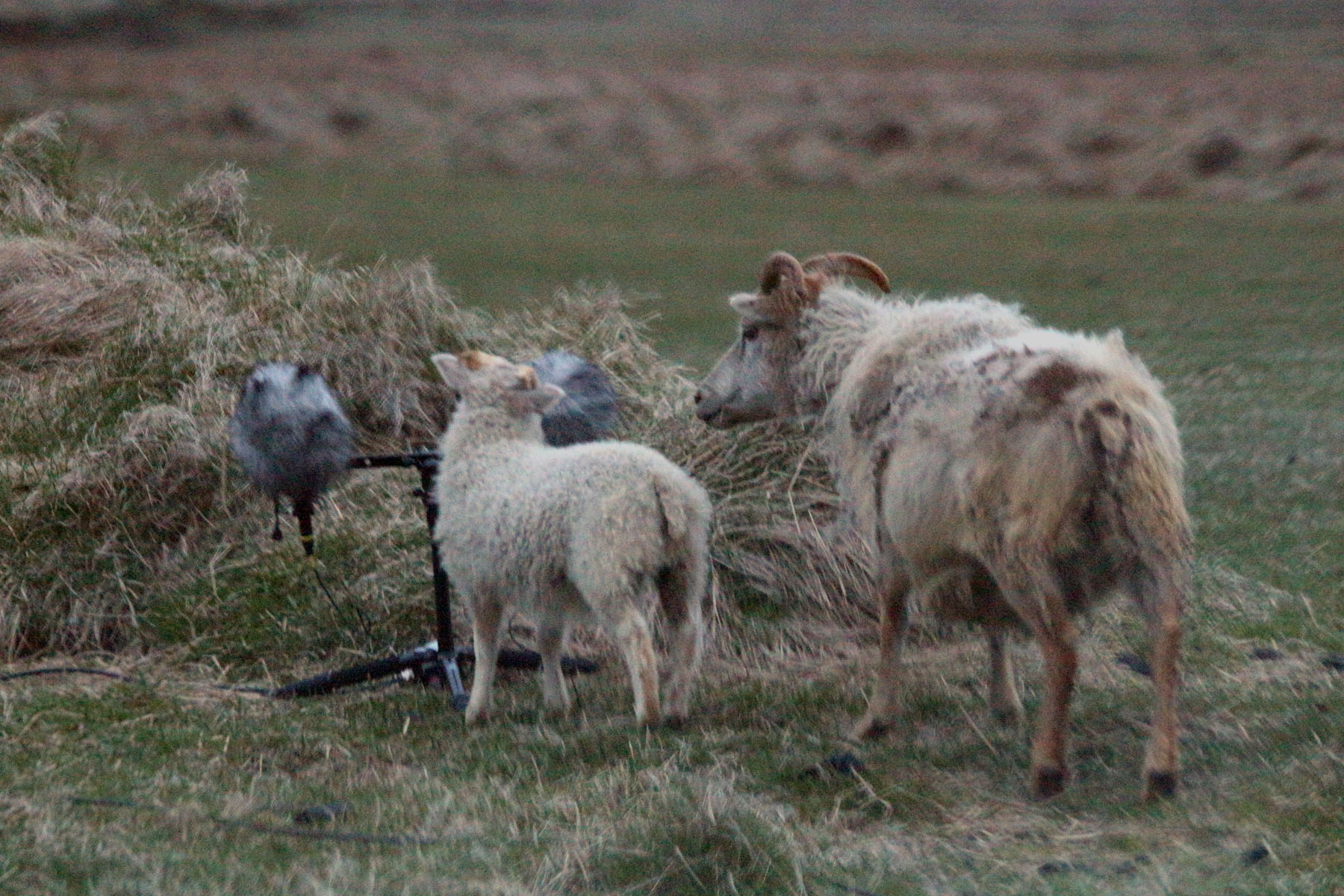
My favorite recordings are those who are many hours long. Even in places where I hear „nothing“, I will more often end up with expressively moments. Here is one of these moments when curious sheeps are sniffing, licking and biting the microphones. Not very interesting, but anyway the loudest part of seven hours long recording. It was recorded in Álftaver, in the south east south of Iceland, around midnight, 4th of June 2015.
Forvitnar kindur
Mitt skemmtilegasta viðfangsefni eru langar upptökur úti í náttúrunni. Jafnvel þó fátt makrvert heyrist, þá er oftar en ekki eitthvað áheyrilegt í þessum upptökum. Hér er ein slík uppákoma þegar rolla og lambrútur snuðra við hljóðnemasettið. Þetta er ekki merkileg upptaka en engu að síður háværasti parturinn úr sjö klukkustunda langri upptöku. Þessi hljóðpartur var tekinn upp um miðnætti í Álftaveri þann 4. júní 2015.
This recording is almost straight forward from the recording I posted about a year ago “Dawn in Stafholtstungur, part 1”.
Now the traffic in the county increase slowly from previous recording, but all the time it is possible to listen to the birds activity in details around the recording place.
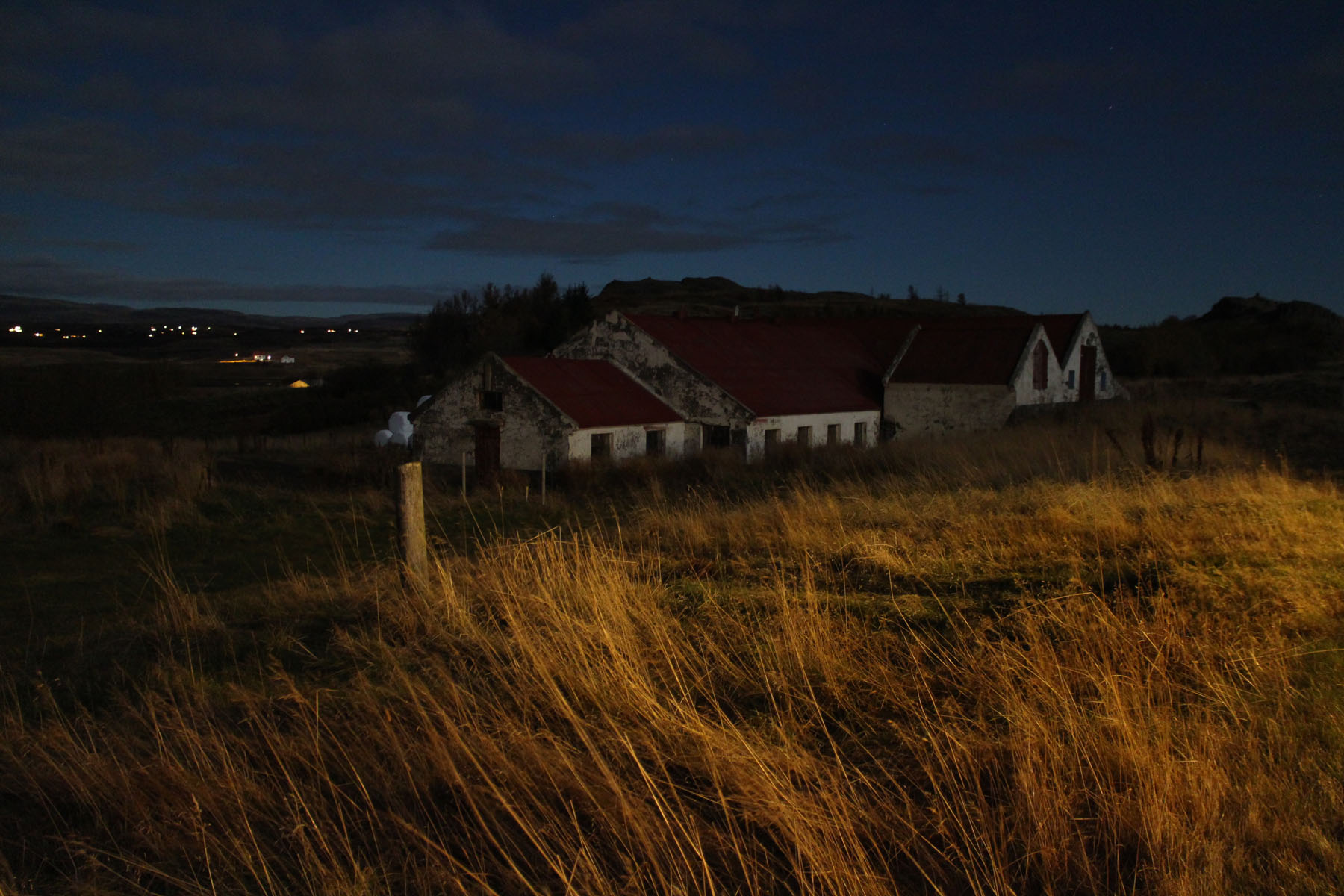
This was recorded the 18th of October 2013, between 6 and 7 in the morning near the farm Arnarholt.
Quality headphones are recommended while listening at low level in relaxed position.
Dögun í Stafholtstungum, annar hluti
Hér er á ferðinni svo til beint framhald af upptöku sem fór á vefinn fyrir um ári síðan; “Dögun í Stafholtstungum, fyrsti hluti”. Heyra má að umferð eykst í sveitinni þar sem klukkan er farinn að ganga sjö. Gera má ráð fyrir að það heyrist í sumum bílum, þá líklega flutningabílum, um langan veg frá Norðurárdal suður til Borgarfjarðar. En þegar þögnin er sem mest er vel hægt að heyra í fuglum athafna sig í smáatriðum nærri upptökustaðnum.
Upptakan var gerð við bæinn Arnarholt þann 18. október 2013
Mælt er með því að hlusta á þessa upptöku í góðum heyrnartólum og á lágum hljóðstyrk um leið og slakað er á í þægilegum stól eða rúmi.
Vatnajökull is the largest ice cap in Europe by volume (3,100 km³). Vatnajökull has around 30 outlet glaciers (icefall) flowing from the ice cap. Svíafellsjökull is one of them.
Glaciers are not a playground for everyone. They have its own weather system and the gravity force will destroy everything that get lost in the ice.
Two British students lost their lives 1953 in a storm which lasted for 10 days on the glacier. It was not until 2003 that some of their equipment was found, carried forward with the movement of the outlet glacier. No human remains were found.
Two German tourist have been missing since 1st of August 2007 when they were on a hiking trip on Svínafellsjökull. Nobody knows what really happened but it is most likely that they fell in a swallow somewhere on the glacier, but their equipment was found in a small valley, high in the nearby mountains.
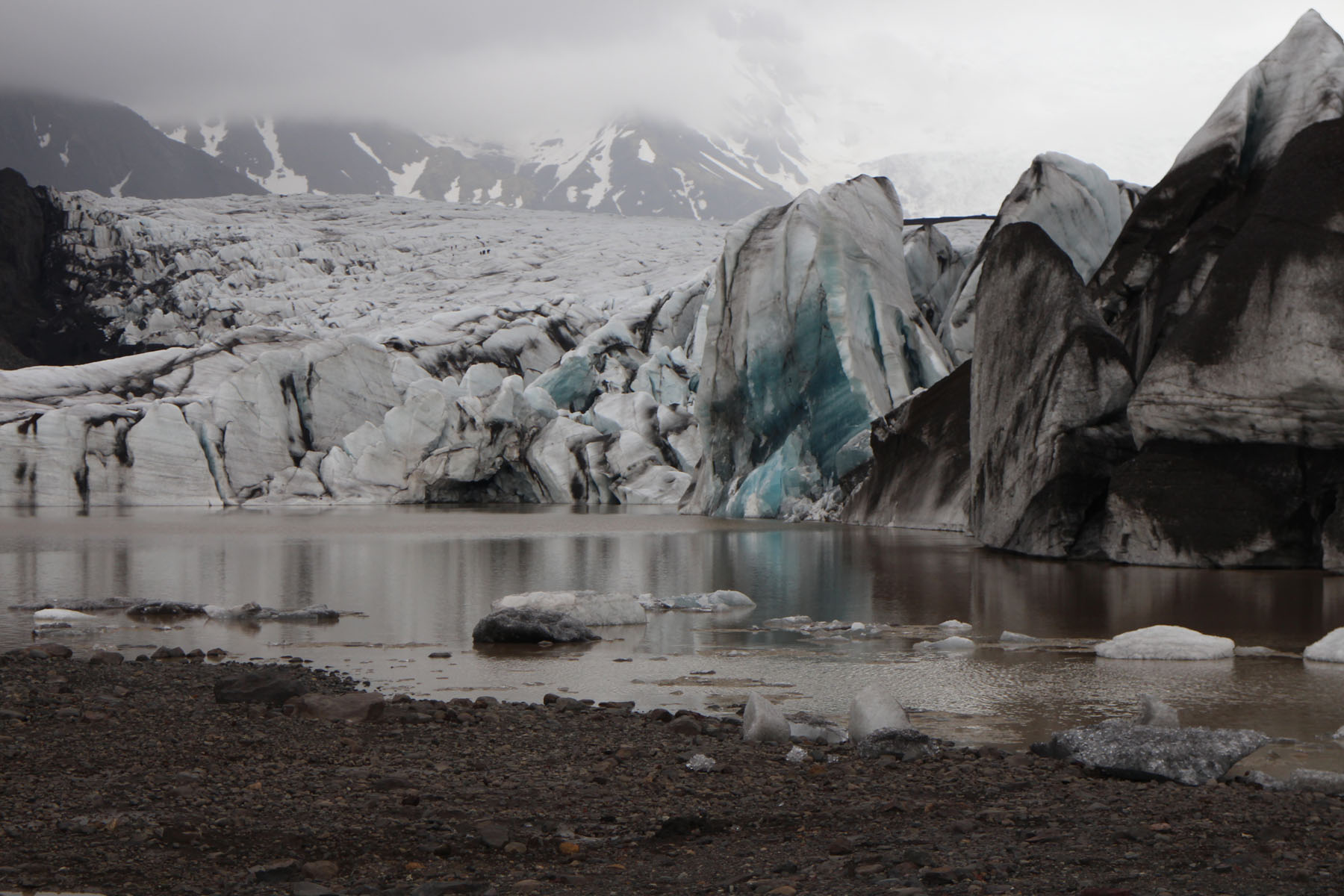
All glaciers have been shrinking fast last decade. That can be easily seen at the end of Svínafellsjökull witch now has a big glacier lagoon that did not exist few years ago.
As glaciers the glacier lagoons can be also dangerous. Icebergs can suddenly fall off the icefall and make huge waves in the lagoon, also when icebergs turns around or brake down in a parts.
I got in touch of these forces when I was recording the lagoon under Svínafellsjökull, 23rd of May 2014. I hid the equipment from other tourist in a landslide nearby and about two meters above the lagoon surface. Two Aquarian hydrophones where placed in the lagoon and a pair of MKH20 was used to pick up the sounds above the lagoon. The idea was to record in two or three hours.
I was in another place with my second recorder to record a sound close by the glacier.
After one and half hour I suddenly hear a big „bang“ with a long powerful echo from nearby mountains. All the icebergs on the lagoon suddenly moved around as a beans in a boiling pot.
I ran to the recorder´s place on the other side of the lagoon. The bag with the recorder was floating between the Icebergs so it was no problem to locate it in the muddy water. I disconnect the battery and took it inside to dry it as fast as I could. But nevertheless, it had several malfunctions since this drowning.
I am not sure what really happened. The flood line does´t goes all the away to the recorder´s place. I think it is most likely that some icebergs pulled the recorder by the hydrophones into the lagoon.
Thanks to Sound Devices in US and the reseller in Iceland (Pfaff-Borgarljós and Bragi Kort) I got a new recorder for a very nice price. Most of the loss was then covered by the insurances.
Update: In late summer 2020, I took the recorder apart, piece by piece, and cleaned it. It is now in top condition.
Flóðbylgjan við Svínafellsjökul
Jöklar og umhverfi þeirra getur verið hættulegt þeim sem það ekki þekkjir. Jöklarnir eru síbreytilegir og hafa sitt eigið veðrakerfi. Því ber að umgangast þá með varúð. Skemmst er að minnast hvarf tveggja þjóðverja á Svínafellsjökli þann 1. ágúst 2007 .
Mér var það svo sem lika ljóst að jökullón geta verið hættuleg þann 23. maí 2014 þegar ég staðsetti upptökutæki við jökullónið neðan við Svínafellsjökul. Tveir Aquarian vatnahljóðnemar voru staðsettir ofan í lóninu og aðrir tveir MKH20 hljóðnemar ofan við lónið. Sjálfur fór ég með annað upptökutæki til að hljóðrita upp við jökulinn sjálfan.
En líklega er aldrei of varlega farið. Eftir u.þ.b. eina og hálfa klukkustund kvað við mikill hvellur frá jökulsporðinum sem bargmálaði í fjöllunum ofan við jökulinn. Stuttu síðar fór allt jökullónið á hreyfingu eins og iðandi suðupottur. Mér varð því ljóst að upptökutækið við lónið gæti verið í hættu. Hljóp ég því sem fætur toguðu að staðnum, en allt kom fyrir ekki. Tækið var komið út í lónið og flaut þar í tösku milli ísjaka. Eftir að hafa þrifið það og þurrkað kom í ljós að tækið hafði bilað varanlega eftir þessa sundferð.
Allt bendir til þess að ísjaki hafi dregið tækið í lónið á vatnahljóðnemunum því flóðlínan hafði ekki náð upp að staðnum þar sem tækið hafði staðið. En skaðinn var skeður sem leytist þó á endanum þokkalega farsællega þó tjónið hafi verið eitthvert. Með óútskýranlegum hætti vistaði upptökutækið upptökuna áður en það drukknaði. Það sem hér má heyra eru síðustu andartök tækisins.
Síðla sumars 2020 tók ég upptökutækið í sundur, stykki fyrir stykki og hreynsaði það. Það er nú í topp standi.
Recorder: Sound devices 788
Mics: Aquarian H2n-XLR & Sennheiser MKH20 (AB40)
Pics: Canon EOS-M (See more pictures)
Recording location: 64.007509, -16.883081
Weather: Calm, cloudy, around 9°C
Jökulsárgljúfur canyon in Vatnajökull National Park is situated in the north of Iceland near the river Jökulsá á Fjöllum. In the middle of Jökulsárgljúfur, between Dettifoss waterfall and Ásbyrgi canyon, is Vesturdalur valley.
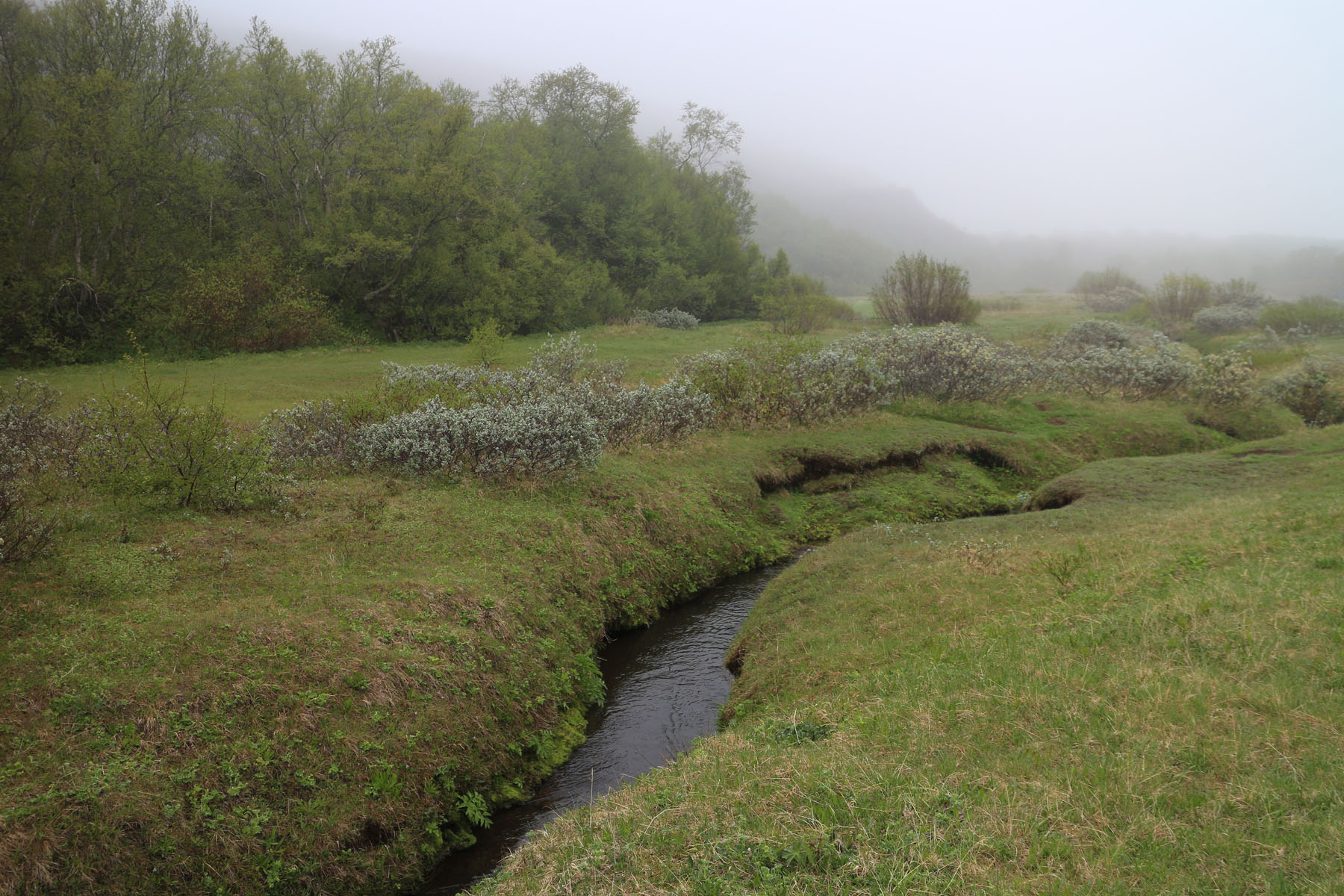
Vesturdalur is mostly surrounded with steep cliffs with luxuriant flat bottom. Through the valley flows a small creek, Vesturdalsá, on its way to the river Jökulsá á Fjöllum.
The first week in June 2014 I arrived there on a foggy night and placed the microphones close beside the creek. The soundscape in the fog was particular. The rumble sound from Jökulsá River about 3 km away, filled the air with extreme murky mysterious power. But all around me was a beautiful bird song that followed me in to the sleep.
This recording is several hours long so it is most likely that more of this recording will be available online someday.
Thanks to the Friends of Vatnajokull who made this recording trip possible.
Quality headphones are recommended while listening at low level.
Vestudalur við Jökulsá á fjöllum
Þann 8. júní 2014 eftir miðnætti kom ég í Vesturdal við Jökulsárgljúfur. Talsverð þoka var á svæðinu svo skyggni var fremur lélegt. Mikil frðsæld var í dalnum enda mjög fáir á svæðinu. Fjölskrúðugur fuglasöngur kom úr öllum áttum, en loftið var þrungið drungalegum drunum frá Jökulsá á Fjöllum í austri. Áður en ég lagðist til svefns fann ég stað fyrir hljóðnemana við bakka Vesturdalsár sem liðaðiðst hljóðlega um dalinn.
Um leið og tækið var komið í gang leið ekki á löngu þar til ég var kominn í draumheima með notalegan fuglasöng í eyrunum næstu klukkustundir fram undir morgun.
Þessa upptöku má þakka samtökunum Vinum Vatnajökuls sem gerðu það kleift að af þessari upptökuferð gat orðið.
Mælt er með því að hlusta á upptökuna í góðum heyrnartólum og á lágum hljóðstyrk.
Recorder: Sound Device 744
Mics: Sennheiser MKH20 (AB40)
Pics: Canon EOS M (See more pictures)
Recording location: 65.933496, -16.555915
Weather: Calm, fog, around 6°C



 HLJÓÐMYND - SOUNDIMAGE